
The other day, I finished reading Chesapake Climate Action Network (CCAN) founder/director Mike Tidwell’s superb new(ish) book, The Lost Trees of Willow Avenue – “A riveting and elegant story of climate change on one city street, full of surprises and true stories of human struggle and dying local trees – all against the national backdrop of 2023’s record heat domes and raging wildfires and hurricanes.” So first off, I strongly recommend the book, for several reasons:
- It’s thoroughly researched and reported, written in a clear and engaging manner, with seriousness and science balanced by humor and interesting personalities/characters (e.g., Rep. Jamie Raskin; climate scientist Ning Zeng, whose goal is to bury huge numbers of dead trees in order to sequester their C02 for 100s if not 1000s of years; Mike Tidwell himself, including his battle with Lyme disease – quite deer ticks quite possibly fueled by global warming, by the way), inspirational stories (e.g., the volunteers who saved 100s of trees in their neighborhood by removing invasive vines which certainly would have killed them), etc.
- It approaches the subject material in a unique – and uniquely relatable – way, by focusing on the LOCAL impacts, in this case on the specific locality of Willow Avenue in Takoma Park, Maryland, but actually universal in that what’s discussed in the book (climate/environmental impacts and responses on one street in one DC-area suburb) are likely to happen – in fact, ARE happening (or are basically certain to happen) – to ALL of us, in ALL of our towns and on ALL of our streets. I’m not sure any other book quite like this has ever been written, actually; but regardless, it’s a very smart and innovative approach to discussing the climate crisis.
- It’s certainly not pollyanish, but it’s also not doom-and-gloom; instead, it’s pragmatic, realistic, and ultimately hopeful that if we all take action, collectively, we can (and must!) win this fight, particularly given the increasingly strong economic arguments -even putting aside the environment – for a clean energy/clean tech economy.
For all those reasons, definitely check out the book; I’m confident you’ll find it well worth your time!
So with that, bringing this back to Virginia specifically – the blog’s name is Blue Virginia, after all 😉 – I got to know the book’s author, Mike Tidwell, during the fight to pass the Virginia Clean Economy Act (VCEA) back in 2020. As I wrote at the time – and I think Mike and I were mostly in sync on this, as his organization (CCAN) helped push for the bill’s ultimate passage – while VCEA was far from perfect, including not being ambitious enough on numerous fronts, it was a *vehicle* that we’d never had in Virginia, and that could be improved upon in the future – but in the meantime would (hopefully) accelerate the Commonwealth’s transition from fossil fuels to clean energy.
So five years later, I wanted to circle back with Mike Tidwell to hear his thoughts about how things are going with VCEA, as well as what the next steps might be in strengthening that “vehicle.” I also was curious to get his assessment about where we’re at, more broadly, right now, given the Trump administration’s brain-dead, heinous assault on clean energy, plus its corrupt promotion of fossil fuels – in short, the diametric opposite of where we should be headed right now. So I was fortunate to have the chance to chat with Mike for a while yesterday afternoon; see below for a few highlights from our conversation, condensed for readability and length.
Question #1: Back in 2020, while helping to push the eventual passage of the historic Virginia Clean Economy Act, you talked about how it wasn’t a perfect piece of legislation by any means, but that it would be a vehicle that we would then use to drive clean energy growth in Virginia. Since then, we’ve definitely seen some of that growth, but I’ve also heard a LOT of concern that VCEA isn’t strong enough, moving fast enough, able to overcome “NIMBYs'” and other opponents to new solar farms, etc. In general, it seems like VCEA needs to be strengthened significantly, or it’s simply not going to achieve the goal of getting to 100% renewable energy by 2045/2050. Anyway, I’m curious what your thoughts are, in hindsight, on VCEA, and what you think Virginia needs to do going forward, particularly if we’ve got a Democratic “trifecta” (governor/HoD/Senate) as of January 2026.
Tidwell’s response #1: “Yes, the VCEA should move faster. The Biden administration’s goal for the electric sector was 2035. The faster we decarbonize, the better for our health, our wallets, our planet.
We’re putting clean energy online at roughly the clip we thought we might be able to, which is good. But we’re not in the same energy environment we were in 2020. Right now we have immense electricity needs, and about 90% of that demand is associated with data centers. Some are associated with things we want like health research, but many are associated with things that I think most people recognize are not societal goods: generative AI like ChatGPT, social media data analytics, other unnecessary or harmful forms of AI.
The [Virginia] legislature has so far signaled it wants to continue to attract data centers, given that they have advanced no meaningful guard rails on the industry. It is truly baffling. They’re not money makers for the state; we have to give away a billion dollars every year to bring them here. They’re driving up electric bills. They consume a ton of water. And they’re drastically increasing our electricity needs.
So if the legislature wants data centers here, they’ll need to cut a lot of red tape to bring a lot more clean energy online. They will need to increase our clean energy targets and reform the approval process. And they need to require that the industry contract for their own clean electricity so every day families aren’t paying for all this excess electricity infrastructure. No one is saying no data centers at all. But there’s no reason we should actively shell out taxpayer money to the richest corporations in the world if they are not at the very least aligned with our state goals.
Instead, right now, monopoly utilities are proposing to build tens of billions of dollars of new gas plants to serve these AI warehouses. Gas plants that we will pay for with our wallets, with our health, and with our planet. Virginia families are being robbed, on their energy bills and at the hospital and of their futures.
For reference: JLARC report – JLARC’s independent forecast shows that unconstrained demand for power in Virginia is expected to double within the next 10 years, driven primarily by the data center industry’s growth (Figure 3-3). Almost all of the demand growth is expected to occur in the Dominion transmission zone, which covers the Northern and Central Virginia regions, where most new data centers are being built. JLARC’s forecast largely matched the most recent PJM forecast.
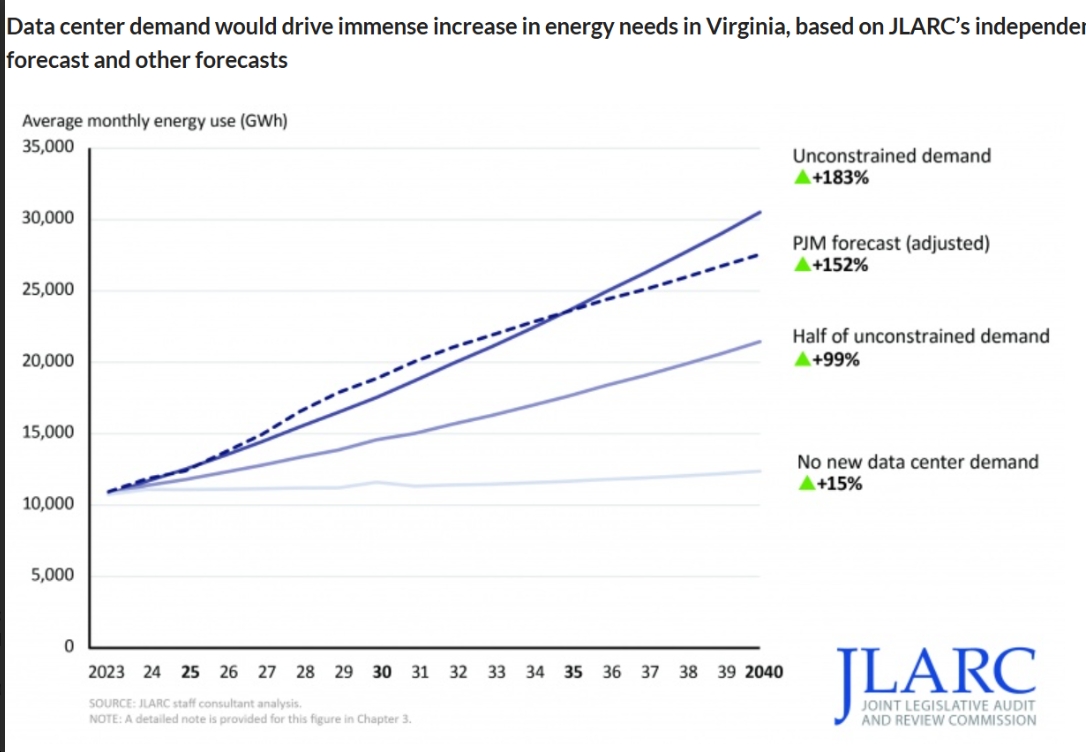
Another way to read this is that, between 2023 and 2040, electricity demand would increase by less than 1% per year (15% overall through 2040). With unconstrained demand, it’s increasing 10.76% per year (183% through 2040). That means…data centers are responsible for over 90% of increased demand.
‘JLARC estimates unconstrained demand from data centers could add nearly $40 to Virginians’ monthly electricity bills by 2040.’ I think this is a significant undercount; I’m not sure they fully appreciated the effect of grid-wide congestion and generation constraints.”
Also, from our interview, here are some more thoughts from Mike Tidwell on what we specifically need to do in order to strengthen VCEA and fulfill its promise: “If your question is what’s needed to help VCEA fuflill its promise, we clearly need solar siting reform; we need legislation. There have been bills…this is a conversation that’s been going on almost since the moment the [VCEA] passed. There’ve been no breakthroughs yet. There’s the solar developers want X, Y and Z, and the the environmental land use people want some restrictions and the non-culture war NIMBYs are there, then you have the culture-war NIMBYs and it’s a mess. But the reality is [VCEA is] still law, this still needs to happen, we have to we have to figure it out. You know, I think Bill McKibben’s new book, ‘Here Comes the Sun,‘ has put new wind in the sail of solar advocates…It’s all about how solar is much more disruptive and revolutionary as an energy source than we’ve fully understood. For example, in California so much solar combined with battery storage has been installed that gas combustion for electricity generation in the fifth largest economy in the world has dropped 40% in the last two years in California. And…human beings worldwide, despite Trump, are deploying at least a gigawatt of solar every day around the world. And for a while in last summer, China was building a gigawatt, which is like the size of a large nuclear power plant of solar. They were building a gigawatt of solar every eight hours.
Here in Virginia, I think that Dominion wants to build a lot of solar; they have been successful in getting their projects sort of approved and working with counties to get their big projects approved. But for how long? I think that you’re going to see the frustration among legislative advocates of the Clean Economy Act, plus renewed enthusiasm from the grassroots inspired by Bill McKibben and others, combined with a suddenly frustrated Dominion that wants to keep pace, that wants to build more solar, and perhaps will start feeling the the constraints of of the NIMBYism. So it’s not easy, and similar fights are being fought in every state in the country. I just feel that inevitably you can’t suppress the cheapest, fastest new carbon-free energy source in the world. You just can’t suppress it forever. It’s coming out and I think we’ll figure it out…I’m still optimistic that these barriers, these hiccups were inevitable. To pass VCEA, there was always…we had to figure out a lot of things and solar siting is one of them…
We obviously have the challenge of data centers which you refer to, and we’re going to need – and Abigail Spanberger has been saying some positive things on that front – so, there’s going to have to be some reform on data centers. But honestly, the more I read about the data center boom, the more I believe it’s not going to be nearly as big as Dominion and others and the tech bros would want us to believe. You know, there’s a story on the front page of the Washington Post…about growing fears that this is a bubble and a bubble that’s not only going to affect the tech industry, but by extension the whole economy. I mean, the only thing that’s really propping up Trump’s failing economy is is AI hysteria.
…I think we’re not going to have the data center buildout that the hysteria is suggesting. I think that maybe a lot of these data center investments are going to be stranded assets, but it’s just inconceivable that the grid’s going to double or triple just so people can use large language AI for purposes that we can’t even understand yet, right? So, one, I don’t think that competition from data centers is going to be as big as forecast, but it is going to be there and it’s going to be real. We’re going to have to build a lot of clean energy and I think solar is going to be the fastest, cheapest and – also McKibben among the many brilliant things that he points out in his book, in this country and in part in Virginia, you know 30 million acres of corn is grown every year…corn ethanol, which provides like 1% of our energy. Take 30 million acres where, if you were to cover that same land, which you know to grow corn, you need full sunlight. Means you can have full sunlight for solar panels, farmers could make more money if you covered those same 30 million acres with solar. You’d have more than enough electricity to power the whole country…
…[balcony solar] is not going to solve all of our problems, but I guess Germany now generates a gigawatt out of electricity from balcony solar and Utah just passed enabling legislation. There’s going to be a bill in Annapolis that’s going to pass….So there’s that…there are a lot of things Dominion does to frustrate and aggravate and delay rooftop solar…
…The most important things are solar siting reform and data center reform…and just surviving three more years of Trump. Right. But you know we’ve got to electrify the car fleet. I think people underestimate how solid the EV market is in this country. Small but growing steadily and it’s going to continue to grow even without tax credits. We’ve got to figure out the charging station network
Question #2: On Dominion’s offshore wind project, so far it seems like it’s survived the Trump administration’s war on offshore wind; I’m curious why you think that’s been the case, at least so far, and whether you think that will continue. Also, I’m curious about your thoughts on data centers potentially sucking up a lot of the power produced by this project (e.g., according to this article in the Virginia Mercury, Dominion Energy’s massive, 176-turbine offshore wind project off of Hampton Roads “will produce enough electricity to meet the needs of about 600,000 homes, or just a bit more than the energy that will be required to power a single data-center mega project that is currently being developed in Hanover County.” Crazy, huh?)
Tidwell’s response #2: “The project has been a huge success so far. There is a whole ecosystem of offshore wind development that has been stood up in the Hampton Roads economy. And it will start producing clean electricity this year. The project is not hooked up to a data center and it was envisioned well before the sudden advent of data center load growth. The project serves the whole grid. Every electron of clean electricity is a good electron and contributes to decarbonizing the grid and moving us to a climate stable future.”
Question #3: Since your book was mostly written before Trump won the 2024 election and took office, I’m curious about your thoughts regarding the Trump administration’s assault on the environment, science, clean energy, etc., and what the implications are for the global fight against the climate crisis and to ramp up clean energy scaling. Does this make it more likely that we’ll need to resort to desperate measures like geoengineering down the road? Or are the economics of clean energy/cleantech just too strong at this point for Trump to derail their growth?
Tidwell’s response #3: “Yeah, it’s bad, it’s bad what they’re doing. Clearly it’s bad. But think about it – if the clean energy revolution weren’t a serious serious threat to Trump’s oil and gas puppeteers, they wouldn’t have to take these extraordinary steps. And they’re taking these extraordinary steps because renewables are an existential threat to them. And they can only take these steps at the federal level. I mean, they can bully other countries and all that. They’re not going to get that far. But if you look at China, which is, you know, going to become the, forget petro states, is going to become the first electrostate. They’re going to electrify everything in that country and they’re going to export all that technology, and they’re completely committed to that economic model. You look at Australia, which a country known for coal, and they’re going to be at at least 80% carbon-free grid by 2030. Carbon emissions are dropping in Europe, in the EU. They’re going down. And half of all cars sold in the world’s largest automobile market in the world, which is China, will be either fully electric or plug-in hybrid electric. And then there’s the blue states here, like again, California, fifth largest economy in the world, and it’s just amazing what they’re doing…solar plus batteries is base load power. There are many days where solar plus battery is what powers the entire state at night…They tried to amend enabling laws [in Texas] and all these Texas ranchers and came and said f*** you, we want wind power, we want solar. They wanted to really gut, they wanted to shut it down basically and were not able to in Texas…
…I don’t think it matters about belief anymore. I think that the economics of it is just going to take over. I mean Pakistan – going back to McKibben’s book – Pakistan has in just like two or three years, sort of in rogue fashion, has built the equivalent of like half the the entire country’s grid with solar panels that have been imported cheap from China. You know, the grid operators in Pakistan starting two and a half years ago started going, why are people using less electricity? What is going on? And they finally started looking at Google Earth photographs of rooftops and farm fields and they started to see this explosion in solar panels. And you could go on Tik Tok and learn how to install your panels. That happened absent policy. It happened for economic and practical reasons. And that’s just one example of what’s to come.
And back to electric cars. I mean, this part is rarely discussed, but I’ve had an Ionic 5, Hyundai Ionic 5, for over three years now. We’ve put 45,000 miles on it. I cannot believe that car. I mean, first of all, just oil changes alone, we would have spent like $3,000 in oil changes, you know, every 3,000 miles, 50 bucks or whatever. And there just are so few moving parts. And it also gets more efficient over time. We get over-the-air updates through our Wi-Fi. The car learns our driving…we get more miles to the kilowatt hour of of juice today than we did we bought it. Combustion engine goes the other way – it gets LESS efficient. Our car is getting MORE efficient…
…I argue in my book, one, I mean even before Trump I was writing a book that said the path we’re on with clean energy is insufficient. It’s happening, but we’re still in carbon overshoot and we are going to have to look at other additional solutions like carbon direct capture, geoengineering. We basically have to have four things in my opinion – we’ve got to have the conversion to clean energy…that bus left a long time ago in terms of being able to save us by itself. Two, we’re just going to have to get better at adaptation, which for a lot of people, they’re just not going to be able to adapt; but adaptation is going to have to be part of it. Three, negative emissions, what the IPCC calls negative emissions… that technology today is where solar was in the 1970s. And I think Ning Zeng in my book personifies that. And then there’s a lot of smart people, including James Hansen, are saying we ought to at least research reflecting sunlight away from the planet, which I agree with…Ocean acidification is what negates the moral hazard in my view. I mean, this is a water planet. This world as we know it can’t survive with a dead ocean. And if you cool the planet but don’t get off fossil fuels, you will kill the world’s oceans and that will kill the planet. You kill the planet through different means, right?… You still have to get off carbon….If you cool the planet, you still have the utter moral mandate to get off fossil fuels because if you don’t, you’ll have a cooler planet with a dead ocean, which will lead to a dead planet…In terms of reflecting sunlight, I think to do it right you have to first we need a lot of research, we need to develop international governance and whatever we do has to be done at the international scale….We can’t have rogue nations or individuals doing this; there has to be either international consensus or a strong legitimate coalition of the willing that’s willing to reimburse countries that maybe suffer adverse effects.”