
UPDATE 2:30 pm:
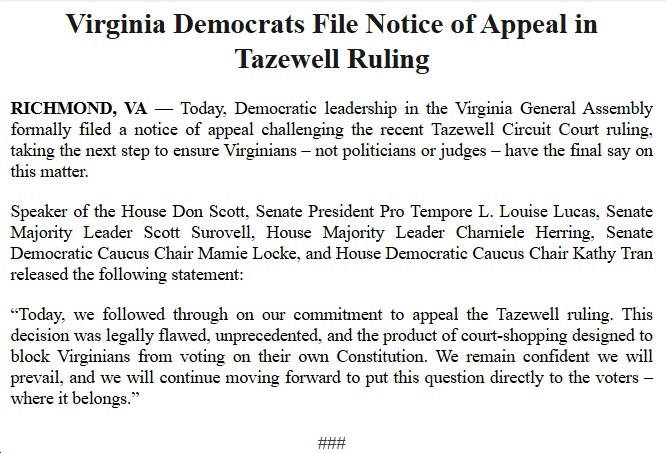
The lawyers (correction: Kyle Ford says, “To clarify. Not a lawyer YET. I’m a mere country bumkin who has to take the bar”) have been busy since yesterday’s ruling by a Tazewell County Circuit Court judge on the Virginia Democrats’ redistricting amendment.
First, check out what Sam Shirazi has to say:
- “the first thing the judge found was the legislature didn’t really follow its own internal procedures. And I won’t go into the ins and outs of it, but essentially the Democrats had to do this in a special session…to be perfectly honest, I have a hard time believing this will be upheld on appeal. I think this is the least likely grounds for the decision to be upheld, if it is upheld, because typically courts are very skeptical to get into the legislative procedure. They kind of leave that to the legislature. I think there’s a big separation of powers issue… at the end of the day, both these, both the state Senate and the House of Delegates passed this twice with majority votes.”
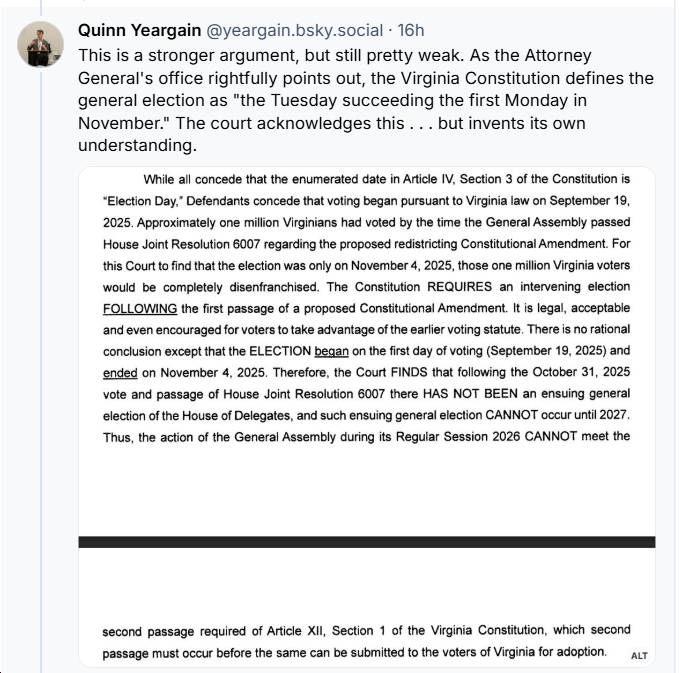
- “The second reason why the judge ruled for the Republicans, he basically looked at the Virginia state constitution and looked at the phrase after the next election And he essentially said the election was underway when the Democrats passed the proposed constitutional amendments…Again, I’m a little bit skeptical if the Virginia Supreme Court is going to uphold that…the Virginia Constitution says it has to be passed after the next general election. It doesn’t say, you know, three months before the general the Virginia general election, it has to be passed. It doesn’t say you can’t you can’t pass it after early voting started. So a lot of that is being read into the Virginia constitution when it’s not there.”
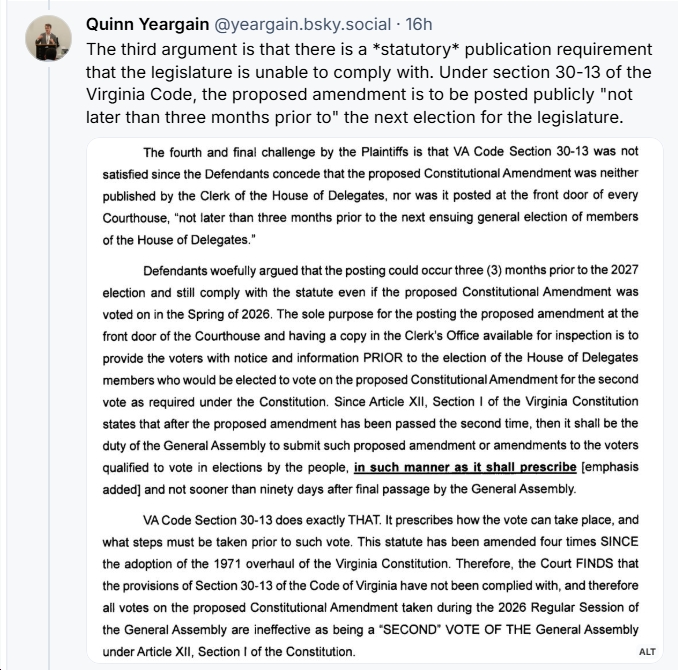
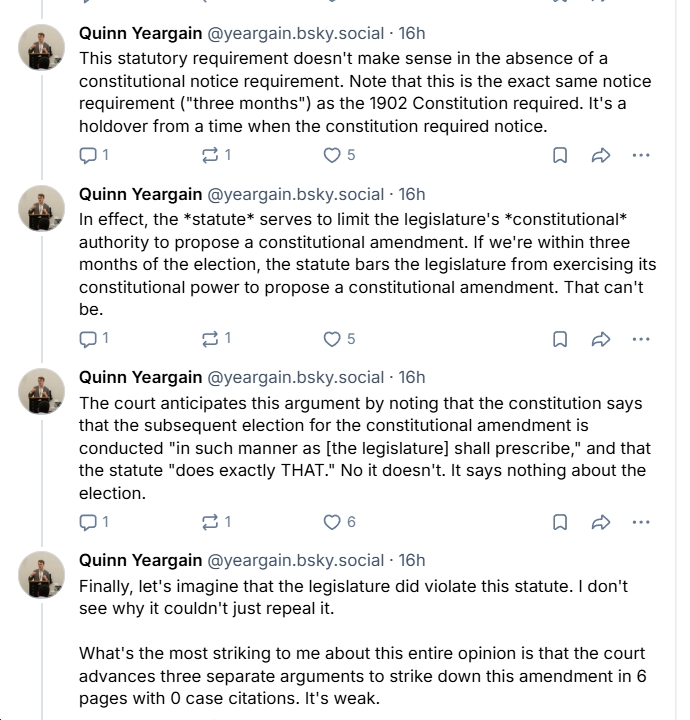
- “… this third question that the court court ruled on. And I do think you know this is probably the one where the Virginia Supreme Court will have to decide, and it’s perhaps the closest call. And the question was essentially about the state statutory provision. So it’s not part of the state constitution, it’s part of the state law. It says that after this General Assembly session, the clerk of the House of Delegates will send a notice to each of the courts in Virginia basically saying that there have been proposed constitutional amendments. The clerks of each of those courts, the law says, shall post these notices three months before the election. So obviously that didn’t happen here because the election was basically less than a week away when the Democrats passed this…I explained this in my last podcast that the Democrats argued this is essentially a quirk in the law. The Constitution was changed. This three-month requirement was removed from the Constitution, but it was never removed from the state law…it is important to note that the statute itself does not impose any requirements on the General Assembly. So the statute is basically about the duties of these clerks.”
- “So now I basically have to look at my crystal ball and try to predict what the Virginia Supreme Court will do. you know I’m not going to do that. I think it’s very difficult. I could see them ruling either way on this matter…I think the Democrats, they are confident this is gonna be overturned on appeal. Their position is essentially that this judge was handpicked by the Republicans to rule in this case. He was obviously gonna be favorable to them and that once it gets the Virginia Supreme Court, who has you know a reputation for being pretty nonpartisan, they are gonna see this pretty straightforward that the Democrats did follow the procedures. So both sides feel confident.“
- “I do think the Virginia Supreme Court tends to be pretty deferential, especially in political things, to the elected branches of government. And so, you know, either explicitly or implicitly, I could see them saying, you know, at the end of the day, the legislature did this. It it was passed in two separate sessions of the General Assembly with majorities. And do we really want to come in and strike this down, especially when this is not the final say? Ultimately, the final say, if the referendum goes forward, is with the voters in Virginia. So the voters are the ones who ultimately have to approve this…they are thinking you know is this the type of issue where we, the Virginia Supreme Court, want to step into this and stop the process and stop the voters being able to make the ultimate call?”
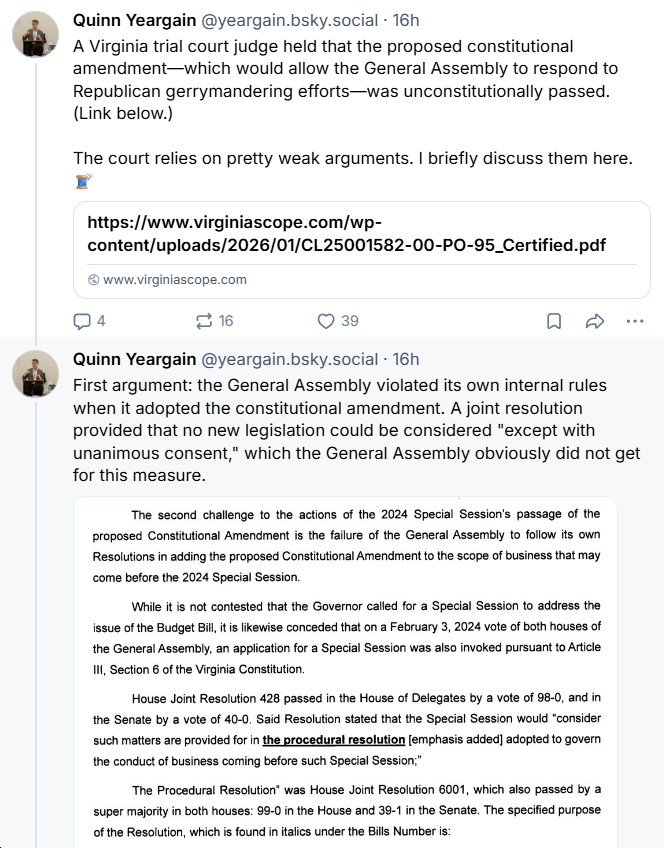
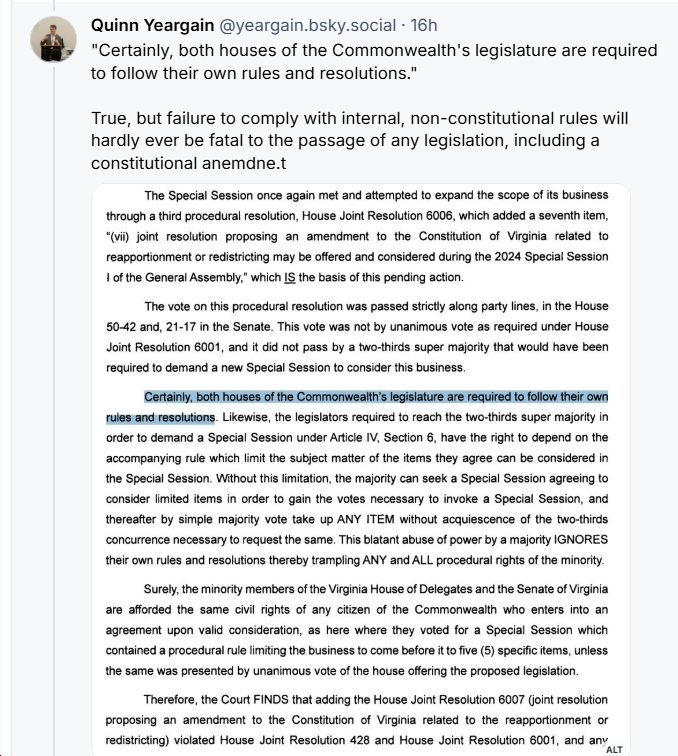
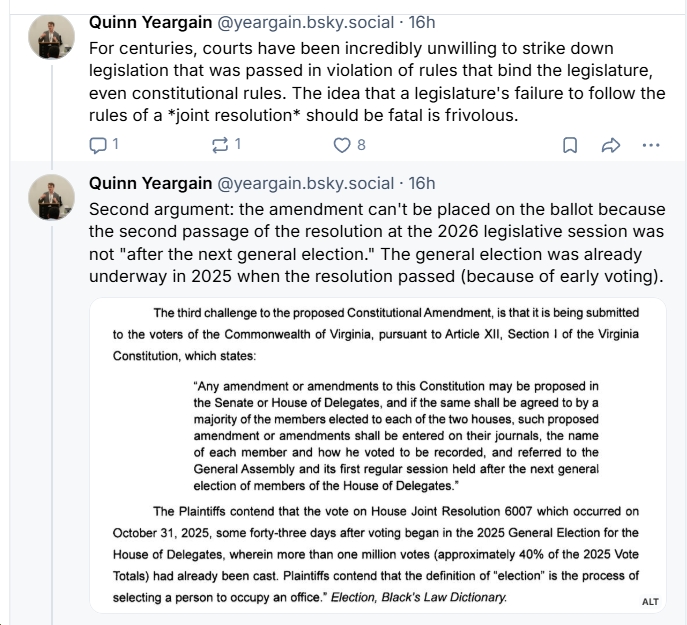
Also, check out this superb analysis by Quinn Yeargain (Associate Professor of Law and the 1855 Professor of the Law of Democracy at the Michigan State University College of Law):
- “…failure to comply with internal, non-constitutional rules will hardly ever be fatal to the passage of any legislation, including a constitutional amendment.”
- “For centuries, courts have been incredibly unwilling to strike down legislation that was passed in violation of rules that bind the legislature, even constitutional rules. The idea that a legislature’s failure to follow the rules of a *joint resolution* should be fatal is frivolous.”
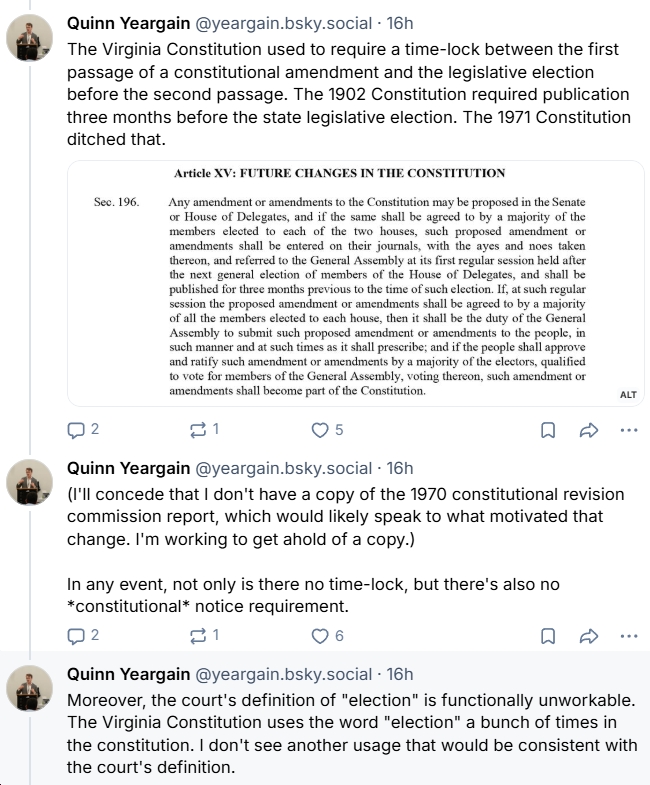
- “The Virginia Constitution used to require a time-lock between the first passage of a constitutional amendment and the legislative election before the second passage. The 1902 Constitution required publication three months before the state legislative election. The 1971 Constitution ditched that. In any event, not only is there no time-lock, but there’s also no *constitutional* notice requirement.”
- “…the court’s definition of ‘election’ is functionally unworkable. The Virginia Constitution uses the word ‘election’ a bunch of times in the constitution. I don’t see another usage that would be consistent with the court’s definition.”
- “What’s the most striking to me about this entire opinion is that the court advances three separate arguments to strike down this amendment in 6 pages with 0 case citations. It’s weak.”
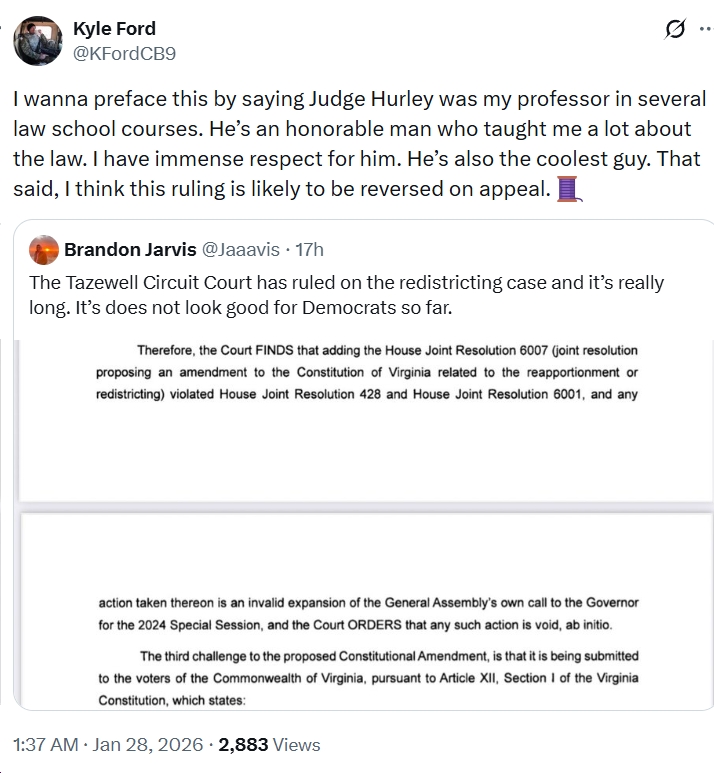
And finally, check out this excellent analysis by Appalachian School of Law graduate Kyle Ford:
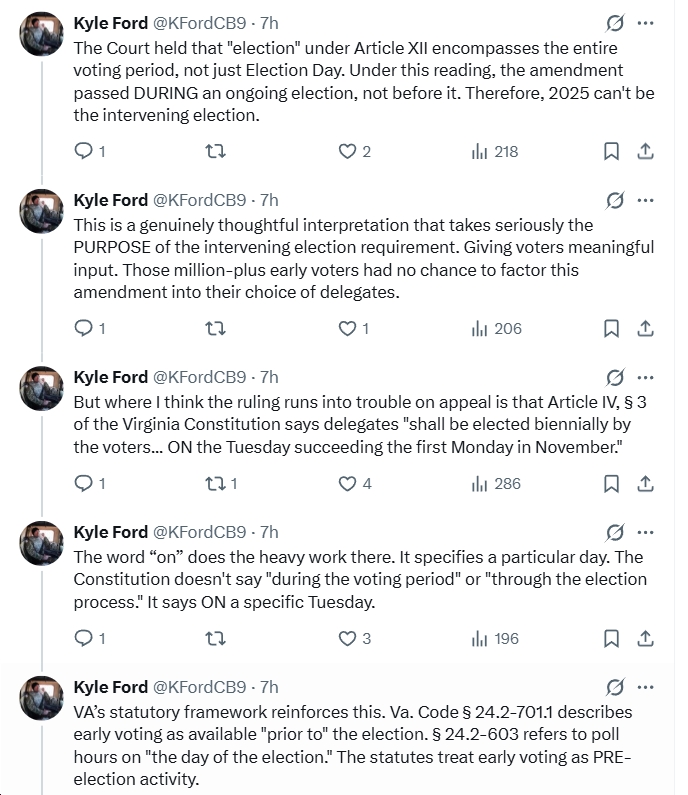
- “…where I think the ruling runs into trouble on appeal is that Article IV, § 3 of the Virginia Constitution says delegates ‘shall be elected biennially by the voters… ON the Tuesday succeeding the first Monday in November.’ The word ‘on’ does the heavy work there. It specifies a particular day. The Constitution doesn’t say ‘during the voting period’ or ‘through the election process.’ It says ON a specific Tuesday.”
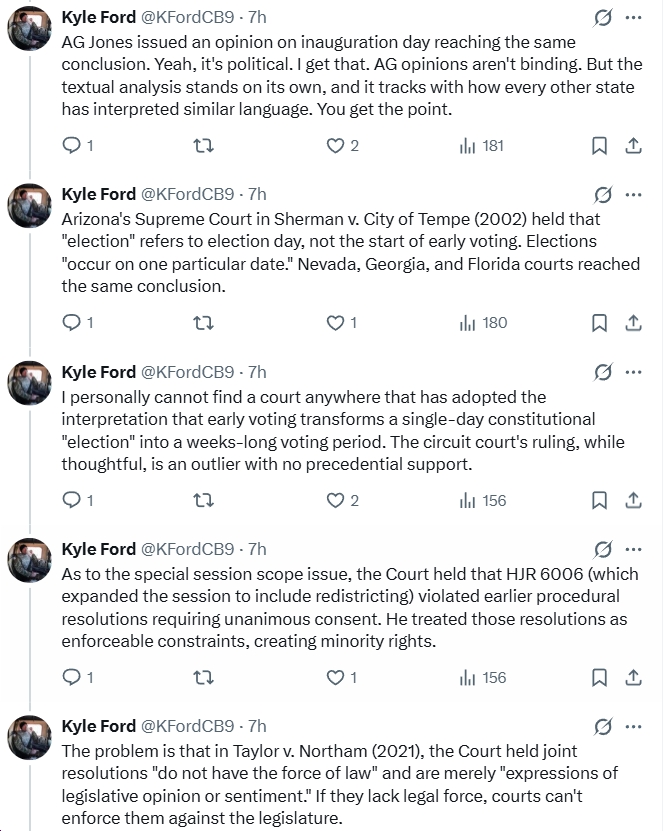
- “I personally cannot find a court anywhere that has adopted the interpretation that early voting transforms a single-day constitutional ‘election’ into a weeks-long voting period. The circuit court’s ruling, while thoughtful, is an outlier with no precedential support.”
- “…in Taylor v. Northam (2021), the Court held joint resolutions ‘do not have the force of law’ and are merely ‘expressions of legislative opinion or sentiment.’ If they lack legal force, courts can’t enforce them against the legislature.”
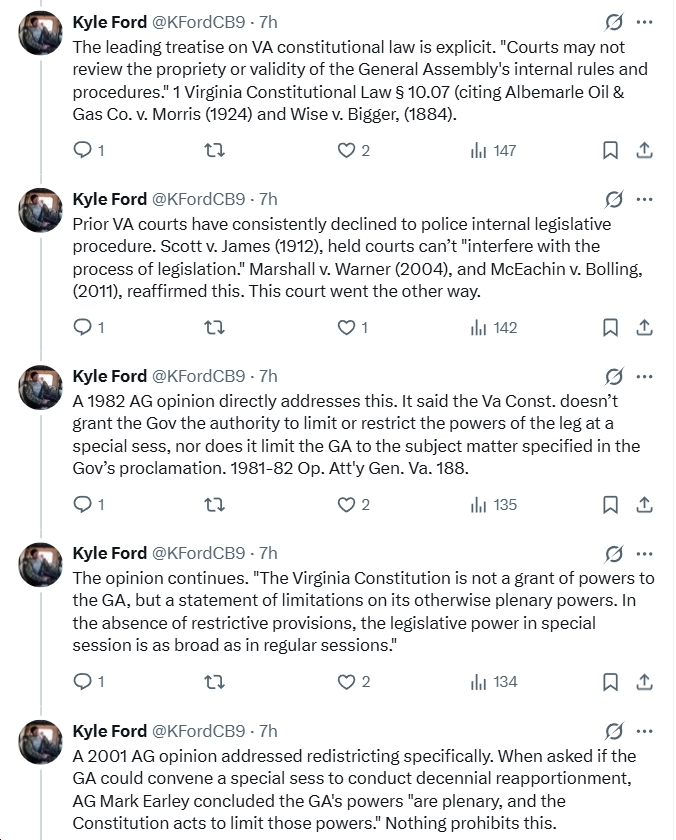
- “The leading treatise on VA constitutional law is explicit. ‘Courts may not review the propriety or validity of the General Assembly’s internal rules and procedures.'”
- “Prior VA courts have consistently declined to police internal legislative procedure.”
- “A 2001 AG opinion addressed redistricting specifically. When asked if the GA could convene a special sess to conduct decennial reapportionment, AG Mark Earley concluded the GA’s powers ‘are plenary, and the Constitution acts to limit those powers.’ Nothing prohibits this.“
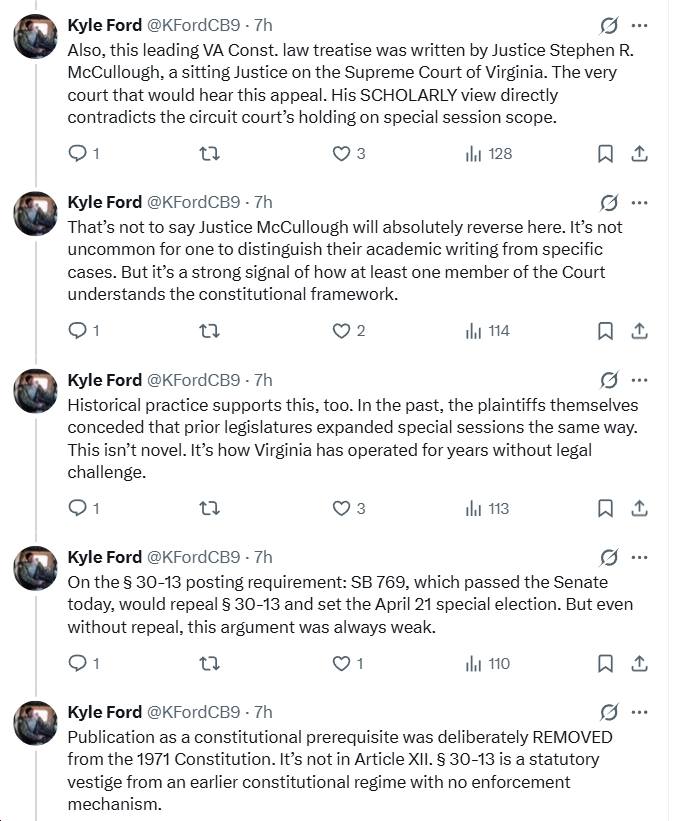
- “Also, this leading VA Const. law treatise was written by Justice Stephen R. McCullough, a sitting Justice on the Supreme Court of Virginia. The very court that would hear this appeal. His SCHOLARLY view directly contradicts the circuit court’s holding on special session scope.”
- “On the § 30-13 posting requirement: SB 769, which passed the Senate today, would repeal § 30-13 and set the April 21 special election. But even without repeal, this argument was always weak.”
- “Publication as a constitutional prerequisite was deliberately REMOVED from the 1971 Constitution. It’s not in Article XII. § 30-13 is a statutory vestige from an earlier constitutional regime with no enforcement mechanism.”
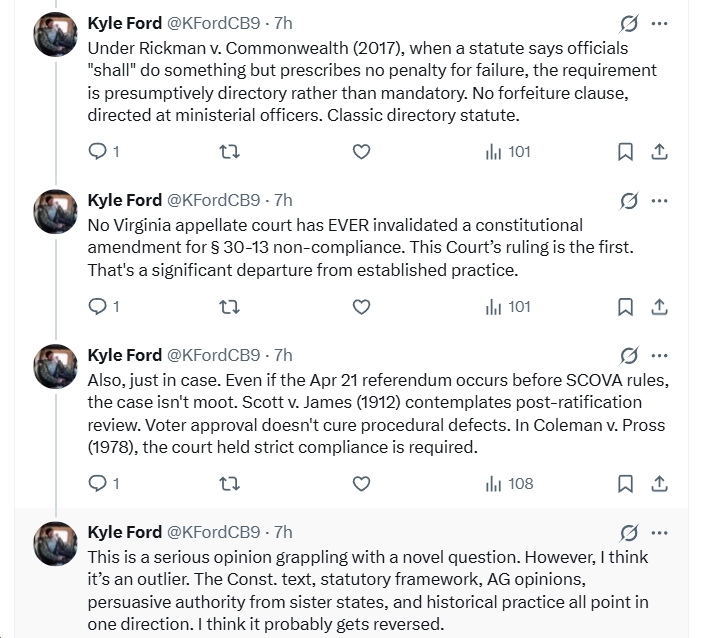
- “No Virginia appellate court has EVER invalidated a constitutional amendment for § 30-13 non-compliance. This Court’s ruling is the first. That’s a significant departure from established practice.”
- “This is a serious opinion grappling with a novel question. However, I think it’s an outlier. The Const. text, statutory framework, AG opinions, persuasive authority from sister states, and historical practice all point in one direction. I think it probably gets reversed.”
UPDATE 1/30: More from Kyle Ford…
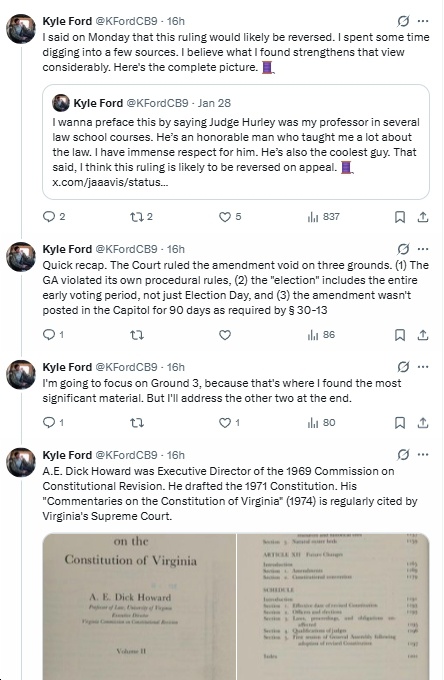
- “I said on Monday that this ruling would likely be reversed. I spent some time digging into a few sources. I believe what I found strengthens that view considerably.”
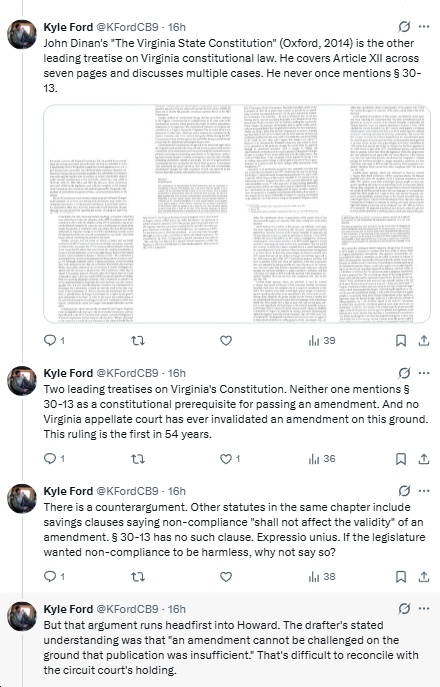
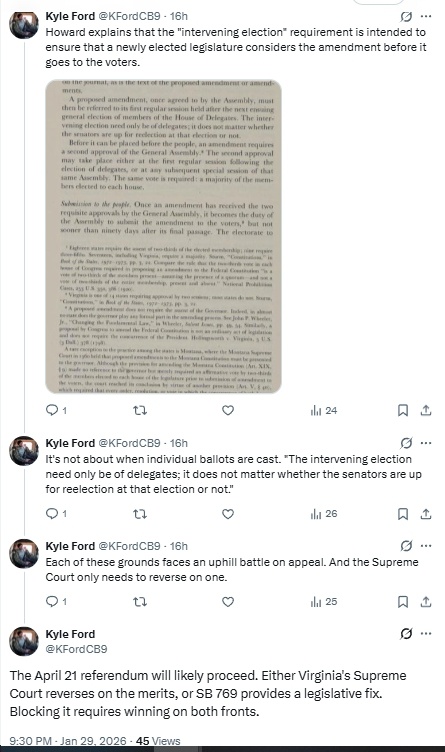
- “Howard, who ran the Commission, later wrote that this removal meant amendments could not be challenged on publication grounds.”
- “Each of these grounds faces an uphill battle on appeal. And the Supreme Court only needs to reverse on one.”
- “The April 21 referendum will likely proceed. Either Virginia’s Supreme Court reverses on the merits, or SB 769 provides a legislative fix. Blocking it requires winning on both fronts.”
- “These are difficult legal questions, and reasonable people can disagree. But based on these sources, I’m even more confident that reversal is more likely than not.”
********************************************************