
See below for video and a transcript (bolding added by me for emphasis), following the video, from Sen. Mark Warner’s press availability held earlier today.
“(0:01) Well, good afternoon, everyone, and welcome to the regular update from Washington. (0:08) As usual, this has been a busy week. (0:12) I’d like to start with something that I’ve spent a lot of time on, which is the, I believe, (0:18) baseless effort to try to once again relitigate the 2020 election.
(0:24) You may recall this was a case where a few weeks back a search warrant was issued to (0:31) look at the election results from Atlanta, Fulton County. (0:35) And one of the mysterious things that happened was, why in the heck was the director of national (0:40) intelligence, Tulsi Gabbard, on the scene when she has nothing to do with domestic election (0:49) security? (0:52) There was a set of confusing answers that came after that, one saying the president, (0:56) she said the president asked her to be there, which begs the question of why would the president (1:00) even know about a search warrant being issued? (1:05) These were the kind of abuses that were corrected with the reforms after Watergate. (1:11) And then Ms. Gabbard suddenly said, well, there must have been some foreign nexus.
(1:15) Well, earlier this week, the affidavit that was issued was revealed. (1:23) And I wasn’t surprised, but this was all based upon debunked conspiracy theories by a gentleman (1:33) named Mr. Oden, Ken Oden. (1:35) And by the way, this guy has been sanctioned because of his illicit and inappropriate behavior (1:41) after the 2020 election.
(1:43) This guy is still somehow in the intelligence community rambling around, you know, trying (1:53) to dig up dirt on 2020 because Donald Trump just can’t get over the fact that he lost. (2:00) So it again begs the question, what was Tulsi Gabbard doing there? (2:03) This was not her job. (2:05) Matter of fact, she’s actively done things to unravel election security in terms of foreign (2:13) influence, which would be her job.
(2:15) But there was something called the Foreign Malign Influence Center that she’s disbanded. (2:19) She worked with the equally inept Kash Patel to shut down some of the FBI activities about (2:25) foreign interference. (2:27) And we’ve seen the more overall administration-wide efforts to undermine and cut about a third (2:33) of the funding for the cybersecurity agency that works with local elections officials (2:38) to make sure they’re hardened against cyberattacks.
(2:41) So why was she there? (2:43) I believe she’s obviously not involved in anything with foreign policy. (2:47) She’s not been involved in any of the briefings on Venezuela, on Iran, on China, on NATO. (2:52) It appears to be a pathetic effort to try to get back in the good graces of her boss.
(2:58) It’s dangerous. (2:59) It’s inappropriate. (3:00) It’s unprofessional.
(3:04) And along with Senator Padilla, who is the ranking member on the Rules Committee, we’ve (3:08) asked her to come testify before Congress. (3:12) What is she doing? (3:12) Why is she doing it? (3:14) And why isn’t she doing the job that she was, I believe, still unfortunately confirmed to? (3:20) On top of that, we have continued comments about the president nationalizing elections, (3:27) which is totally against the Constitution. (3:29) We see the president and his Department of Justice try to bring charges against two members (3:35) of the Senate, Senator Kelly and Senator Slotkin from Michigan, and four House members, (3:41) literally for exercising the First Amendment rights.
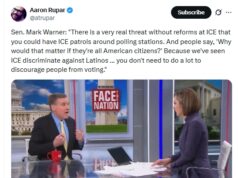
(3:46) And the fact that the grand jury, which virtually never happened, said there’s no violation (3:52) here and turned down the indictment is an indication that, thank goodness, there is still (4:01) part of our constitutional system is holding. (4:03) And we also have the ongoing debate about the role of ICE. (4:10) And I know I’ve raised constant concerns about the idea of ICE roving patrols showing up (4:17) at polling stations.
(4:18) I know people have said to me, well, Senator, if you’re an American citizen and legally (4:23) able to vote, why should you be worried if ICE is there? (4:27) Well, let me give you a couple examples. (4:29) One, we have definitely seen in Minnesota and in Virginia, ICE, I believe, discriminate (4:38) against folks of Latino heritage, whether they’re citizens or not. (4:41) We have a number of families that are mixed status, some legal, some not legal, who will (4:49) be scared away from voting.
(4:50) And then we’ve also got, if you’re saying, well, that still didn’t apply to me, ICE is (4:55) collecting personal information on American citizens using some of the major tech companies. (5:02) Do you really trust ICE to have that information about you? (5:06) And for them having that information, it doesn’t take much to dissuade Americans from (5:11) voting to start with, but it can have an enormously chilling effect. (5:15) And I am increasingly concerned about the integrity of our elections in ’26.
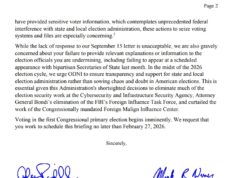
(5:20) I’m concerned. It appears that we’re going to have a statewide referendum on redistricting (5:25) on April 21st. (5:27) I’m concerned that they may try out some of their tactics in Virginia before (5:33) this fall’s elections.
(5:35) And I have more to say about this, but it is it is of enormous concern. (5:42) I also I wanted to raise the issue of sort of about one item here. (5:46) I got to just refresh my memory.
(5:50) I’m going to end on two things that are actually good news. (5:52) And I don’t get a lot of good news on this job these days. (5:56) One was yesterday, six House Republicans joined with all the Democrats to say, you know, no (6:03) to Trump’s tariffs on Canada.
(6:06) Canada, our biggest trading partner, I believe it is still Virginia’s biggest trading partner. (6:10) It and China go back and forth. (6:12) These tariffs are a tax.
(6:15) on Virginians and the fact that there’s now been both the Senate and the House, and I (6:20) want to compliment my friend Tim Kaine, who’s been leading this effort in the Senate to (6:25) say, no, you know, we’re not going to put this tax in place illegally because this is (6:30) before the Supreme Court. (6:32) And at the end of the day, not just Canada, but Mexico, but the tariffs that he’s raised (6:36) all across the world. (6:38) We’ve gone from an average tariff rate of about 2.3 percent to over 18 percent.
(6:45) That is a tax. (6:47) And whether it shows up in prices now or whether it shows up in the cost of (6:53) manufacturing, Americans are paying it. (6:58) And that’s one of the reasons why Americans are so uniformly rejecting this president, (7:03) because he’s not brought prices down.
(7:05) He’s not focused on obviously on decreasing health care costs where he’s taking health (7:10) care away. He’s so obsessed about whether relitigating 2020 or sticking (7:17) America’s nose into international affairs everywhere. (7:20) This was going to be the guy that was going to end foreign wars.
(7:23) And instead, he has deployed American troops in six different countries and in (7:29) meantime is managing to offend all our allies. (7:31) So it was good news coming out of the House yesterday that now the House and the Senate (7:36) in bipartisan way has said no to these Trump tariff taxes. (7:39) And then finally, one again, small ball, but, you know, I’ve had bipartisan legislation (7:45) for a while with Senator Kennedy from Louisiana that finally signed into law that (7:51) basically says, how do we stop the IRS from making payments to dead people? (7:58) Now, you’d think that shouldn’t be that hard, but we’ve had to pass a law that (8:05) basically says on the do not pay list and the list of data about who have died, (8:13) they are coming together.
It is now part of the law. (8:17) And, you know, while it was not a huge number, any of these stories where somebody (8:23) who’s dead gets paid by the federal government just lends credibility to the notion (8:28) that everything in the government is inept. (8:31) So at least this loophole has now been closed.
(8:35) And for those deceased recently or otherwise, don’t expect any more federal dollars. (8:42) So with that, let me turn it over to Kath. (8:44) I’m happy to take your questions.
(8:47) Our first question is from Mitchell with WTOP. (8:52) Hi, Senator. Thanks a lot for joining us.
(8:54) By the way, I enjoyed your reference to small ball since we still have all this snow (8:58) creed on the ground, baseball season just a few months away. (9:02) But at any rate, more pressing, obviously, the issue related to DHS. (9:07) What are your concerns with Congress likely to head out of town here without this being (9:12) resolved? Are you worried in any way that this issue is going to languish without any (9:18) reforms and that the issue could kind of go back to a back burner at some point? (9:23) Well, I’m concerned about that, but I also know that the reforms that we ask for that I (9:29) think are overwhelmingly supported by the American people.
(9:32) You know, if you cut through all the details, it’s basically saying that I should (9:36) operate on the same principles that our local police force do that, you know, they’ll (9:41) mask, identify yourself, get a warrant if you’re going to search somebody’s house. (9:46) These are basic policing responsibilities that ICE has kind of abused. (9:52) So I think the American public’s for these reforms, I would point out, and this is one of (9:59) the issues that ICE got so overly funded with a big ugly bill last summer that they’re not (10:06) going to cut off their funds.
(10:08) And even with issues like TSA and FEMA, you know, there are funds available on those (10:14) accounts. And I don’t think it will get pushed back. (10:19) I mean, nobody’s going to miss a paycheck for at least the next couple of weeks, but I (10:25) think it has to be dealt with.
(10:26) And I just feel like there was a lack of seriousness from the White House. (10:33) I’ve not reviewed all the documents that came in last night. (10:36) I’m going to get that update in about 30 minutes.
(10:41) But reasonable people could have sat down and work this out. (10:45) And, you know, and now we see the announcement today that they’re going to shut down the (10:48) operations in Minneapolis. (10:51) You know, I’ll believe it when I see it, but if they shut it down in Minneapolis, doesn’t (10:57) mean the same kind of ICE surge couldn’t happen in Richmond tomorrow or Norfolk tomorrow (11:02) or in Fairfax County.
(11:05) So we’ve got to have a reform system. (11:09) Our next question is from Jacob with Scripps News. (11:15) Hi, Senator.
Thanks, as always, for holding this call. (11:18) Two questions on two separate topics, if I may. (11:20) First, we discussed last week this whistleblower complaint that’s making its way through (11:26) ODNI.
And as you may have seen, there’s been some back and forth between the lawyers (11:32) representing the whistleblower and the general counsel at ODNI about whether the (11:36) whistleblower and their attorney should be able to provide Congress directly with the (11:41) complaint in some sort of classified setting. (11:43) ODNI seems to say that they’re not lawfully able to do so. (11:46) I just wanted to ask if it’s your understanding that the whistleblower is allowed to (11:52) provide certain congressional offices or officials with the unredacted complaint.
(11:59) And similarly, if you’ve been in touch at all with the whistleblower or their team as all (12:03) of these developments have unfolded. (12:06) And then secondly, just on a point you mentioned in your opening remarks about the Trump (12:09) administration trying and failing to secure this indictment against those lawmakers, as (12:15) you may have seen, former White House counsel Bob Bauer today called for a revamping of (12:21) the independent counsel statute to try to prevent any presidential administration from (12:27) weaponizing the Justice Department against sitting lawmakers. (12:30) Wanted to get your reaction, if that’s something that you might be supportive of Congress (12:34) trying to take action on.
Thank you. (12:35) Thank you. Let me take them in reverse order.
(12:38) You know, I’ve not seen Bob Bauer’s proposal, but on the face of it, it seems to make (12:43) sense. You know, we read about other countries where, you know, a dictator or somebody in (12:49) power goes after his political or her political opposition and arrest lawmakers. (12:54) That’s never happened in our country.
(12:58) And now the fact that they brought such a bogus indictment against these members of (13:03) Congress that, in my understanding, is where they didn’t get a single vote amongst the (13:07) grand jury. That is a stunning statement on how badly put together this plan was pursuing (13:18) political enemies. But, you know, as we’ve seen, I don’t know if they’re out of legal (13:24) jeopardy, whether they’re going to try to go to another grand jury.
(13:27) We actually heard we’ve heard where grand juries wouldn’t invite indictably Jim Comey at (13:32) one point and the case then fell apart. (13:35) But if you can continue to use and harass your political opponents using the power of (13:41) Justice Department, you’re still going to run up huge legal bills. (13:46) It’s it’s un-American.
(13:48) You know, nobody has said what these members said was not protected by the First (13:52) Amendment or protected by the speech and debate cause in the Constitution. (13:58) So it’s it’s mind boggling to me. (14:01) And again, it’s you guys know I’ve been accused a lot of times of being way too (14:07) bipartisan.
But I have been so disappointed. (14:11) You know, we’ve heard a few Republican members speak out. (14:15) But why there’s not universal condemnation.
(14:18) Why there’s not anybody that says Congress needs to be separate and not subject to the (14:26) political retribution of a president. (14:28) You know, this is how a democracy unwinds. (14:30) So I’m I’m pretty disappointed with my my friends for not speaking up on this issue (14:37) on the whistleblower complaint.
(14:39) A couple of things. I won’t go through all of the details because it’s it’s pretty (14:43) complicated. But let’s let’s start with the basic fact.
(14:47) Whistleblower. Let me also say on whether the whistleblower I have not talked to the (14:52) whistleblower or their attorney. (14:54) We always leave that again throughout my tenure on the Intelligence Committee.
(15:00) They make the initial approach to our staff. (15:02) The staff does the first review. (15:04) And I’m not actually sure whether the whistleblower’s lawyer has reached out.
(15:08) I think they’ve expressed interest, but I’m not sure. (15:11) But let’s go through the what we do know. (15:13) This whistleblower brought a complaint in May.
(15:16) The director of national intelligence, based upon testimony of her then general counsel, (15:21) her now assistant general counsel, briefed the DNI in June, outlining some of her legal (15:27) obligations. We, the Congress, didn’t get even indication (15:34) there was a complaint until November. (15:38) And there is usually the obligation that you’re supposed to report within 21 days.
(15:43) We then it took from November till February till we got the complaint. (15:49) And this was, again, a bipartisan request from the whole gang of eight. (15:53) I obviously can’t comment on the substance of the complaint, but frankly, I can’t even make a (15:58) judgment on the substance of the complaint because it was so redacted.
(16:04) So we have asked for some of the underlying intelligence. (16:07) We’ve asked to try to get it redacted, at least at the gang of eight level. (16:11) And in terms of the lawyers, the lawyers’ willingness to try to bring the complaint to the (16:19) committees, this is a little bit of what the director is hanging her hat on, but it doesn’t (16:27) pass a smell test.
(16:29) You’ve got this obligation to report, but then there is a bit of ambiguity about the legal (16:37) guidance the ODNI is supposed to give to the whistleblower’s attorney about how they present (16:43) that information. So you’ve got to get legal guidance on how to come forward. (16:48) And it appears they’ve just been dragging their feet on that and punting it.
(16:52) So she says, well, she had no obligation. (16:54) Well, I don’t think any reasonable person would have thought that if the whistleblower brought (16:59) the complaint in May, that now in February, months and months later, though, you wouldn’t (17:07) have gotten basic legal guidance on how you present it in a way that’s appropriate. (17:13) So I feel this is a dereliction of duty from the ODNI.
(17:18) I feel this was an effort to not just keep this from me, but it’s an effort to keep it from (17:25) the whole gang of eight, Democrat and Republican alike. (17:29) And there’s going to be more to come because we’re going to get access to the underlying (17:35) intelligence and we have to get some level of redaction at least. (17:40) And that’s why the gang of eight was set up, because we are we have a record of keeping (17:44) everything secret.
And, you know, in many ways, it’s made the situation worse by, you (17:51) know, what appears to be almost the cover up may be worse than the crime in terms of the (17:56) complaint itself. But I can’t make a judgment on that because I don’t know. (18:01) Our next question is from Charlie with ABC 13.
(18:06) Hi, Senator, I wanted to ask you about the SAVE Act that passed the House recently and is (18:11) now in the Senate. (18:12) So my question is, you now have to show a real ID to board a plane. (18:16) Do you think similar identification requirements should apply to voting? (18:21) Well, I don’t accept the premise of your question because we actually have you got to show (18:26) ID to vote in Virginia right now.
(18:28) You can’t walk in and vote and say, you know, Mark Warner or Joe Jones, you got to show an (18:34) official ID like a driver’s license, or if you don’t have a driver’s license, you have to (18:40) bring other documents showing where you live and then you put in a provisional category. (18:46) This SAVE Act, and by the way, you know, our IDs have become more and more driver’s (18:52) licenses. You have the kind of real ID component.
(18:55) But this SAVE Act, which I strongly oppose, would require you got to show your birth (19:02) certificate. You got to show your passport. (19:07) Most Americans, I think it’s only about 50-50 now in terms of the number of Americans that (19:12) have a passport.
You talk about how this would disenfranchise folks. (19:16) Folks in rural communities have a much lower percentage of passports. (19:21) You’re going to say to folks on South Side and Southwest, you know, you don’t get to vote (19:25) because you never got a passport or you don’t have your birth certificate.
(19:29) And what also ought to be, I think, just insulting is, you know, you got to bring your (19:38) birth certificate. God forbid you’ve got married and changed your name. (19:44) This is outright discrimination against women who choose to change their name when they (19:48) get married.
So this is not a valid effort. (19:55) I strongly oppose it. (19:57) And as documents after documents, investigation after investigation shows, the number of (20:05) non-citizens trying to vote is so minuscule.
(20:11) And I think after, I can’t remember, was it 24 or 20, it was like nationwide millions and (20:16) tens of millions of things were looked at. (20:18) And they were like in the tens, not in the hundreds, but I believe in the tens, the number (20:23) of people who actually were non-citizens that voted. (20:26) You know, let’s actually, I honestly think we ought to get more Americans registered to (20:32) vote.
I think it would be we’d have a stronger democracy if more people voted. (20:36) And I still am, I guess I’m old school. (20:38) I still remember when things like motor voter making it easier to register when you get (20:44) your driver’s license or government offices was broadly bipartisan.
(20:48) And I sure as heck hope we could get back to that. (20:52) Our next question is from Regina with Wavy. (20:57) Good afternoon, Senator.
(20:59) Thank you so much for taking my call. (21:01) I have a couple of questions involving the media, but the military in Hampton Roads. (21:09) Number one, we learned today that border officers fired an anti-drone laser on what (21:17) turned out to be a balloon without consulting the FAA.
(21:23) Imagine if that had happened in Oceana, the Oceana area. (21:27) Number two, a sailor, a Marine from the USS Iwo Jima fell overboard, missing at sea. (21:35) The Norfolk based Truxton and the USNS supply collided yesterday during an unwrap known (21:46) as an underway wrap when they’re transferring supplies back and forth.
(21:53) I have said before to other members of Congress, it appears the Navy, which has lost (22:00) several aircraft recently, has forgotten how to be the Navy. (22:05) Comment on that and also the border situation with El Paso. (22:10) Yeah, thank you for both questions.
(22:12) You know, any time we lose a sailor, it’s a great tragedy. (22:15) And I pray that he’s recovered. (22:18) But obviously, we may have lost another American patriot.
(22:25) You know, and you’re right, whether the we’ve seen planes fall off aircraft carriers. (22:30) We’ve seen now this description of these ships colliding, my understanding. (22:34) And I just got a quick report on this.
(22:36) So I need to get all my facts straight. (22:38) But my understanding is that it was off the coast of Venezuela. (22:41) And we got close to 20 percent of our fleet off the coast of Venezuela.
(22:46) A lot of those ships home ported in Norfolk. (22:50) How long are they going to be there? (22:52) You know, it takes that many to kind of remember the bad guys are still in charge in (22:56) Venezuela. It takes that many to try to quarantine and blockade Venezuelan oil from (23:02) getting out.
Are they going to be on a long, long term deployment? (23:07) Many of them have been down there literally for months already. (23:10) And, you know, as great as our Navy is, it still gets stretched. (23:15) I mean, we think back a couple of weeks ago when the Iranian people went to the street (23:19) trying to throw off that repressive regime.
(23:22) And we were the president was didn’t have all the assets that if he wanted to take a (23:28) strike against Iran, he couldn’t because the aircraft carrier that was normally there (23:36) was off the coast of Venezuela. (23:37) Now we’ve taken an aircraft carrier from the Indo-Pacific and moved it into the (23:43) region. President talking about a second one.
(23:46) But this kind of lack of a theory of the case and how we’re not going to overstretch (23:52) the Navy is a huge concern. (23:54) And I also go back to the Iranian situation. (23:57) All these things are interconnected.
(23:59) One of the reasons why we couldn’t bring more pressure at that moment when the people (24:03) on Iran were out in the streets and literally thousands of them were killed by this (24:07) repressive regime, we couldn’t get our European allies to help us because they were (24:13) focused on Trump’s effort to break up NATO and potentially threaten Greenland. (24:18) So these kind of activities, I think, make America less safe, stretches the resources (24:25) of the world’s best Navy, our Navy. (24:28) And I fear when you’re on these long deployments and as you got to get more details (24:32) on this, but if they were moving things from one ship to another, I’m not going to (24:38) comment on full causation.
(24:40) But when you’ve got people deployed this long, it takes a toll. (24:45) It takes a toll not only on the ships, but it takes a toll on the brave men and women who (24:51) are sailors. So I want to get more information on the other.
(24:55) Oh, my gosh. This is the Keystone cops. (25:02) There was, we are we are developing and this is now in the public domain, laser weapons (25:09) that could shoot down drones.
(25:13) And, you know, it is a tool of modern warfare. (25:17) We need to have that. (25:18) We see the enormous power of drones being used in Ukraine.
(25:22) But what happened was, I believe the weapon was lent to the Customs and Border Patrol. (25:28) They wanted to test it out. (25:31) But.
Funny thing happened on the process of testing, they didn’t tell the FAA. (25:39) So they’re doing this because they didn’t communicate or they’re having a bureaucratic (25:43) effort. And not only did they shut down air traffic, traditional air traffic, they were (25:48) shutting down.
You know, emergency, they were, you know, somebody’s got to hurt and you’ve (25:54) got to fly an emergency helicopter. (25:55) It was shut down. So this is incompetence.
(25:59) And as you said, my God, if this was happening, Hampton Roads. (26:05) The amount of air traffic we have, not just commercial, but obviously military, if some (26:12) part of our government is using and testing a weapon without telling the folks who are (26:17) supposed to be in charge of air traffic control safety, that is a recipe for disaster. (26:22) And thank God in the circumstance in El Paso that all they shot down was a balloon.
(26:28) In my understanding, I’ve heard reports that it was not even a weather balloon, but it (26:33) was a party balloon. So, you know, instead of this administration trying to pursue (26:41) political retribution against the president’s political enemies, maybe trying to have a (26:48) little more focus on the operations of our government and making sure that one branch of (26:52) government is talking to another would make Americans a heck of a lot safer. (26:56) And maybe focusing on bringing down costs, which he promised and has done virtually (27:00) nothing on, instead of rate and said, in effect, raising costs with these crazy tariffs (27:06) might be a way to now take the president out of these record low approval ratings.
(27:13) Our final question is from Angela with Hampton Roads Messenger. (27:19) Good afternoon, Senator. (27:21) Thank you for taking my question.
(27:22) My question is regarding the joint resolution terminating the national emergency (27:28) declarative imposed duties on articles imported from Canada. (27:33) Do you know if there are any efforts in Congress to repeal tariffs on any other countries (27:39) in addition to Canada? (27:40) Yes, ma’am. And I appreciate you being on the call.
(27:43) We’ve now said Congress has said bipartisan. (27:47) We don’t want the tariffs on Canada because it’s a tax on Americans. (27:51) And it also Canada is one of our strongest allies.
(27:55) We’ve now turned Canada almost into an adversary because of this president’s actions. (28:00) You know, Senator Kaine has also brought tariff proposals against the tariffs on Mexico, on (28:06) Brazil. I know there’s going to be a number of these other actions in the House.
(28:10) I think they’re teed up. (28:13) There’s got to be a period of waiting, but I think we’re going to see a lot of votes in the (28:17) House take place. (28:18) We’ve seen tariffs, for example.
(28:20) Let me give you two other examples. (28:22) One on India. We spent years trying to make India a closer ally.
(28:26) And India ended up with at one point they’ve been reduced, supposedly, although we’ve got no (28:30) documentation, up to 50 percent on Indian tariffs because he was simply mad that the prime (28:35) minister there, Modi, didn’t say he deserved the Nobel Peace Prize. (28:40) Pathetic. We’ve got tariffs.
(28:43) We had raised tariffs on Australia. (28:45) You know, we are we are building aircraft carrier, I mean, our submarines with Australia that (28:52) helps everybody in Hampton Roads. (28:55) We’ve got a trade surplus with Australia.
(28:57) It’s one of our strongest allies, yet we still whacked them with a tariff. (29:03) This is kind of this is, you know, not no economist of the right mind would say this kind (29:12) of tariff policy with no reason. (29:16) You want to bring more tariffs against China that cheats on so many things, steals (29:19) intellectual property.
Let’s talk about that. (29:22) But instead, we’re tariffing disproportionately our friends and in many cases driving them (29:27) to do more trade with China than with us. (29:30) And I’m glad to see, at least on the case of Mexico, that you’ve got bipartisan support to (29:34) stop that.
Senator, those are all the questions we have today. (29:40) All right. Thanks, everybody.
Be safe.”