Great stuff from the Virginia Public Sector Labor Coalition:
Virginia General Assembly Passes Historic Legislation to Allow More Than Half a Million Public Service Workers the Freedom to Collectively Bargain
Legislation now heads to Governor Spanberger’s desk
RICHMOND, Va. — Both chambers of the Virginia General Assembly tonight passed historic legislation to allow more than half a million public service workers — including teachers, firefighters, state workers, home care workers and service staff at public universities — the freedom to join a union and bargain collectively for their wages, benefits and working conditions.
SB 378, patroned by Senate Majority Leader Scott Surovell, passed the Senate by a vote of 20-18 and the House by a vote of 61-36. HB 1263, patroned by House Democratic Caucus Chair Kathy Tran, passed the House by a vote of 62-34 and the Senate by a vote of 20-18.
While the General Assembly must still pass a budget that funds the legislation, today marks a significant step toward ensuring all workers have the dignity of a seat at the table and a voice on the job.
“At the start of this legislative session, I announced this bill as one of our caucus’s key affordability proposals, and I am proud to deliver a conference report that is one of the most significant advances for workers’ rights anywhere in the country in recent history,” said Leader Surovell. “Senate Democrats will continue to fight for workers, including the public sector workers we rely on every single day for high-quality services that they deliver to our families and communities.”
“At a time when costs continue to rise and public sector workers struggle to rent or buy homes in the communities they serve, we must act to make life more affordable for them,” said Caucus Chair Tran. “From our teachers, to home care workers, to firefighters and frontline workers, public sector employees work hard to provide the best possible services to our families, and they deserve a seat at the table. Together, we will continue to show that Virginia can be one of the best states in the country for both business and workers.”
“I applaud the General Assembly for passing this bill,” said Portsmouth firefighter Kurt Detrick, who serves as President of Local 539, Portsmouth Professional Firefighters and Paramedics “The problem right now is that firefighters, teachers, and other public service workers cannot even begin the process of deciding whether or not we want to collectively bargain unless a few politicians decide that we are worthy of this right. This legislation would put that decision in the hands of the workers, which is where it belongs, and I am glad it is headed to Gov. Spanberger’s desk.”
“It is simply not right that our freedom to be a part of a union is dependent on our zip code. We show up every day and work hard to make our communities better and stronger; we deserve the same rights and freedoms as anyone else,” said Natalie Boyd Thomas of Portsmouth, a social worker who’s been working to organize a union with AFSCME. “Senate Bill 378 and House Bill 1263 will fix this. It’s good that these bills are headed to the governor’s desk so that our local public service workers have a voice on the job.”
“There are several school divisions that have successfully implemented collective bargaining and union contracts in the last five years,” said Nicholas Green, a member of the Education Association of Norfolk and a Norfolk middle school teacher. “Workers in Arlington won the right to speak their native language while at work. Workers in Prince William won better grievance procedures. Workers in Montgomery County won limits on meetings and protections for planning time. Our working conditions are students’ learning conditions. We need to have a voice if we want to bring changes to the issues we want to see — no matter if it’s worker pay and retention, or student behaviors and social and emotional learning, or having school facilities free of black mold and asbestos. This bill gives us that voice.”
“This victory isn’t just a win for us, but for all Virginians who need care. Our care strengthens families, supports communities, and helps Virginia invest in care at home rather than more costly alternatives,” shared Athena Jones, SEIU Virginia 512 home care chapter chair. “I’m proud of our union, and our sibling unions, who have stood united in our fight to ensure that all workers in Virginia are treated with respect and that our rights are protected by law.”
“We are the people who keep the schools safe and clean for the students to get their education, and who keep the buildings clean,” said Wakisha Nunley, a housekeeper for Old Dominion University and member of UNITE HERE. “We deserve change and we deserve it now, and I’m glad it’s about to finally be here, and we will keep fighting until every worker at a public university has the same rights.”
While the Virginia Public Sector Labor Coalition recognizes the passage of this historic legislation as a cause for great celebration, it stands in solidarity in its commitment to the continued fight to ensure all faculty and staff at public universities — including graduate workers, adjunct professors, and tenured professors — have the freedom to collectively bargain.
“Expanding collective bargaining rights to all public sector workers has been a central focus of our work for years, and we are excited that we have taken a major step towards that goal today,” said Cecelia Parks, Chair of the United Campus Workers of Virginia Political and Policy Committee and a librarian at the University of Virginia. “However, we are disappointed that so many of our members, including faculty, graduate student workers, and many staff were left out of the legislation that passed today. Workers like me are the heartbeat of our public colleges and universities, and we are deeply committed to our students and our institutions. Bargaining would give us a seat at the table to improve our working conditions, our students’ learning conditions, and our communities, and we will continue to fight until no one is left behind.”
“We are thrilled that so many public sector workers will now have the chance to improve their working conditions, but are beyond disappointed that instructional faculty and graduate teaching assistants are being left behind,” said Bethany Letiecq, President of GMU-AAUP and Vice-President of AAUP-AFT Local 6741. “This at a time when teaching is under attack by anti-democratic actors at the highest levels of government. And faculty, even with tenure, are being fired without due process. We will continue to fight for college and university instructors—this is not over by a long shot.”
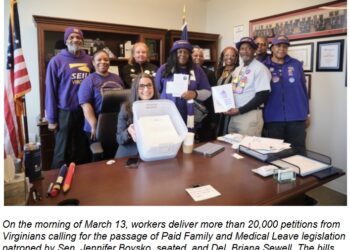
The legislation builds on a 2020 law, championed by Delegate Elizabeth Guzman (D-Prince William) and Sen. Jennifer Boysko (D-Fairfax), that lifted Virginia’s blanket ban on public sector collective bargaining by allowing workers the freedom to collectively bargain in localities that passed ordinances authorizing the practice. A surge in energy led to more than 80,000 public service workers actively organizing to win collective bargaining rights.
###
Authorized by the Virginia Public Sector Labor Coalition, which comprises Virginia AFL-CIO; American Federation of State, County and Municipal Employees (AFSCME); American Federation of Teachers; American Federation of Teachers-American Association of University Professors; Communications Workers of America (CWA); SEIU Virginia 512; Virginia Education Association (VEA); Virginia Professional Fire Fighters (VPFF); UNITE HERE; and United Food and Commercial Workers (UFCW) Local 400. The coalition collectively represents hundreds of thousands of Virginia workers.