As always, if you want to know – and understand! – what’s going on in the Virginia General Assembly, there’s absolutely no better source than VAPLAN (“The Virginia Progressive Legislative Alert Network is a grassroots project/hobby that was created after the November 2017 Virginia House of Delegates elections, to encourage activists who had been involved in those elections to pay attention to what those legislators they just elected were doing.”). So definitely check out VAPLAN, whether on its website, its Twitter or Bluesky feeds; again, these are MUST FOLLOWS to know what’s going in in the Virginia General Assembly; VAPLAN’s founder Cindy seems to watch EVERYTHING – don’t ask me how she does it! LOL – and has a deep, detailed understanding of legislation, legislators, etc. Truly impressive; great work!
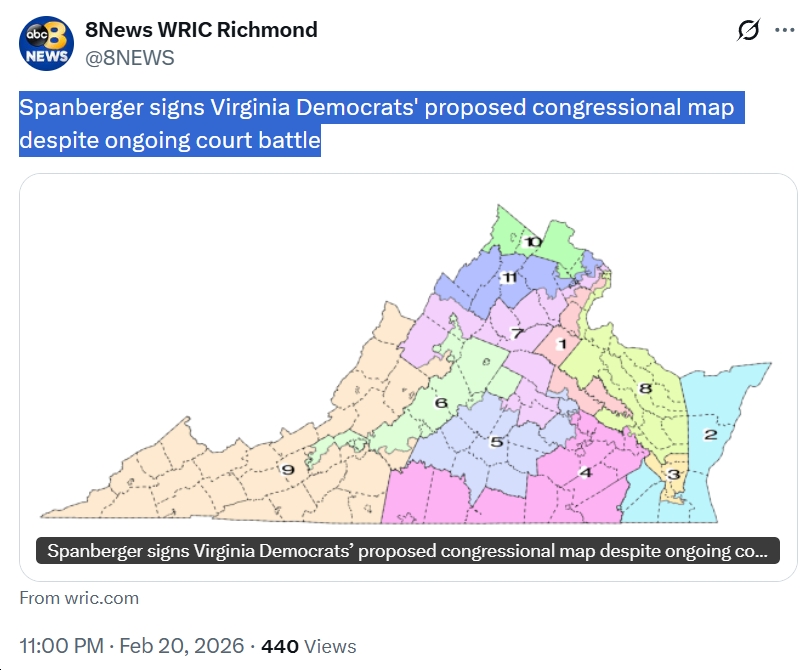
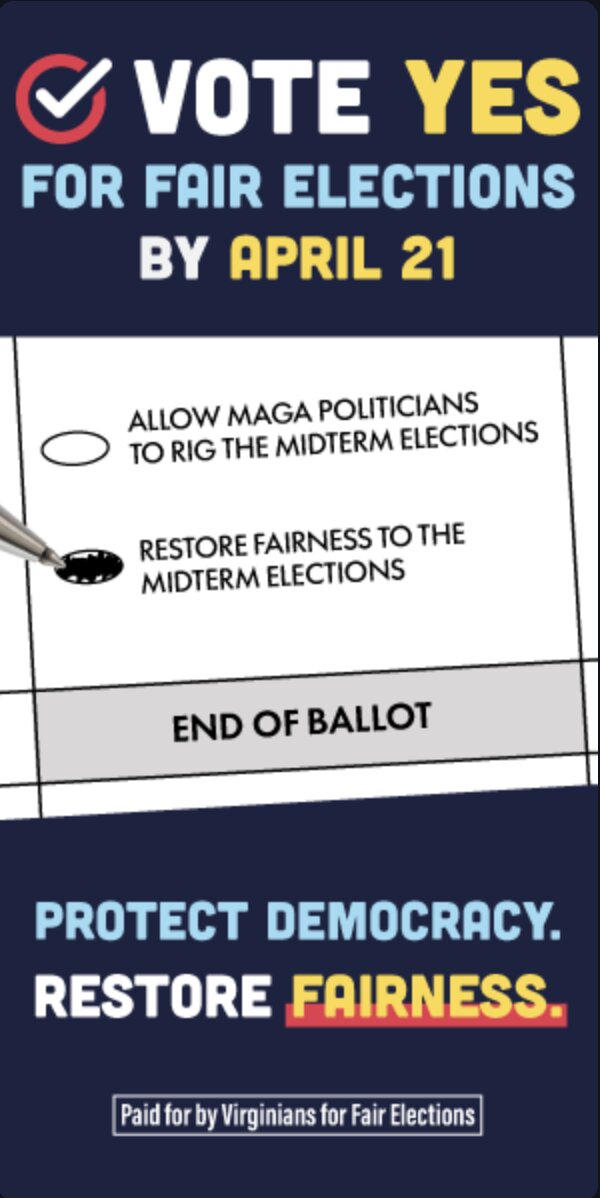
So with that, here’s VAPLAN’s latest update, with a recap of Week #8 of the 2026 Virginia General Assembly, as it’s “coming to an end” (adjournment “sine die” is scheduled for this coming Saturday, March 14, with April 13 being the deadline for Gov. Abigail Spanberger’s vetos/amendments, followed by a “Reconvene” session on April 22 – just one day, by the way, after the redistricting referendum on April 21).
P.S. There are a bunch of serious items here, also an amusing one (“SB300 (Jordan) designating the peanut as the ‘state snack’ passed the Senate unanimously but was continued to 2027 in House Rules”) and one that I find completely baffling as to why it was “continued” – aka, pushed off until next year for consideration – in House Rules committee (“SB42 (Roem) only required a study of the impact of paying off students’ unpaid meal debt at the end of the school year—not actually paying it off, just studying what the impact would be. Unanimous in the Senate, 16-6 in House Education, and then continued by voice vote in House Rules.”)
*****************************************************************************
QUOTE OF THE WEEK, Delegate Price clapping back after GOP pop-up Delegate Williams makes floor speech reciting old anti-gerrymandering quotes from Democrats during 2020-21 redistricting discussion: “As we’ve seen from our friend, he loves to live in history, and that is where all of his quotes came from. The one quote he did forget to say was ‘find me five seats’ and that’s the quote that our president has given SINCE all of the other quotes that [Williams] listed. So I will offer another quote here today, first day of early voting: ‘VOTE YES, FIGHT BACK!’”
Bills in conference
- The House (Price) and Senate (Carroll Foy) versions of the bill ensuring the right to contraception differ somewhat, with the House version (currently substituted on SB596 by the House) referencing federal government (FDA) laws and definitions.
- The House (Krizek) and Senate (Ebbin) Fantasy Contests gaming bills started out the same, but Senate Finance and Appropriations replaced the content of the House bill with just an enactment directing the Lottery an VDACS (the agency responsible for much gaming regulation) to assess the regulation and taxation of Fantasy Contests.
- House (Krizek) and Senate (Aird) versions of the adult recreational marijuana marketplace bills still have a few differences to iron out, including who qualifies for impact licenses; how the revenues are divided between early childhood care, the Equity Reinvestment Fund, substance use treatment programs, and public awareness; the tax rate (6% state plus 1-3.5% local in the House version, 12.875% state plus <3% local in the Senate ); criminal charges for illegal sales (House version creates felony for more than twice); and the Senate version has the Cannabis Control Authority becoming a division of ABC, while the House version it remains independent.
- House (Hayes) and Senate (Rouse) versions of “skill games” regulation are in conference as well, but the language of the two versions is extremely far apart. They don’t even have the same definition of “truck stop” as one another, so there’s a ways to go. One has an optional opt-out locality referendum, the other a required opt-in referendum; they have different fee structures for manufacturers, distributors, and per machine; different host location requirements; the House version allows a maximum of 15,000 machines, the Senate allows 35,000; the House allows a maximum wager of $1 per play, the Senate $5 per play, etc.
House bills that failed in the Senate
- HB35 (Cole, JG) to ban solitary confinement passed the House with a tiny bit of bipartisan support, but was unanimously continued to 2027 in Senate Rehab.
- HB936 (Lopez) would have allowed a county to initiate a parking ticket by mail pilot program. It squeaked by the House, and failed to report from Senate Transportation.
- HB365 (McLaughlin) would have expanded the situations in which a law enforcement vehicle may ignore speed and parking laws. It passed the House on a nearly unanimous vote, and was killed in the Senate Transportation committee on an 8-7 vote.
- HB133 (Simon) passed the House unanimously, but failed to report from Senate Courts of Justice. It would have allowed electronic signing and notarizing of wills and trust documents, with guardrails. This bill met a similar fate last year.
- HB495 (Guzman) would have allowed school districts to require bus drivers to complete mental health awareness training. It passed the House on a party-line vote, and was continued to 2027 by a voice vote in Senate Education.
- HB1415 (Schmidt) would have required any publicly-funded multi-family housing unit to allow residents to have one small pet. It passed the House on a party-line vote, but was killed in Senate General Laws by a 14-1 vote.
- HB295 (Cornett) adds correctional officers to the definition of aggravated murder (class 1 felony). This passed the House with wide bipartisan support, and failed to report from Senate Courts of Justice, on a party-line vote.
Senate bills that failed in the House
- SB586 (Salim) would have required insurance carriers to report to the Bureau of Insurance when AI is used to make determinations on coverage, and to tell patients when AI is used to deny a claim. It passed the Senate with a slightly bipartisan vote of 23-16, but was continued to 2027 by voice vote in House Communications and Technology committee.
- SB269 (Favola) specified when AI may legally be used in mental health counseling, and what recordkeeping is required. The bill passed the Senate unanimously, but was continued to 2027 by voice vote in the House Communications and Technology committee.
- SB42 (Roem) only required a study of the impact of paying off students’ unpaid meal debt at the end of the school year—not actually paying it off, just studying what the impact would be. Unanimous in the Senate, 16-6 in House Education, and then continued by voice vote in House Rules.
- SB486 (Stuart) would have required makers of dietary supplements to include a gluten disclaimer. It passed the Senate unanimously but was continued by voice vote in House Health and Human Services committee.
- SB300 (Jordan) designating the peanut as the “state snack” passed the Senate unanimously but was continued to 2027 in House Rules.
- SB541 (Stuart) would have allowed Virginia to make Eastern Standard Time permanent year-round if DC and Maryland agree to do so also. It passed the Senate on a nonpartisan 24-16 vote, but was continued to 2027 in House Rules by a voice vote.
- SB670 (Salim) regarding the regulation and licensing of fully-autonomous commercial vehicles passed the Senate 35-4 and was continued to 2027 in House Transportation.
- SB538 (Suetterlein) would have required input by the local Commonwealth’s Attorney before the Parole Board releases someone. This is a bill Democrats have blocked in past years, and although the Senate votes 30-10 to pass it, House Public Safety continues it to 2027 on voice vote.
- SB603 (Reeves) passed the Senate unanimously but was tabled in House Education on a party-line vote. It would have allowed school boards to adopt a policy for volunteer student life counseling. The Virginia Education Association had not testified on the Senate side, but spoke strongly against in the House.