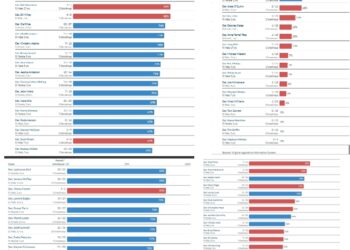
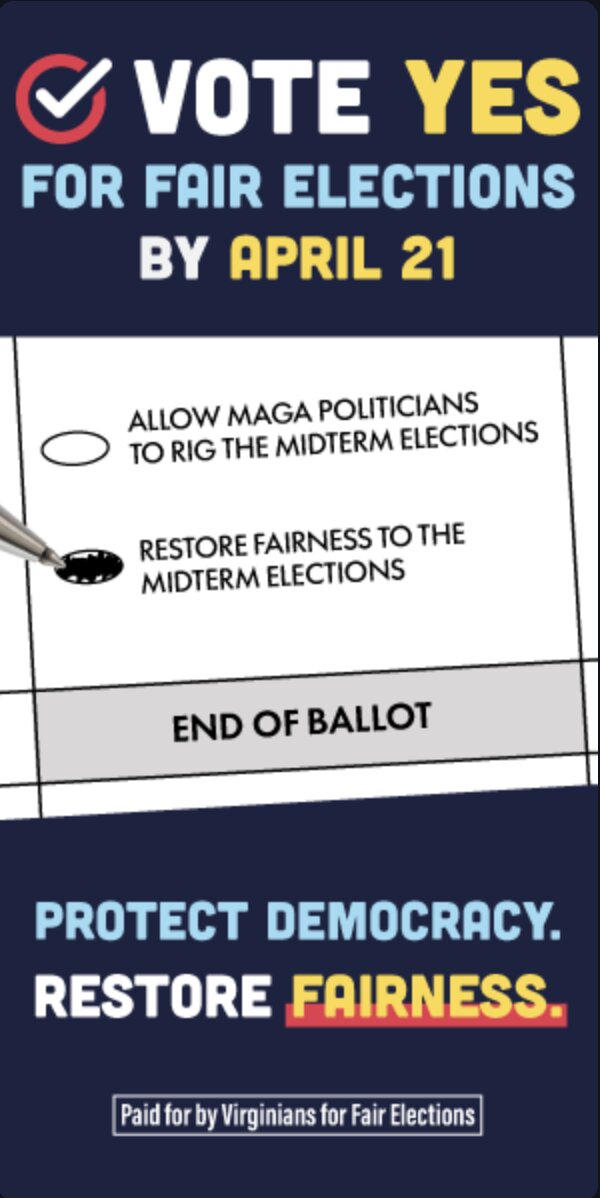
With the 2026 Virginia General Assembly session having concluded (other than the “reconvene”/”veto session” on April 22 and a special session to complete the budget on April 23), it’s a good time to look at how things went. For starters, check out VPAP’s “batting averages” for all state senators and delegates, as well as the “fate of 2026 legislation,” “party unity” scores, etc. Also, of course, Cindy over at VAPLAN does great work, including her progressive scorecard (eagerly anticipating that!), as well as her summary of “long-overdue wins,” “timely responses,” and “missed opportunities” (see here and below). First, a few thoughts of my own…
- I agree with VAPLAN/Cindy on the “long-overdue wins” – for workers, as well as on gun violence prevention, the right to obtain contraception, rejoining RGGI, ending Confederate tax breaks/songs/etc., the Prescription Drug Affordability Board, etc. Also, good stuff on the “timely responses” – restrictions on ICE, allowing balcony solar, limiting other states’ National Guard presence in Virginia and the Virginia National Guard’s deployment at voting locations; etc. On “affordability,” there were definitely good bills which will move the ball forward on this front. But to make a huge dent on things like housing affordability, energy efficiency, etc., I’d argue we’re going to have to think a LOT bigger. I’m just not sure there’s the political will to do so.
- I also agree with VAPLAN/Cindy on “missed opportunities,” particularly on campaign finance reform (yet again, Dominion and other corporate interests won out, while the rest of us lost; gotta love the “Virginia Way,” huh? not!), a new millionaires income tax bracket, etc.
- In general, Democrats pushing to make Virginia’s pathetically regressive tax code a LOT more progressive should be an absolute no-brainer, and yet in the 2026 VA General Assembly session – or, for that matter, the last time we had a governing “trifecta,” in 2020-2021 – we got basically nothing. Which is highly unfortunate, given that even this modest bill (“Establishes a new income tax bracket beginning in taxable year 2026, that taxes income in excess of $1 million at a rate of 10 percent. Currently, all income in excess of $17,000 is taxed at the rate of 5.75 percent.”) would have raised nearly $3 billion in 2026-2027, and $2 billion or more annually thereafter. That’s a lot of money that could be invested into education, Medicaid, etc, but…nope. And why not? If it’s about political positioning, it seems futile to me. Why? Because, regardless, the fact is that Republicans are going to claim Democrats raised a gazillion taxes, are “commies,” etc. no matter what they do; even if they literally raise ZERO taxes, as was the case in the 2026 VA General Assembly session. So if Democrats are going to get lambasted by Republicans as “tax-crazy liberal nutjobs” or whatever, might as well actually raise taxes on the super-rich, big corporations, etc, while investing heavily in the people (working class, middle class) who actually need help. Isn’t that what the Democratic Party is supposed to be about, after all?
- On that last bullet point, note that one reason for the focus on revenues from scaling back data center tax breaks – a good idea, regardless! – is that the other main alternative to raising revenues, namely making our tax code more progressive by raising taxes on the wealthiest Virginians (estate tax? wealth tax? higher marginal tax rates for people making millions per year? all of the above?) was apparently taken off the table. Disappointing.
- Also disappointing, IMHO, was that Democrats really needed to strengthen the Virginia Clean Economy Act (VCEA) in a big way, given that we’re falling behind on the clean energy and climate goals set out in VCEA. As Ivy Main wrote this past week, Democrats certainly did some good stuff – for instance, they “passed integrated resource planning reform legislation that requires Dominion and Appalachian Power to present the SCC with plans that adhere more closely to the spirit of the VCEA”; they also took “tentative steps towards performance-based regulation, which would reward utilities for doing things like meeting clean energy and affordability goals rather than for just building more infrastructure.” So that’s good stuff, but definitely not sufficient – not even close, franky – to the challenges facing us (the climate crisis, which is only getting WORSE; the massive economic/health/security costs of our fossil fuel reliance) and the huge economic and affordability opportunities from moving to a clean energy economy. What we need instead, as Ivy Main correctly points out, is a far more aggressive timeline for decarbonizing Virginia’s economy, preferably by 2045 (or sooner, I’d argue, given the degree of urgency). Ideally, that would mean building a TON more solar power (both utility-scale and distributed/rooftop/etc.), and most importantly pushing for *massive* increases in energy efficiency (aka, the biggest bang for the buck, “negawatts” – the energy you never have to produce in the first place, etc.). And, of course, we also need to rein in the massive increases in power demand by voracious data centers. So where was all that stuff? Well, bills like this one by Sen. Kannan Srinivasan (“Permits the governing body of any locality to give consideration to the adverse impacts on the electric grid caused by high-energy users”) was “passed by indefinitely” (aka, killed). On the other hand, if you look at this list by Ivy Main, a bunch of bills did pass, and those will be helpful, but I’m still not particularly seeing the REALLY big, ambitious stuff needed to tackle this massive challenge.
- One more bill that should have passed, but somehow didn’t make it out of the State Senate, was a bill to protect terrapins from being drowned in crab pots. As Virginia environmentalist Jay Ford put it: “Folks… How can we not agree to stop unnecessarily killing turtles? North Carolina, Maryland, Delaware, New Jersey, & EVEN FLORIDA ALL require these devices on recreational pots. Now Virginia and the Chesapeake Bay remain as the place Terrapin will needlessly drown.” So this bill passed the House 61-35 (along party lines), then somehow didn’t manage to make it out of the Democratic-controlled State Senate. This one illustrates some really bad things about Republicans, but also about how pressure from economic interests can even sway some Democrats too – and harm animals, the environment, etc. in the process, for really no good reason.
With that, what did you like or dislike about the 2026 VA General Assembly session?
Long overdue wins
Lots of important bills that have passed before but were vetoed by Youngkin finally have a good chance to becoming law:
For workers:
- Completing the minimum wage increases begun in 2020 (HB1-Ward and SB1-Lucas)
- Paid family medical leave (HB1207-Sewell and SB2-Boysko)
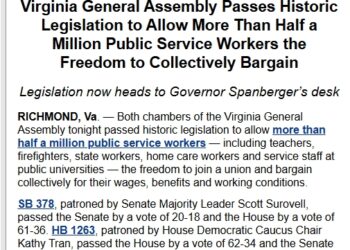
- Public sector collective bargaining (HB1263-Tran and SB378-Surovell)
For gun violence prevention:
- Ban on purchasing assault weapons and high-capacity magazines (HB217-Helmer and SB749-Salim)
- Ban on “ghost guns” (HB40-Simon and SB323-Ebbin)
- Close boyfriend loophole (HB19-McClure and SB160-Perry)
- Firearm industry liability (HB21-Helmer and SB27-Carroll Foy)
Affordability, clean energy and consumers:
- Prescription Drug Affordability Board (HB483-Delaney and SB271-Deeds)
- Rejoin RGGI (HB397-Herring and SB802-Locke)
- Class action lawsuits (HB449-Simon and SB229-Surovell)
- Increase waiting period before beginning eviction (HB15-Price and SB48-Rouse)
- Clean Energy Innovation Bank (HB1444-Lopez and SB225-Surovell)
- Affordable housing on property owned by religious organizations (HB1279-Cole, JG and SB388-McPike)
Other:
- Right to obtain contraception (HB6-Price and SB596-Carroll Foy)
- Marijuana adult recreational market (HB642-Krizek and SB542-Aird)
- Repeal commonlaw crime of suicide (HB43-Simon)
- End Confederate tax breaks (HB167-Askew) and license plates (HB1344-Helmer) and songs (SB801-Ebbin)
Timely responses
In addition to bills with long histories, there were some new bills that addressed problems of the moment we’re in.
- Responding to MN deaths, restrictions on ICE agreements with local law enforcement (HB1441-Lopez and SB783-Salim)
- Task Force to assess VMI’s response to 2021 SCHEV recommendations and how to further distance VMI from the Lost Cause (HB1377-Helmer)
- Allowing newly-developed small-scale “balcony” solar panels (HB395-Krizek and SB250-Surovell)
- Limiting other states’ National Guard presence in Virginia (SB337-Perry) and deployment of the Virginia National Guard at elections (HB286-Helmer)
Missed opportunities
With a Democratic trifecta, there were high hopes for some progressive policies, but between a tight budget due to the impacts of federal cuts, and a general appetite to rock the boat a little less, these failed.
New millionaires income tax bracket (HB188-Convirs-Fowler; HB1074-Hernandez and HB979-Watts)
School construction local tax referendum [currently in Senate budget] (HB334-Rasoul; HB1156-Hodges; SB66-McPike; and SB607-Lucas)
Limits on campaign contributions (SB584-Salim) and corporate campaign contribution ban (HB1447-Glass)