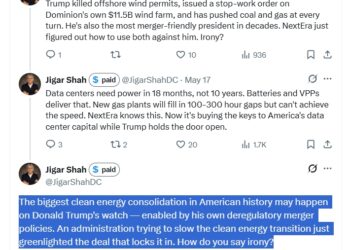
Over at Power for the People VA earlier this week, Ivy Main posed an important question, one that’s particularly timely right now given the possible acquisition of Dominion Energy by NextERA (which, apparently, “has a clear impetus: data centers”), namely “Hey Dominion, what’s up with the gas plants?” As Ivy Main writes (she nails it as usual!):
Why should we residents be stuck with 30 years of paying for a honking-big, fracked-gas-burning, climate-change-driving monstrosity whose sole purpose is to feed the tech companies’ competitive drive for the most advanced chatbots?…
[…]
The onslaught of power-hungry data centers overwhelmed the ability of electric grids to keep generation in balance with demand. At the same time, the Trump administration erected one barrier after another to the wind and solar projects that would most quickly and cheaply bring the balance back. Instead, it is aggressively supporting fossil fuels and weakening pollution limits.
For a utility needing more power at any cost, suddenly gas plants are back on the table. But for the people who have to live with them and pay for them, a gas plant will be an ongoing liability.
Wind and solar exploded in popularity not just because they don’t pollute the air, but also because they have no fuel cost. You build them once, and you know your power price for the next 25-30 years. Fossil gas, on the other hand, carries a price beyond the capital cost of building the plant, but you don’t know what that price will be. Even with a robust domestic supply, gas prices gyrate wildly.
[…]
Fool us once, fool us twice, and are you really willing to go along with Dominion’s claim that fossil gas will be an inexpensive, reliable and desirable fuel source over the next 30 years while we pay off this project, with interest?
And then there’s the fact that building a gigantic new plant to burn fracked gas is politically stupid. Global warming doesn’t factor into the Trump administration’s energy “planning,” such as it is, but climate action was a priority for the previous administration and is going to be one for future administrations. Global warming isn’t going away; it’s getting worse, and wishing away reality is not a long-term strategy.
[…]
…we have to stop digging our carbon hole sometime. Let it be now.”
In sum, building new fossil-fuel-fired power plants (aka, “climate-change-driving monstrosit[ies]”, as Ivy Main accurately describes them) at this point makes essentially zero sense from almost any perspective – economic, environmental, political, you name it. But the data center boom is driving power consumption, and there aren’t a lot of great options to supply that power in places like Northern Virginia. I mean, it’s not like there’s tons of open land in Fairfax, Loudoun, Prince William, Arlington or Alexandria to build massive, ground-mounted, utility-scale solar projects. And it’s not like we’re in the Great Plains, aka “the Saudi Arabia of wind.” Also, obviously, nuclear fusion power is decades away (if ever) from being viable and economical, while small modular nuclear plants are also highly dubious for numerous reasons (the technology’s still under development, the cost would be FAR higher than energy efficiency, solar, wind and energy storage, etc.). Which leaves…not many other options to power data centers in places like Northern Virginia, which is why utilities like Dominion and NextERA are looking at – as Ivy Main puts it – “honking-big, fracked-gas-burning, climate-change-driving monstrosit[ies] whose sole purpose is to feed the tech companies’ competitive drive for the most advanced chatbots.” Brilliant, huh?
Meanwhile, this past week, along with the news of the possible NextERA acquisition of Dominon Energy, a major new report (Bloomberg’s New Energy Outlook 2026 ) came out, which IMHO is highly relevant to this discussion. See below for a few highlights from that report, with my comments in parentheses/bold/green after each bullet point:
- “Rising demand from EVs, data centers, buildings, industry, air conditioning units and heat pumps makes electricity the top supplier of final energy by 2047” (Overall, this is great news, a key components of any serious strategy to tackled the climate crisis is to “electrify everything” – “Clean up electricity”; “Electrify everything”; “Simple.” OK, maybe not so simple, but the concept is clear – everything should run on clean electricity – solar, wind, geothermal, energy storage, etc. – and none should run on dirty fossil fuels.)
- “Solar becomes the power-generation leader by 2032…solar is the world’s largest zero-carbon power source by the end of this decade and then becomes the largest generator overall by 2032” (Excellent – let’s accelerate this as rapidly as possible; and we can, given that solar is cheap – and getting cheaper – plus infinitely abundant, no “negative externalities,” etc. The challenge, though, is getting the solar power from where it’s generated to where it’s consumed, and *that* can be a big challenge, given various obstacles to building new power transmission capacity in this country.)
- “… in many cases, power market reform is immensely complex, time consuming and might not produce optimal results. A far simpler potential option: use batteries at scale to shift midday generation to evening hours. Already, batteries are being deployed in a wide variety of shapes and sizes, in front of and behind the meter, to provide greater system flexibility to grids.” (Energy storage is something which is absolutely crucial, and which has been plummeting in cost for years, yet you still hear false, brain-dead comments by fossil fuel industry hacks, Republican politicians – but I repeat myself! – etc. about how solar and wind aren’t reliable because “what happens when the sun isn’t shining and the wind isn’t blowing?” I mean, it would just be cringe-inducingly embarrassing if it weren’t also harmful, given the massive growth in energy storage and the fact that it’s becoming dirt cheap, allowing us to – what a concept, I know! LOL – *store* the solar and wind power for use when the sun isn’t shining and/or the wind isn’t blowing. Side note on this point – do not EVER vote for ANYONE who uses that phrase, “when the sun isn’t shining and the wind isn’t blowing,” because you can be 100% certain that they’re either fossil fuel industry tools and/or imbeciles, and we really don’t want either of those in positions of power in this country, state, etc.)
- “BNEF has substantially increased its outlook for battery deployment. Storage jumps 17-fold to 3.8 terawatts by 2050 from 223 gigawatts in 2025 but adoption rates vary, with China and the US poised to go slower than many other nations.” (See previous points; and of course, Trump et al are seriously harming our country, including vis-a-vis China and other countries, by being such complete and utter douchebags, imbeciles, fossil fuel industry tools, etc. when it comes to energy storage…and pretty much everything energy-related. The current Secretary of Energy, for instance, is a complete and utter disgrace to the US Department of Energy, where I worked for 17+ years, and to our country general.)
- “A larger, more dynamic power system requires increased flexibility from both supply and demand. By 2035, some 11% of megawatthours generated are shifted, up from 3% today. This includes storage technologies such as batteries, but also flexible demand-side measures, such as smart electric-vehicle charging.” (These tools will be crucial in coming years; will a Dominion/NextERA combo get ahead of the curve on this? Virginia as a whole?)
- “Despite $0.5 trillion in corporate equity and billions in government support over five years for startups and other firms, the next great lowcost energy technology has yet to emerge. Hopes are high for new nuclear, geothermal or storage technologies, but none has been proven sufficiently at scale – yet. ” (Personally, I’d bet on new geothermal and storage technologies; nuclear is almost certainly never going to be cost competitive with energy efficiency, solar, wind, storage, etc.; more likely, nuclear will be a massive boondoggle and dead end.)
- “In power, coal’s share in generation already peaked in 2011 at 41%. By 2050, coal generation accounts for around 8% of output. Rather than supplying baseload power, it is increasingly displaced by cheaper renewables and runs fewer hours, serving a more limited, residual role in systems where alternatives are constrained…” (Trump can try to save “beautiful coal” or whatever idiotic adjectives he uses to describe this antiquated, filthy fossil fuel, but it’s going the way of the dinosaurs – and almost as rapidly as the dinosaurs died out after the gigantic meteor hit the Earth.)
- “Global demand growth for crude oil slows then declines as EV adoption rises under the ETS, while gas use rises to meet electricity demand. Oil and gas demand both drop if countries get serious about CO2 emissions…” (This final bullet point gets at a big problem – gas use rising to meet electricity demand – and also at the the main point of Ivy Main’s post, about Dominion Energy wanting to build “honking-big, fracked-gas-burning, climate-change-driving monstrosit[ies]” to power chatbots and such. So it’s easy to say, just use energy efficiency, storage, solar, wind, etc. to power those data centers, but at least in the short term, that’s easier said than done, given the MASSIVE amounts of power those data centers suck up, how quickly they are coming online, land/space constraints in densely populated areas like northern Virginia, which make it basically impossible to build solar power facilities large enough to power those data centers, etc. Which leaves…unfortunately, as one major option – and apparently Dominion’s preferred option – natural-gas-fired power plants. The problems with those, however, are legion, including the fact that they’re very expensive, that they take years to build, that they require pipelines to feed natural gas to them, that in the process of fracking/transporting natural gas, lots of seriously damaging methane – a HIGHLY potent greenhouse gas – leaks out into the atmosphere, where it contributes to disastrous global heating. Which is why, at this point – given the climate crisis – we shouldn’t be building ANY new fossil fuel infrastructure, let alone “honking-big, fracked-gas-burning, climate-change-driving monstrosit[ies]” to power chatbots. But that does put utilities like Dominion Energy in a tough spot, not that we should feel sorry for them of course…but still, it’s something to keep in mind as we consider our policy options.)
By the way, regarding data centers, we’re still awaiting a final budget plan, which presumably will involve some sort of compromise when it comes to data center tax breaks. The bottom line with data centers is that they suck up massive amounts of power (see this report, which points out that one large data center can consume over 1,000 MW, more than Virginia’s largest nuclear reactor!) – and water, are HIGHLY unpopular, yet are booming as “the largest technology companies, including Amazon, Meta, Google, and Microsoft, are investing quickly and heavily in AI.” Also note that data centers do bring in large amounts of tax revenues as well; Loudoun County, for instance, says :
- “The data center industry is an important part of Loudoun County’s economy that contributes significantly to the county’s resources and substantially lowers the tax burden on the residential taxpayer.
- Data centers added $16 billion in value to the real property portfolio in Loudoun County in 2024 for a total of $41 billion. The growth in data center real property continues to reduce pressure on the residential tax base to fund the growth of services.
- Data centers generate almost half of the county’s property tax revenues. Over the past decade, revenue growth from data centers has allowed the county to address increasing service needs for Loudoun County Public Schools and to fund improved services to our residents while consistently lowering the real property tax rate. That revenue growth is also a major factor in the decision to lower the tax rate on vehicles by 67 cents in Fiscal Year 2026.
- The assessed value per square foot of data centers is $609, which is around triple the value of other commercial uses.
- For every $1 in services that Loudoun County provides to data centers, the county receives $26 in tax revenue.
- Absent the data center industry, the county’s real property tax rate would likely be more than $1 per $100 in assessed value instead of the current $0.805 cents per $100 in assessed value which is six cents lower than the 2024 tax rate. Since 2008, the county’s tax rate has dropped from $1.285 to $0.805.”
So we can hate these things all we want, but as long as we keep demanding the services they provide, and as long as they bring in massive $$$ to localities, something tells me that they’re not only NOT going to go away, but that they’re going to keep expanding for years to come. Which means the questions are going to continue regarding how to power them, where to site them, how to tax them, etc, And no, there are no easy or magic solutions available here, even as we absolutely need to make sure that data centers pay their fair share, use clean energy, become more energy efficient, use as little water as possible, don’t destroy neighbors’ quality of life, etc, Meanwhile, we’ll see how the current battle over taxing data centers plays out in Virginia in coming weeks…



![VA DEQ: “pollution from data centers currently makes up a very small but growing percentage of the [NoVA] region’s most harmful air emissions, including CO, NOx and PM2.5”](https://bluevirginia.us/wp-content/uploads/2026/01/noxdatacenters.jpg)