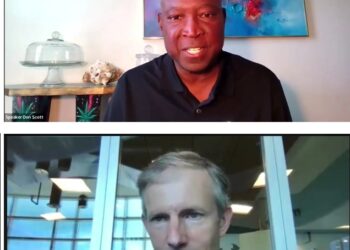
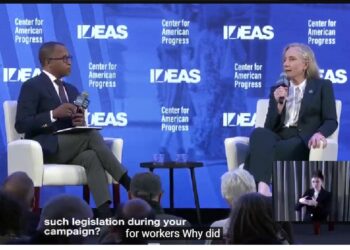
See below for video and highlights from a FaceTime interview by singer/musician/comedian Tevin Davis with Gov. Abigail Spanberger, in which he says his goal is “to try and get answers to the concerns and frustrations so many of you have, directly from the source.” Topics covered include cannabis, ICE, and collective bargaining. Nice job and great scoop! It starts off as follows, with Tevin Davis asking:
“The reason I called you is because, you know, the people are feeling frustrated. They’re a little confused and they’re feeling betrayed by some of the vetos that you have made I think on the recreational cannabis on the warrantless ICE arrests and on the collective bargaining. Can you break it down to me like I don’t know nothing about politics so that I can clearly understand your rationale on why you veto these bills and are these issues still something you even support?”
Here are a few of Gov. Spanberger’s responses:
- Gov. Spanberger: “I appreciate the opportunity to talk about it because these are really important issues and they’re, you know, really complicated…issues, and so I’m happy to walk you through it, because these are important issues to a lot of people including myself.”
- Gov. Spanberger: “First on the recreational cannabis, we are in this kind of gray area right now where in Virginia it’s legal to use cannabis recreationally, but you can’t buy it in any sort of retail venue. And so there’s been work for a number of years of getting Virginia to a place where we can start a retail cannabis market. And there was a bill that was put through the General Assembly. And I really appreciate the work of the patrons there. And so in kind of digging into that bill…this is like creating an entirely new retail market for an intoxicating substance, creating a new agency and authority to regulate it, new law enforcement entities…a process by which stores can get licenses, a process by which growers can actually grow it…and folks who are going to be transporting it legally can get licenses…if you think about what it takes to have spirits in an ABC store or wine and beer in a grocery store, there’s an entire kind of spectrum of regulations around those intoxicating substances. And so in reviewing this legislation that’s…over a hundred pages worth of statute that’s either being totally created or some places adjusted to kind of build out this new retail market. There were a variety of places where I saw that there needed to be some amendments to the bill…So I did a lot of outreach, my team did a lot of outreach to other states where they some that have had newer cannabis markets, some that cannabis markets have been there for quite some time. You know, what are the lessons learned? What do they wish they had known when they were just getting started? And we got a lot of really great feedback from governors, from their policy folks, and I brought that, you know, to my review of the legislation, and I think principally one of the things that I found to be like a real challenge was that the bill was set up to move really quickly…Among the amendments I put forward was even backing that time frame up to give the state and to give the CCA authority, which would be the cannabis authority, time to build itself out, train up its folks, put out all of its regulations, process licenses. And that I think is one that was a real core and important one…It was also a priority for me…between 200 and 400 or so stores across the Commonwealth is probably where the market can bear. And so one of the amendments I put forth was that, ok, when we start let’s start with 200…we want to make sure we’re not oversaturating a market and setting them up for failure…The bottom line is I have supported a retail cannabis market. I know that Virginia needs to get to a retail cannabis market because the gray area is not working for anybody. I put forth a whole variety of amendments and you know it’s certainly the legislature’s prerogative to accept them or reject them. Ultimately they did the latter. But at the same time you know I think the reality is had they accepted them all certainly I would have signed the bill had they chosen to sever the amendments and take them in a more individual basis, then you know that would have been additional conversations to be had. But for me, the reality is I’m the one who’s going to be tasked with as governor making sure that we’re setting it up properly. And it’s a huge shift. And I think this is one of those things where, you know, the old saying, the devil’s in the details. We have to get it right… to be clear I know a lot of people are not pleased with that…friends and family are displeased as well, but it is I do think it’s an obligation to get it right.”
- Gov. Spanberger: “And then you mentioned ICE agents, as I would term it, abusing their power, scaring and terrorizing communities, wearing masks, seemingly unaccountable, of course, in Minnesota, murdering two US citizens, arresting US citizens, separating families, deporting people to horrible places in El Salvador. Like, all of it is atrocious. It’s antithetical to American values and to good community policing priorities. And so, this isn’t what you asked about, but if you’ll allow me, I’m going to go back a moment. On my very first day in office, the day I was sworn in, I signed an executive order, because my predecessor had required state agencies to enter into what are called 287(g) agreements. And that’s when you actually like give your officers and deputize them over to ICE to basically do ICE’s bidding. And per the constraints of those agreements, you actually put your people under ICE control…they’re under ICE supervision. And so on day one, the first thing I said is absolutely no more agreements, no more 287(g) agreements with ICE, with state agencies. And I asked for a review to make sure I had a full understanding of any agreements that were in place. About two weeks later, after I had a full accounting of how many agreements were in place and what the impact was, then I signed another executive order requiring all Virginia state agencies to end those agreements. And so that would be, you know, certainly state police chief among them, Department of Corrections and a couple other state agencies to end those agreements completely. Now…there was a bill that I vetoed and a bill that I signed. One of them was a bill that would preclude ICE agents from taking any law enforcement actions within courthouses or schools or hospitals. And it in part puts liability on the security officer at a courthouse for when they let an ICE officer come into a courthouse. Now, this is where there’s just actually like a basic constitutional authority issue and a supremacy clause issue. Which is that if an ICE officer or any federal agent – ICE is the kind of the one that we’re concerned with – but any federal agent, if they have a warrant to execute an official business for the security guard at the courthouse to kind of stop them, now we’re putting that individual in a position where they might be either violating state law if they let them come in or violating federal law if they stand in the way of a law enforcement action and could be charged with obstruction. So from like a legalistic standpoint, it’s kind of not enforcable, runs up against potential challenges from a constitutional perspective. But importantly, importantly, I don’t think it is safe to communicate incorrectly to vulnerable immigrant families that in schools or in hospitals or courthouses or commonwealth’s attorney’s offices that they are fully kind of immune to any sort of deportation or any sort of ICE action. Because even if I were to have signed that law into place it wouldn’t have actually guaranteed that. And I am really sensitive to the idea that we cannot tell vulnerable people things that may not actually come out to be the truth of the matter. Because from a constitutional perspective, those law enforcement officers can indeed enter those spaces. And then, putting a security guard in the position where they’re choosing sort of which law they might be running a foul of is a challenge. Now, in response, because I totally recognize and agree with the intent of this bill, I put out another executive order. One, saying absolutely no ICE actions may occur on state property. Because that’s as governor, that’s what I can totally control and dictate, can occur on state property without a warrant. And no staging areas can be used that are state property…no ICE efforts on state property. And then I have tasked my agencies and the administration, the secretariates of education, health and human resources, public safety to put out best practices and guidance to that security officer in the hospital, in the school, in the courthouse. so that if they think they see what might be immigration action that they know how to respond and you know look out for and respond appropriately if they see what might be immigration activities occurring in those locations. And then separately, there’s also the bill related to mask-wearing. That’s a place where I had put forth an amendment trying to give individuals like a civil right of action so they can legally also sue ICE agents for wearing those masks…I wanted to give that extra kind of hope to it but sign that bill as is because certainly you know I began my career as a federal law enforcement officer and like essential to your ability to do your job with like dignity and honor and respect for the people who may have made a terrible mistake or who are on the other side of the law or importantly victims that you might encounter is to be able to have like the dignity of that face-to-face discussion and to not so fear not engage in the sort of like theatrical enforcement that we have seen ICE continue to do over and over again. I mean it does a disservice not just to any ideal of law and order, but it degrades the trust, frankly, that even, you know, local or state law enforcement have worked so hard to try and build up. And so, this is one that I like I feel very very strongly about. And I but I also think that we have to be super honest with vulnerable communities when it comes to the fact that if there is a ICE agent you know with a warrant or if there is an ICE agent coming to execute on immigration activities, I don’t want people to think that some places may they may be safer when they’re not.”
- Gov. Spanberger: “So collective bargaining. So I’ll start with this. So in the Commonwealth of Virginia, the only group of folks who are actually fully fully fully prohibited from being able to collectively bargain. So that would mean you know joining a union and having that union create a collective bargaining agreement for them, are state employees. At the local level, it is the law that localities can opt in. Now fully fully acknowledge that there are some localities where they haven’t opted in and people might themselves wish to collectively bargain and don’t have that option, but it’s actually state employees where they cannot collectively bargain at all. And so this is something that I support giving public servants the right to collectively bargain. You know, before I ever got into politics, I was a career public servant at the federal level, of course, where they’re procluded from collectively bargaining. And so at the state level, there was a bill that went through the General Assembly, a result of a lot of, you know, strong negotiations, a lot of work. The House had one version of a bill, the Senate had one version of a bill. Even on the last day, they had two different conference reports, as they call it. And so ultimately they voted to pass a collective bargaining bill. And in that case again I put forth a whole variety of amendments because you know there’s two roles that I play in there. One is it would be at the state level that we would be setting up the public employee…board that would be supporting all of the collective bargaining units in their negotiations with their employer…among the things that that I put forth as an amendment was to say this is an entirely new process for Virginia, this is an entirely new board that we’re putting together, and so let’s have the state employees go first, kind of learn any lessons, any areas of improvement, any new regulations that might need to be pushed out. And admittedly, like every bargaining unit might have different priorities and some of the discussions might be happening. But my worries were if we have everybody go at once, that that might kind of overwhelm this new entity that we’re creating. But also let’s have the state go first and then months later we’ll have localities fold in. And so you know of course during that time employees at the local level would still maintain their ability to be able to collectively bargain localities could opt in. But getting to that point where then everybody can collectively bargain would be months down the road at the local level. And so here was really just a question of implementation of guidance. I was hearing from school districts. I was hearing from localities. The thing I was hearing actually, frankly, from a number of the localities that already have collective bargaining where they’re so proud of the collective bargaining agreements that they have on the ground, and that this bill based on some of the provisions would have superseded and kind of changed the nature of the agreements that they were proud of that fit their community and the work that they had long done to try and get to a really good collective bargaining agreement. And so we got really constructive feedback. And I incorporated that feedback from localities. And, you know, I acknowledge completely there’s there are some localities that, you know, don’t necessarily want to move towards collective bargaining. But when I was hearing from a variety that already had and said, here’s, you know, our lessons learned, we hope this is helpful. You know, to be able to apply some of those in the amendments is what I did, because ultimately we have to be able to set up our communities for success. Like we’re talking about first responders and teachers and the very basic function of our our you know counties and communities and and cities and towns. And you know, I think really importantly in addition to those amendments, which ultimately the General Assembly again as is their prerogative they didn’t accept those amendments. And so ultimately I vetoed that bill and I look forward to working on it again to get to a bill that you know again can pass the House and the Senate and that I can sign a law, that is kind of implementable and durable. Because it is a significant change to move to a circumstance where you know all of our localities could potentially be trying to negotiate collective bargaining agreements at the same time. And I want to set us up for success. And I think it’s also really important to note that just during these past whatever it’s been 150 days or so, I signed into law the paid family and medical leave act. We’re the first state in the south to have a paid family and medical leave act. It is not something that many states have…I also signed this paid sick leave bill because, you know, there’s millions of Virginians that like they have to go to work sick because they cannot they don’t have the right to call in sick. you know, if they’re sick, if their kids sick, and if we think even about the strength of our workforce, making sure that our workforce that people can take care , of themselves if they need to, whether it’s kind of, you know, long-term health needs or just a day that they’re under the weather that they’re going to get much better and maybe not get their co-workers sick if they have that option. We raised the minimum wage…farm worker minimum wage. We put heat protections in place, strengthened our wage theft laws. And so I think that’s important because certainly, you know, I respect and understand that for public sector employees. And again, you know the collective bargaining bill has nothing to do with anyone who works in the private sector. The right to unionize exists there. Different story. This is just for folks who work for you know the county or the state or you know locality. But it is really important to note the amount and the really good work that the General Assembly did and bills that I signed into law focused on workers rights here in the Commonwealth of Virginia. And we’re really I think setting a a really important example of what people should expect when it comes to dignity to be able to take time off, dignity to be able to be with a dying parent or to be there through a a child’s longer term illness, let alone, you know, a day you’re there to go to the doctor. And and so, the thing about it is like the the process of all of the legislation, right?”
- Gov. Spanberger: “Over a thousand bills went through the General Assembly and some of them like capping insulin at $35 a month will change people’s lives. raising the minimum wage, removing prior authorization requirements, right? And for anyone who’s had like a long-term illness that they’ve tried to get taken care of and they’ve gone to the doctor over and over, they know what a headache that you know that word prior authorization is. And the work that the General Assembly did, that we did in partnership with the General Assembly, I’m really really proud of. And so the the other thing…the next three and a half years we’re going to continue to keep a pace of doing really good things and I think leading an example particularly for other states and for other states that sometimes skew…are they purple, are they red, are they blue, I want us to show the good policies we put in place that change people’s lives when you elect legislators and I’m going to go all partisan here, Democrats, and a governor who are focused on on impacting people’s lives and doing right by community members and protecting people from gun violence with a whole host of gun violence prevention measures – whether it’s the production ban on assault style weapons, whether it’s limiting magazine size, because we know that if you are meaning to do great harm, the more bullets that you have in your magazine the more harm that you can do; strengthening safe storage because so frequently, you know, kids who come upon firearms in homes, in so many horrible circumstances, there’s a terrible, tragic accident, and making sure that adults who are responsible gun owners know that it is their responsibility to keep kids safe. And so I’m proud of the work that that we have done and I look forward to more of it in the coming years.”
- Gov. Spanberger: “And…I get it that, you know, certainly, for the legislator who has worked on these bills, like the bill they voted on is of course the bill that they would want me to sign into law. And I get that, and I own that and I recognize that some people are angry. But it’s also different perspectives, right? And I have been a legislator, so I do understand it. But I’m also now looking at it and I’m… I’ll go back to the cannabis bill. When I’m talking looking at the cannabis bill and I’m sitting down with our our Secretary of Health and Human Resources and I’m sitting down with the Secretary of Education and their whole team and we’re saying, ‘OK, so what are some of the lessons learned about like mitigating youth consumption of alcohol or what are some public safety? What are some of the lessons learned about, you know, really driving down those rates of drunk driving, right? What are some of the lessons learned that we have as it relates to other intoxicating substances that we want to make sure we’re getting right?’ Because certainly, you know, adult recreational use of cannabis is one thing, but we also know that childhood there’s there’s kind of different things that we want to make sure that from a state perspective, like how are we able to implement this? We’re starting out with enough licenses to put three retail shops in every locality, right? Does every locality need two to three retail shops? Do we think that’s what the market can bear or are we potentially setting up the market for some instability? Or importantly, right, if if you were to say today, oh, I think I might want to open a retail shop. If we let all the licenses go at one point in time as soon as the market opens, it’s going to be people who have access greater access to the capital and people who can move quickly to find a space to rent the space and to be ready to establish a business that the learning curve that might occur that would then allow for additional entrance into the market. You’ve already saturated the market and really made it a challenge for you know people who might choose to enter that space as an entrepreneur precluding them from doing so. And it’s entirely possible that the things I’m worried about maybe I’m worrying about too much, but it is also my responsibility to worry about the implementation, because it is a substantial change to how like to an entirely new type of retail business in Virginia. And I have an obligation to get it right and, and I take that obligation seriously. And you know it is the details that really truly matter. And I am a fine-tooth-comb, detail-oriented person And I’ve always been like that. It is you know, drove my sisters crazy growing up. It drives my three kids crazy. And you know, I recognize the disappointment that sort of the timing of this decision has made. But it’s on the question of the principles of it whether it’s you know cannabis, protecting immigrant communities, or public sector collective bargaining, my stances aren’t changed. It is just a question of making sure that we are being crystal clear with how we’re moving forward.”
- Tevin Davis: “They just want to make sure that you’re fighting for them, and they’re on edge because you look at leaders like John Fetterman, who seemingly abandoned the people that voted him in. How can you just ensure the people that you are fighting for them, the ones that voted you in?”
- Gov. Spanberger: “This is where I would say like we, and particularly in Virginia, apart from every assault on our democracy, on our communities, on our sense of being that we’re seeing coming out of Washington, right? A reckless president who, you know, I had the honor of impeaching twice when I was in Congress. I was on the floor of the House, I was in the gallery of the House of Representatives on January got trapped in there for an extended period of time while insurrectionists raided the Capitpl and now he wants to give people money. I got into politics to stand up against what I believed was unacceptable and wrong. I was never in politics. I ran in what seemed like and what was considered to be an impossible red seat back in I entered the race in 2017, flipped it in 2018… I love what you can do in politics. I love that you can help people in politics. I’m proud of the work that I ushered through when I was in Congress. And I decided to run for governor because in government, in state government, you can impact people’s lives far faster and quickly. By my congressional experience, this is so fast. And the idea that as of this summer, July 1st is when the new bills go into law, we’re changing people’s lives, right? The sick leave and the paid family medical leave act, like we have to build those programs up a little bit so they won’t be implemented, they’ll they’ll be phased in, but you can just change people’s lives. And so what I would say to people is like I am always a person I have been. I am consistent. I am hardworking. I believe deeply in helping people in the power of government whether it’s state or federal. And I want to get it right. And I will always do what I believe is right. And frankly…it would be easier to just…make everyone happy. But I believe it’s important to do the right thing…and to do it the right way. And people don’t necessarily have to agree with me. They can think I’m wrong. Like I respect that. But like I am honestly trying and working to make that every step that I take on behalf of the people of Virginia and on behalf of our Commonwealth that I’m doing it right…The other thing is it’s a one-term governor, so everything I’m doing right now, if I don’t implement it right, in some ways it would be easy to just say okay, let’s just do all these things because it won’t be on me if something goes sideways or if I don’t do it well. And I guess I would also say in Virginia we also have to acknowledge in addition to all of the things coming out of Washington, every new outrage from Trump, we also worked so hard to get redistricting done to win that amendment. People put a lot of time and energy and effort and you know frankly I feel frustration that the Supreme Court of Virginia said nope, you know votes of more than three million Virginians don’t matter. Supreme Court said we’re not even going to talk about it. And frankly in Virginia now, we’re left to deal with the circumstance. We have incredible candidates who are running. We’ve got primaries coming up in August. And I say all this because like we just keep facing disappointment after disappointment, and I know that I have added to that. And so I would say to people like I will continue to do what I believe is right and I’m in the weeds and in the details and people can disagree, but I promise you that like I am in this to try and make lives better, because the whole reason I got into politics was I had friends who were facing a circumstance of a very ill child. all sorts of aspects of their lives were under attack. And I realized that like I had the ability while they’re just desperately trying to like, you know, make their lives work and keep their baby okay, that people like me have the ability to like fight for what’s right and stand up for them and that I have an obligation to do so because, you know, when you see something’s wrong, you have to fix it. To whom much is given, much is expected. Those are driving forces in my life. And it is hard and it is heavy to have like the weight of responsibility of decisions that will impact 8.8 million people. It is a responsibility I asked for, one that I campaigned vigorously to have, but it is one that I honor and take seriously. And and so every decision I make and every time I make somebody happy or mad or anywhere in between, it is because I believe that I am doing the right thing. And I’m grateful for the trust that people placed in me. And I think it’s important to know that I continue to endeavor to do what’s right and to really be in the details so that frankly, you know, there’s so much in the news that can make your head hurt. My goal is that people just know, well, I don’t even want to get in the details, but I trust that she’s working. I trust her whole team and the entirety of her administration are like spending every minute focused on how to make life more affordable, how to make this state the best place to be yourself and to, especially at a time of all this chaos at the at the federal level. And you know, it’s been a it’s been a busy and chaotic couple months. And I hope that we’ll we’ll kind of go into a place where you know, again, people are never going to like everything, every decision I make, every choice I make, every thing I say. But I do want people to have the certainty of knowing that like I really believe that I’m making the right choice. And I’m happy to explain it. So Tevin, thank you for coming to my TED talk!”
- Gov. Spanberger: “I love doing town halls because sometimes if you just see the headlines, it’s hard to kind of cut through the noise. And particularly at a time where everything is filled with worry and everything is dark…I think most people like we jump straight from like the unknown to work into the you know catastrophic worst case sort of scenario. And it’s hard and it’s heavy on all of us and thanks for the call.”