by Michelle Moore, Bridge2Blue
Virginians are being inundated with ads from big tech companies and their allies urging lawmakers and officials to preserve the preferential tax and regulatory treatment enjoyed by data centers and power companies.
Their aggressive lobbying makes the priority clear: protecting profits. Big data firms, fossil-fuel interests, utilities, and developers are working to preserve the framework that benefits them financially. The real question is who is standing up for taxpayers and ratepayers—and who is addressing the rising costs being shifted onto Virginians.
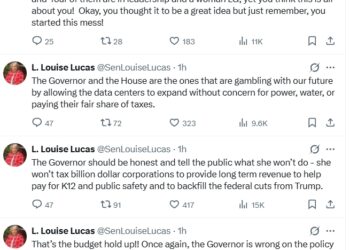
In a June special budget session, Virginia lawmakers will decide whether to continue giving data centers and some of the world’s wealthiest companies a $1.9 billion annual tax break—roughly 6 percent of the state’s annual budget—or end the subsidy and invest that revenue in Virginia communities. The issue is at the center of the state budget impasse: the Senate pushing to phase out the tax break and the House resisting.
At the same time, public pressure is mounting. Voters increasingly see the state’s favorable treatment of data centers as unfair: unchecked expansion is raising costs, straining resources, and harming communities. More people are questioning projects that shift costs onto taxpayers and ratepayers, fall short on job promises, strain water and energy supplies, damage air, water, and land, and depress home values. After all, who wants to live next to a data center or high-voltage transmission lines?
If these projects are truly beneficial to Virginians, why are these deals negotiated behind nondisclosure agreements? Why are they pushed through streamlined approval processes and granted exceptions to existing standards? And why do taxpayers and voters tolerate decisions made on their behalf that produce outcomes so clearly out of balance?
Virginians want good-paying jobs—especially in communities long overlooked by Richmond—to strengthen local tax bases and spur growth. But that should not mean prioritizing the profits of multinationals and regulated utilities over the well-being of ordinary Virginians. There are better paths to lasting job creation than bad deals that leave families with higher bills, strained water supplies, and communities scarred by industrial sites, transmission lines, and pollution.
Without reasonable intervention, rates will keep climbing—even though Virginia’s underlying electricity demand is essentially flat once data center load is removed. In other words, outside of the data center boom, Virginia is not experiencing the kind of demand growth that would justify massive statewide expansion of power generation and transmission.
Yet while Virginians are already paying more for everyday expenses due to Federal budget cuts and White House actions, they are also being asked to fund new power infrastructure they will barely use and that delivers little proportional benefit to the state or local communities. In effect, they are helping finance higher profit margins for the industries that gain the most from data center growth: big tech, utilities, fossil-fuel interests, and developers.
Consider Dominion Energy, a major beneficiary of Virginia’s data center boom. Recently, the State Corporation Commission (SCC), the independent agency that regulates investor-owned utilities, approved a large gas “peaker” plant in Chesterfield that Dominion said was needed for reliability.
But reliability for whom? The answer is clear: reliability for data center expansion with ratepayers covering an estimated $1.47 billion in costs.
Rather than scrutinizing the concentrated demand straining the grid—overwhelmingly tied to data centers—and requiring stronger mitigation from the largest new users, regulators accepted that justification and approved the project. For utilities, the incentive is straightforward: when more infrastructure is built, construction costs are passed on to ratepayers and the utility earns a guaranteed return.
Now, Dominion is moving ahead with what has been described as a multi-billion-dollar project and the largest fossil-fuel plant in Virginia history: a 3,000-megawatt facility in Cumberland. The full price tag is not public, but Virginians are likely to pay a substantial share.
Greater reliance on fossil fuel leaves Virginia more exposed to global fuel price spikes and multinational energy markets that push prices up, not down. If affordability is the goal and cleaner energy a path, then Virginia must address the real forces behind this costly infrastructure buildout. These plants are a major step backward from the Virginia Clean Economy Act, and stronger oversight and new cost-lowering tools cannot offset the rising costs of new generation and transmission.
A new rate class for heavy users is not enough. Individual ratepayers should not have to fund infrastructure for privately owned data centers, and neighboring communities should not have to absorb the harms of air and water pollution, falling property values, and damage to places like the James River’s Dutch Gap Conservation Area.
As Virginians and voters, we can demand a fair deal—one in which data centers pay their fair share and data centers and utilities are not allowed to harm and pollute Virginia communities:
- Tell your legislators to end massive data center tax breaks – Take Action
- Urge your legislators to stop polluting Virginia communities –Take Action
Virginia should attract investment—but on terms that are fair, balanced, responsible, and accountable to Virginians and their communities.