Video, Statements: VA House, Senate Democrats Release Budgets for FY 2026-2028
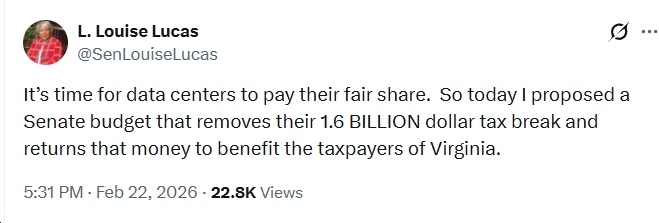
Proposed Senate budget "Reins in a data center tax exemption projected to cost $1.54M/year that now forgoes $1.6B annually — redirecting over $1 billion into education, health care, housing, transit, and direct tax relief"
See below for press releases rom the VA Senate Democrats and the VA House Democratic Caucus on their proposed budgets for FY 2026-2028. Also, I’ve posted video of the Senate Finance and Appropriations, as well as the House Appropriations Committee, meetings held today.
SENATE DEMOCRATS UNVEIL BUDGET TO DELIVER AFFORDABILITY FOR VIRGINIA FAMILIES
Reins in a data center tax exemption projected to cost $1.54M/year that now forgoes $1.6B annually — redirecting over $1 billion into education, health care, housing, transit, and direct tax relief
RICHMOND, Va. — The Senate Democratic Caucus today released proposed amendments to Senate Bill 30, a biennial budget funded in significant part by allowing a runaway data center sales tax exemption to expire — one originally projected to cost just $1.54 million per year that now forgoes $1.6 billion in annual revenue, a more than 100,000 percent increase from the original forecast. The budget delivers a $499 million tax rebate ($100 single/$200 joint filers), raises the standard deduction, protects Medicaid, funds 3 percent teacher salary increases, invests $50 million in affordable housing, and provides $205.7 million for Metro over the biennium.
“Affordability and opportunity are inseparable. For years, Virginia has been writing a blank check to some of the world’s most valuable corporations — a check that started at $1.54 million and has grown to $1.6 billion — while families struggle to pay for childcare, health insurance, and a place to live. This budget takes more than a billion dollars that had been flowing out of our treasury unchecked and invests it in the education, health care, and opportunity that every Virginian deserves. That is what it means to govern responsibly.” – Senate President Pro Tempore and Finance Committee Chair L. Louise Lucas (D-Portsmouth)
“When legislators created the data center sales tax exemption in 2008, they were told it would cost up to $1.54 million a year — a modest price for bringing jobs to distressed communities. Nobody imagined it would one day cost over a thousand times that. Today Virginia forgoes $1.6 billion every single year, a figure that grew 118 percent in a single year. At some point, a program never designed to be a blank check for some of the world’s most profitable corporations becomes exactly that. We are proposing the expiration of this exemption and putting that money to work for the people of Virginia.” –Senate Majority Leader Scott A. Surovell (D-Fairfax)
“Washington is threatening to take health coverage away from hundreds of thousands of Virginians through Medicaid cuts and the expiration of federal premium tax credits. This budget draws a clear line: Virginia will not abandon its families. We are protecting Medicaid, shoring up the individual insurance market, and investing $128.6 million in public health — and we are funding it by recapturing a data center tax exemption that grew from a $1.54 million fiscal note to a $1.6 billion annual giveaway, rather than cutting services or asking working families to pay more.” – Senator R. Creigh Deeds (D-Charlottesville), Chair, HHR Subcommittee, Senate Finance and Appropriations Committee
“The original data center tax break was designed to help struggling communities attract jobs, and it cost $1.54 million a year. What it became — a $1.6 billion annual subsidy flowing overwhelmingly to the most a luent part of our state and to some of the wealthiest corporations in the world — was never the intent. We are recapturing that runaway giveaway and putting it to work for the people of Virginia: in their schools, their doctors’ o ices, their transit systems, and their pocketbooks.” – Senate Democratic Caucus Chairman Mamie E. Locke (D-Hampton)
DATA CENTER EXEMPTION: A PROJECTION GONE OFF THE RAILS
$1.54M — Annual loss projected in original 2008 fiscal impact statement
$2.8M — Projected loss under 2010 statewide expansion (future years deemed “unknown”)
$685M — Actual revenue lost, FY 2023
$1.02B — Actual revenue lost, FY 2024 (+49% year-over-year)
$1.6B — Actual revenue lost, FY 2025 (+118% year-over-year)
100,000%+ — Increase from original projection to current reality
81% — Share of all state economic development incentive spending (FY 2024)
$1.01B+ — General fund revenue recaptured over the biennium by allowing exemption to expire
Sources: Virginia 2025 ACFR; JLARC (2025); Good Jobs First; Cardinal News
###
The Virginia Senate Democratic Caucus represents the 21 Democratic members of the Virginia State Senate.
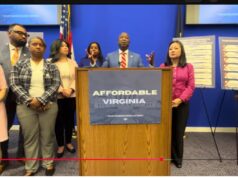
House Democrats Release Budget to Build an Affordable Virginia
Richmond, VA — Today, House Democrats released their proposed biennial budget for Fiscal Years 2026–2028 — a responsible, balanced plan focused on responding to federal cuts, lowering costs, strengthening healthcare, expanding childcare, and supporting working families across Virginia.
House Appropriations Chair Torian delivered the following remarks:
“Over the past year, federal actions have created real gaps – gaps in healthcare funding, in workforce programs, in education support, and in the safety nets that families rely on. Virginians should not be collateral damage of decisions made in Washington. This budget backfills those holes, not out of politics, but out of prudence […]
“But this budget is not just about filling gaps. At its core, this budget is about affordability – and about whether Virginia is doing everything it can to help families not just survive, but build stable, secure lives. It is about confronting the affordability crisis that touches nearly every household in Virginia […]
“Governing is not about choosing between compassion and responsibility – it is about delivering both.”
House Democrats’ Affordable Virginia Budget
Lowering Housing Costs and Expanding Supply
$187.5 million for the Virginia Housing Trust Fund
$25 million to create a revolving loan fund for mixed-income housing
$17.6 million to support rapid rehousing efforts amid federal cuts
$17 million for eviction prevention assistance
Expanding Access to Quality, Affordable Childcare
$137.6 million increase in childcare subsidy funding — bringing total support to $577 million over the biennium; these slots serve families making up to 85% of the state median income
$25 million to establish a pilot program for private employers to provide childcare benefits to their employees
Protecting and Expanding Affordable Healthcare
Fully funds Medicaid and CHIP forecasts with a net $2.4 billion GF investment
$79.1 million in premium assistance for Virginians losing federal tax credits
$63.1 million to partially restore Medicaid and CHIP reductions
Fully restores prenatal and postpartum coverage for immigrant women
$45 million to protect core public health services
$10 million for Virginia’s free clinics
$11.1 million for sickle cell disease services
Supporting Working Families
Supports increase in minimum wage to $13.75/hour in 2027 and $15/hour in 2028
Strengthens and expands the Commonwealth’s paid sick leave policy for workers
$20 million to implement collective bargaining for state employees and home healthcare workers
Authorizes Treasury loan for Paid Family Medical Leave Program
$15.3 million to strengthen labor law enforcement
Other Major Investments Across the Commonwealth
Public Education
2% raises in each fiscal year for teachers and staff ($382.9 million)
$400.4 million in flexible funding for school divisions
$148.4 million to expand special education support
$347 million for school construction through casino revenue
Higher Education
Continued tuition moderation and affordability
Increased support for workforce credentials (18,000 additional credentials)
Expanded tuition assistance grants and targeted HBCU and HSI support
Public Safety & Veterans
$81.1 million for State Police for operational and administrative costs
$12 million to support Sexual Assault and Domestic Violence agencies
$10 million annually increase to expand the Safer Communities Program ($40 million over the biennium)
Federal Uncertainty Protection
$200 million deposit into a new Federal Unanticipated Contingency Fund
Employee Compensation
2% salary increases in each fiscal year for state and state-supported local employees
$323.5 million to stabilize the State Employee Health Insurance Fund
$235.1 million for employee bonuses signed into law earlier this year
Natural Resources & Infrastructure
Over $600 million for water quality and environmental improvements
$2 billion in capital investments focused primarily on improving existing facilities
The House of Delegates will vote on the reported budget bill on Thursday, February 26th.
*****************
Attorney General Jones Statement on Budgets Released by Virginia House and Senate
House and Senate Budgets Strengthen Office of the Attorney General, Address Long-Needed Compensation Challenges
Richmond, VA – Attorney General Jay Jones issued the following statement regarding the introduction of 2026-2028 biennial budgets by the Virginia House of Delegates and Senate of Virginia this afternoon:
“As the General Assembly advances the 2026–2028 biennial budget, the amendments increasing funding for the Office of the Attorney General reflect months of good-faith collaboration with legislative leadership and appropriators. I thank Chairman Torian and Chairwoman Lucas, along with the professional staff of the House Appropriations Committee and the Senate Finance and Appropriations Committee, for their diligence and partnership throughout this process.
The budgets released today increase capacity within our office and address long-standing compensation challenges for the hardworking attorneys who wake up every single day to serve the Commonwealth and our communities. Collectively, these investments will allow us to raise pay, hire new positions, and continue delivering real results for Virginians.
We look forward to continuing to work with legislative and executive leadership to advance these priorities and strengthen the Office of the Attorney General to work diligently to face our collective challenges and solve problems for Virginians through the completion of the budget process.”
###
Freedom Virginia Applauds General Assembly Budget Amendments That Will Prioritize the Middle-Class
RICHMOND, Va. — Today, the Virginia Senate Finance and Appropriations and House Appropriations Committees each announced their respective budget amendments to the 2026-2028 biennial budget. In response, Freedom Virginia Co-Executive Director Ryan O’Toole released the following statement:
“Throughout this entire session, we’ve advocated for a Virginia You Can Afford, and urged the General Assembly to prioritize middle-class affordability and tax cuts over corporate interests. We’re thrilled to see today’s budget amendments, and while there is work to be done over the next three weeks to resolve differences between the two chambers and create the strongest possible conference budget, this is a clear statement that the legislature is heeding the call to ease the burden on hardworking people and make life more affordable.
“We’re especially supportive of the Senate’s bold action to reform the sales and use tax exemption for data centers. Given the scale of the affordability crisis Virginians are experiencing, we urge all conferees to adopt this measure, and other similar measures, that fund a Virginia we can all afford by closing loopholes on the ultra-rich and big corporations. On that note, we do continue to oppose the legalization of slot machine-like skill games and hope that conferees will decide to fund critical affordability measures through fairer forms of revenue generation that don’t prey on hardworking people.”
Below is a summary of major amendments reflected in the House and Senate budgets that advance the “Virginia You Can Afford” agenda:
Health Care:
The House and Senate budgets each fully fund the Affordable Medicine Act, so hundreds of thousands of Virginians not on Medicare will benefit from the savings of Medicare-negotiated prices;
The House and Senate budgets each provide funding for hundreds of thousands of Virginians in the health insurance marketplace to afford health insurance through premium assistance, fixing the problem left by Congressional Republicans
Child Care:
The House and Senate budgets each provide funding to establish an innovative Employee Child Care Assistance Program to ensure more affordable child care options that help more Virginians join, and stay in, the workforce;
The House budget provides significant increases in support for the Child Care Subsidy Program, which would enable nearly 12,000 Virginians to afford quality child care so they can get a job and provide for their families;
The Senate budget provides critical support to eliminate the fiscal cliff that abruptly disqualifies hardworking parents from child care subsidies when their income grows, which currently disincentivizes career advancement and harms children and parents alike
Housing:
The House and Senate budgets each provide landmark support to advance the development and construction of tens of thousands of affordable homes
Jobs and Workforce:
The House budget provides authorization for a treasury loan to begin implementation of Virginia’s Paid Family and Medical Leave insurance program, which will enable 3.4 million Virginians to reject the choice between taking care of themselves or a loved one or earning a paycheck
Consumer Protection:
The House budget provides funding to establish one unified Virginia Gaming Commission to streamline oversight of Virginia’s legalized gaming options, ensuring that the Commonwealth prioritizes consumer protection and affordability over corporate handouts
Middle-Class Tax Cuts:
The Senate budget ensures that hardworking Virginians can keep more of what they earn by increasing the standard deduction to $9,200 per filer ($18,400 for joint filers) and extending the sunset on the standard deduction and earned income tax credit
###
Freedom Virginia is a nonpartisan 501(c)4 organization committed to building a Commonwealth where all Virginia families have the freedom to thrive. Freedom Virginia advances economic security policies through grassroots activism, voter engagement and legislative advocacy. Our efforts began in 2020 and since then we’ve pushed for a more economically secure Virginia by sharing real stories about Virginians’ lack of access to affordable healthcare, education, energy, and the need for policies that foster more safety for families. Visit our website at freedomva.org to learn more.
Paid Family and Medical Leave Funded in Virginia House and Senate Proposed Budgets
Both chambers include funding necessary to establish statewide PFML program
RICHMOND, Va. — Both the proposed Virginia House and Senate budgets, which were released today, provide for funding to establish a statewide Paid Family and Medical Leave program.
Senate Bill 2, patroned by Senator Jennifer Boysko (D-Fairfax) and House Bill 1207, patroned by Delegate Briana Sewell (D-Prince William) would allow a worker to take up to 12 weeks off at up to 80% of their pay to take care of themselves or a loved one in the event of a serious illness or injury, or to welcome a new baby.
Currently, 76% of Virginia workers lack access to Paid Family and Medical Leave. Without access to this insurance program, working parents are forced to choose between taking care of a loved one and losing pay. Additionally, research shows that ensuring families can access Paid Family and Medical Leave not only reduces poverty but also improves health outcomes.
Right now, parents who take unpaid leave for four weeks lose an average of $3,700 in income.
“We’re thrilled to see this program accounted for in the state budget,” said Tara Gibson, Virginia spokeswoman for Americans for Healthy Families. “Families across Virginia deserve the security of knowing that in the event of a serious illness or injury, they will still have income coming in the door to pay the bills. We’re grateful to our champions, Senator Boysko and Delegate Sewell, for bringing us one step closer to an economy that is working for, rather than against, hardworking Virginians.”
“No one chooses to get sick, but how we respond to sickness as a society is a choice,” said LaChae Kelly-Taliaferro, a grocery store from Carrollton. “Like every other person, I have always worked hard. Seven years ago, I was teaching pre-K at a daycare when my late husband was diagnosed with congestive heart failure. He had to stop working, and I was forced to get a second job. Unfortunately, I did not have access to Paid Family and Medical Leave, even though that program would have helped me immensely when my husband had to get a heart transplant. Thank you to the House and Senate for funding this legislation, which I look forward to becoming law.”
A January poll from Christopher Newport’s Wason Center showed that 84% of Virginia voters — including 97% of Democrats, 79% of Independents and 70% of Republicans – support or strongly support a law to require a Paid Family and Medical Leave program that would allow workers to receive partial pay for up to 12 weeks to care for themselves or a loved one in the event of a serious illness, or to welcome a new baby. While paid sick days would ensure workers can stay home for short-term illnesses, a Paid Family and Medical Leave program would provide a safety net for serious life events.
Next steps:
HB 1207 is currently being considered by the Senate, and SB 2 is currently being considered by the House.
###
From The Commonwealth Institute for Fiscal Analysis:
Virginia Money Committees Reject Corporate Tax Breaks, Restore Health Care Funding, and Boost School Funding; Senate Requires Data Centers Pay Their Fair Share
Additional work is needed to make even more transformative investments in long-underfunded public services
Today, Ashley Kenneth, President and CEO of The Commonwealth Institute for Fiscal Analysis (TCI), released the following statement on the budget proposals presented by the House Appropriations Committee and Senate Finance and Appropriations Committee:
“The House and Senate money committees take a step toward building a budget that makes life more affordable for Virginia families by protecting health care, boosting education funding, and more. After Governor Youngkin proposed to cut health care funding, prioritize corporate tax cuts, and left out funding for Virginia’s new SNAP cost-share requirement, lawmakers have begun to correct course — and in some areas, move Virginia forward.
“Undoing harmful cuts, making select investments, and closing loopholes that drain shared resources — like the Senate’s decision to end the data center tax exemption — is a strong starting point. Building a more affordable and equitable Virginia will continue to require bold choices and long-term, transformative commitments.
On Tax Policy
“Both chambers largely rejected Youngkin’s proposal to double down on federal tax breaks for corporations and exempt taxes on tips and overtime for select workers.
“The Senate takes critical action to ensure data centers pay their fair share in taxes, after the latest data shows that the multi-billion dollar industry was exempted from $1.6 billion in state sales and use taxes in fiscal year 2025. The Senate also proposes to do another round of tax rebates. As details emerge, we hope to see that these rebates are refundable, so that a millionaire doesn’t benefit while low-income families who need it most are left behind.
“There’s a continued need to flip our upside-down tax code, which currently allows a millionaire to pay the same top state income tax rate as our teachers. To ease the burden on families, we will continue to advocate for a Fair Share Tax, so we have the resources to invest in family-focused tax credits, such as a state-level child tax credit, and other programs that lower the cost of child care, food, and more.
On Public Education
“Both the House and Senate make some progress on support for students facing higher barriers while also providing some resources for the work of the Joint Subcommittee studying the transformation of the school funding formula to make it more transparent and, hopefully, more adequate and equitable.
“The House and Senate both boost the add-on for students with disabilities, which was created last year to address the state’s severe underfunding of special education services. The House invests an additional $148.4 million over the biennium, more than doubling it, while the Senate makes a more modest contribution.
“Each chamber also increases support for students from low-income families, with the House including a one-time boost of $100 million within a larger $400 million in one-time flexible funding in the upcoming FY2027 school year, while the Senate provides $118.7 million over the upcoming two years through a combination of general and nongeneral funds.
On Health Care
“The House and Senate budgets respond to federal actions that are creating cost and administrative barriers to health coverage and food assistance. Both include funding — $79.1 million in the House and $200 million in the Senate — to offset rising ACA marketplace premiums since enhanced federal subsidies expired. They also set aside funding to cover likely SNAP program benefit costs resulting from new federal provisions, funding that Governor Youngkin failed to include.
“Both chambers restore $29.5 million and continued access to the FAMIS Prenatal program, which was completely eliminated in Gov. Youngkin’s proposed budget. This program provides prenatal, labor and delivery, and sixty days postpartum coverage to certain immigrant groups and served more than 11,300 pregnant people in 2025 alone.
“Finally, we are happy to see that both budgets increase support for Virginia’s Free and Charitable Clinics by $10 million over the next two years. These facilities provide essential care to people with no or inadequate coverage and are expected to face increased demand as federal changes push people out of coverage.
On Economic Opportunity
“Both the House and Senate make some progress toward child care affordability through a public-private partnership model. The House invests an initial $25 million in this program and; the Senate provides $50 million.
“Additionally, both budgets fund their commitment to get Virginia to a $15 minimum wage, fund the infrastructure for statewide collective bargaining, support paid sick leave standards, and establish the first comprehensive Paid Family and Medical Leave program in the South.
On Criminal Legal System
“Both the House and the Senate invest in a more fair criminal legal system. This includes funding to set the statute of limitations for court debts to ten years and increase the start of court debt collections to 180 days. The House also included funding to ensure people who work while they are incarcerated are paid at a more meaningful rate to go towards reducing their court debt. They also included funding for a new opt-out court date reminder system.
“Both chambers also make investments to improve community safety by addressing the root causes of violence. The House shifts $20 million from Operation Ceasefire to expand the Safer Communities program to Danville, Hampton, Hopewell, and Newport News, and the Senate invests $25 million for the Office of Safer Communities.
Looking Ahead
“Over the coming days, TCI will share our side-by-side analysis to highlight the specific differences between the budgets proposed by former Governor Youngkin and the House and Senate money committees.
“We call on lawmakers to advance the strongest choices — including to ensure data centers pay their fair share of taxes — so that, together, we can invest in affordability and create opportunities for Virginia families to thrive.”
###
About The Commonwealth Institute
The Commonwealth Institute for Fiscal Analysis advances racial and economic justice in Virginia by advocating for public policies that are designed in partnership with people most impacted, and shaped by credible, accessible fiscal and policy research.