by Ken Sandler, Ph.D.
This Tuesday, March 17th, the Fairfax County Board of Supervisors will hold a public hearing to consider the sale of 41.7 acres of county property to a data center developer. The following is testimony on this matter that I’m providing to the Board, as a county resident. I encourage others to make their voices heard on this issue as well.
Dear Fairfax County Supervisors:
I am writing you in opposition to the proposed sale of a portion of the Stonecroft property for development of a data center. I am concerned about both the undemocratic process the Board has employed and the impact a new data center would have on the county.
Topics I will cover below include:
- The secrecy of this process;
- The lack of urgency for this deal to be rushed through; and
- The impacts a new data center would have on local air quality, county energy and climate goals and affordability.
An Undemocratic, Confidential Process
Let’s review the timeline for this proposed sale, based on documents released last month. On June 20th of last year, the County signed a letter of intent with the purchaser to pursue this transaction. The letter included a confidentiality clause stating:
“Each party shall keep the terms of this letter, and any non-public information exchanged in connection with this letter, confidential except for disclosures (1) to such party’s affiliates and its and their advisors…”
The clause ends with consideration of the possibility
“that Seller receives a request pursuant to the Virginia Freedom of Information Act (‘Virginia FOIA’) to disclose any information in connection with this letter, including, but not limited to, the existence of this letter,” in which case, “Seller will use its best efforts to notify Buyer at least two (2) business days before the deadline for Seller’s response and provide Buyer with an opportunity to explain the basis for withholding the requested information under Virginia FOIA, and Seller will reasonably consider such assertion within applicable law.”
In accord with these terms, the County kept this letter and these negotiations hidden from county residents for eight months until February 11-12, 2026, when it announced the proposed deal and the planned March 17th hearing on its website and in a Facebook post. However, most of the documents relating to this deal were not posted until very recently, after a coalition of five local environmental groups sent a letter requesting such information under the Virginia Freedom of Information Act (FOIA).
In keeping its confidentiality promises to this data center developer, the County fell short in its commitment to “Inclusive Community Engagement”, one of the four Key Drivers of the Fairfax County Strategic Plan. As the FOIA office stated in response to the environmental group letter, while negotiating with the seller, SCG Global Holdings, the County also reached out to other developers about their potential interest in the site as well.
So, this deal was kept secret not from the interested business community, or even potential competitors, but only from the residents of the county – i.e., confidentiality was imposed not for business reasons but for the purpose of avoiding democratic accountability.
I appreciate the one month of transparency and opportunity to comment that we have been granted. However, we all know that once transactions like this one have been underway for months, the momentum favors their approval, as both sides have become committed and won’t want to back down.
But the Board needs to remember that you are elected officials representing the citizens of this County, and our interests must come first.
If this project is approved, the door of transparency that opened last month will most likely slam shut again, as data centers in an industrial site like this one are generally considered “by-right” developments not requiring public hearings or processes. So, this is very likely our only opportunity to have any influence on this proposed sale – unless the Board slows down this process to allow for genuinely “inclusive engagement.”
Is this Sale Urgent?
The county justifies the sale of this property on its website by noting: “Proceeds of the sale will help fund modern police training facilities collocated with a new Criminal Justice Academy, which is funded by the county’s Capital Improvement Program. By consolidating and upgrading training operations, the county can improve conditions for law enforcement personnel while diversifying revenue sources.”
To unpack this language, as FFXNow reports, based on materials from the February 17th Board meeting, the new Criminal Justice Academy is already fully funded with $88 million from the Capital Improvement Program (CIP), and upgrades for other parts of the campus are also already funded in the CIP. Some of the $166.8 million from the sale would be applied to help upgrade other facilities on the campus but it is not clear how much is needed for those purposes.
So, while I support high quality training facilities for our law enforcement officers, the main project to upgrade those facilities is already fully funded, and it is not clear how much this proposed sale would add to related campus projects or else be directed to other uses. Thus, allowing more time for public input and potential consideration of other uses for the land in question should not be seen as a major barrier to the upgrade of police training facilities.
Energy, Climate, Pollution and Affordability Impacts
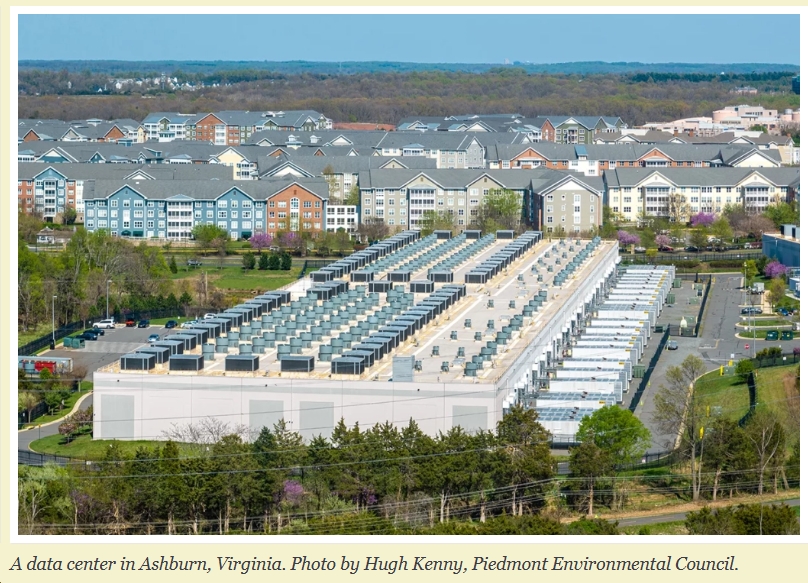
The county has defended the proposed sale with the argument that the data center would be in an industrial area next to Dulles airport rather than adjacent to a residential area, mitigating such concerns as noise and the deadening of community spaces. But the environmental, energy and climate impacts of data center would not be mitigated by the location of this site. Although many aspects of data center construction and operation are not under county control, the Board cannot simply wash its hands of its responsibilities to protect the interests of residents and ratepayers – including the business community.
To be clear, 41.7 acres of land is enough to build a large data center that would use enormous amounts of energy. We can only guess how much energy that might be, but it is the Board’s responsibility to consider these issues in order to represent and protect the interests of county residents.
Here is some very rough math. Free-standing data centers being built in Virginia today have a peak power need of 20-50 MW on the lowest end. There are data centers being built today to consume a maximum of 100 MW to over 1000 MW, but I’m going to go with very conservative estimates to make the point.
So, conservatively assume the data center or data centers to be built on this site would use only 80% of their maximum capacity in a year. For 20-50 MW capacity, that would equate to between 480 billion – 1.5 trillion BTU in a year. For perspective, the entire county government used nearly 1.2 trillion BTU in 2025.
Think of the implications of this. How severely will ratepayers be saddled with the price increases from this huge increase in electricity demand and the grid infrastructure that would need to be built or expanded to accommodate it? The argument that this is a good deal for county residents may fall flat if the rise in energy costs caused by this deal have a greater economic impact than the funds to be gained from the sale.
Fairfax County is already struggling to meet the Community-wide Energy and Climate Action Plan (CECAP) goals to which it has committed – a solemn promise to the citizens of the county and a legacy to leave our children and grandchildren. How will we even come close to meeting those goals if we massively increase the county’s energy burden like this? And no, excluding data center impacts from county calculations does not solve the problem!
In response to the question “Has or will the county require the new data centers to procure new non-carbon emitting sources of energy for their use?”, submitted in the letter from five local environmental groups, the county responded only: “Virginia law does not currently require non-carbon emitting sources of energy”. So, as with FOIA and transparency, the Board seems committed to meeting only its minimum legal requirements rather than striving to do better for the people of Fairfax County.
In addition to the profound environmental impacts if this data center’s massive energy needs were to be met with dirty fossil fuel sources, there are also direct impacts on local air quality. A recent study from Virginia Commonwealth University found that air pollution from diesel generators used by data centers sometimes even exceeds power plant emissions.
A Board that was serious about meeting its environmental commitments would explore opportunities to sell this land parcel to renewable energy providers. They may not offer as much cash as data center developers, but the payoff for local health, environment, energy affordability, community pride and county reputation would be enormous.
I urge the Board to slow down, gather more community input and consider what would be the best decision for the people and the future of Fairfax County. Data centers are one of the most controversial issues in local politics today, an issue about which you do not want to be caught on the losing side. Thank you again for your time and consideration.