| Getting your Trinity Audio player ready... |
By Karen Kinard
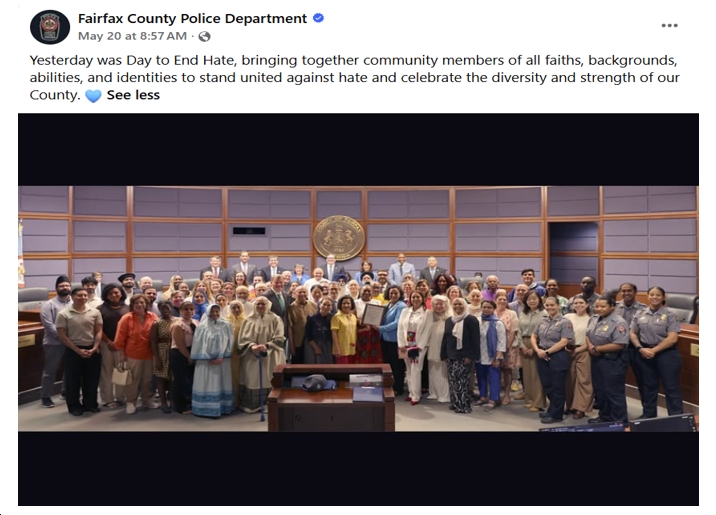
In May 2026, the Fairfax County Police posted a wonderful photo showing people working together in community and celebrating diversity as a strength. It reflects a vision that rejects hate and is a reminder that we can build a thriving democracy that respects every person and the value of our differences. It made me happy.
The photo below, however, shows that some individuals in Virginia advocate hate and division, which I find both worrying and sad.
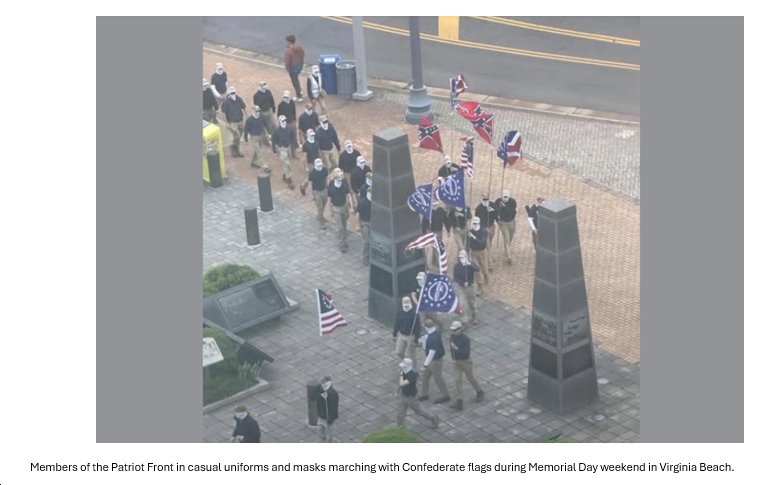
Members of the Patriot Front in casual uniforms and masks marching with Confederate flags during Memorial Day weekend in Virginia Beach.
These individuals claimed to be members of the Patriot Front, a white supremacist group, protesting in Virginia Beach over Memorial Day weekend. The Patriot Front split from the Neo-Nazi Vanguard America organization after the 2017 Unite the Right rally in Charlottesville, Virginia. Key quotes from their materials: “Membership within the American nation is inherited through blood, not ink.” “Nationhood cannot be bestowed upon those who are not of the founding stock of our people.” They frame their ancestors as having “conquered” America exclusively for their descendants.
Groups like Patriot Front are exactly the kind of threat that civil rights organizations like the Southern Poverty Law Center (SPLC) have long worked to expose and confront. Yet instead of supporting that work, the current administration is turning its fire on the very groups defending voting rights, civil liberties, and equal justice.
Surviving the Upside-Down World of Civil Rights Under the Current Administration
The federal government has turned civil rights enforcement (which made the first picture possible) upside down by targeting organizations focused on defending justice for all and voting rights. Recently, the FBI raided the offices and homes of volunteers affiliated with voting rights groups in Ohio, and the Justice Department secured a grand jury indictment against the SPLC, even though legal experts have described the case as weak, politically driven, and deeply flawed.
These charges against the SPLC are another attack on voting rights and civil liberties and part of a broader effort to intimidate organizations on the front lines of defending democracy. They were preceded by April grand jury indictments in Montgomery, Alabama, claiming that the SPLC defrauded donors and banks by paying informants inside the hate groups it is known for monitoring and combating. According to Acting Attorney General Todd Blanche, “The SPLC is manufacturing racism to justify its existence.”
These claims run counter to the SPLC’s long record of monitoring hate groups like Patriot Front, supporting major civil rights cases, and working with law enforcement to expose and prevent extremist violence. As part of that work, SPLC used informants to infiltrate white supremacist organizations and gather information about planned violence and those involved in carrying it out.
As a long-time donor, I understand the SPLC has used informants who risk their lives by infiltrating dangerous organizations to help prevent violence. Protecting those informants requires maintaining their cover, not exposing them. I do not believe there has been any “mission reversal” by the organization that helped bankrupt the United Klans of America and partnered with the FBI (when the FBI had a real Civil Rights Division) to confront violent white supremacy groups and militias.
Republican-led investigations into the SPLC have distorted both the facts and the results of its informant program, suggesting that money paid to informants over eight years supported hate groups rather than funded intelligence gathering that helped expose threats such as the 2017 Unite the Right rally in Charlottesville. That claim ignores the role informants have played in helping law enforcement prevent violence and identify people for prosecution.
The current DOJ has repeatedly been found by courts to have lied and engaged in misconduct. The SPLC asked the court to require the release of grand jury transcripts, citing errors and misleading claims in the indictment and pointing to extensive evidence it had gathered about the risk of violence in Charlottesville. On June 4, the DOJ filed a superseding indictment to correct major flaws, then bumbled its case even more by sharing a draft with the press that disclosed protected grand jury information. Not surprisingly, the SPLC has filed a motion to dismiss all charges as vindictive prosecution.
A Mighty Protector
The SPLC has a strong record of defending civil rights and alerting law enforcement to potential violence. It helped create the civil litigation strategy used against participants in the Unite the Right rally in Charlottesville and likely influenced the legal approach that led to a D.C. church winning control of the “Proud Boys” trademark after its “Black Lives Matter” sign was destroyed.
The SPLC has also provided information that helped thwart a planned attack on a mosque in Las Vegas, blocked a neo-Nazi from obtaining security clearance at the Philadelphia Navy Yard, and warned federal law enforcement ahead of the Unite the Right rally about potentially armed participants. More broadly, it helped journalists, researchers, and law enforcement agencies track extremist groups, including by identifying the Boogaloo movement as an emerging anti-government threat well before Boogaloo–affiliated individuals killed a federal officer and sheriff’s deputy in 2020. Several protesters claiming Boogaloo ties also appeared in Richmond to oppose Virginia’s new stricter gun laws.
The Jim Jordan Show
Following the DOJ’s prosecution, Alabama’s attorney general opened an investigation into the SPLC. Further amplifying the attack, House Judiciary Committee Chair Jim Jordan held two performative hearings aimed at publicly undermining the SPLC‘s reputation. In those hearings, however, Ranking Member Jamie Raskin provided a succinct defense of the SPLC’s civil rights record and made clear the political purpose behind Jordan’s investigation.
Raskin first asked the simple question: Where are the donor complaints or civil lawsuits that usually accompany real fraud claims? He cited the numerous fraud complaints and lawsuits involving Trump University as an example of what actual public fraud allegations look like.
Raskin argued that this is part of the Trump administration’s broader efforts to “turn off the lights” on federal extremism monitoring by defunding and dismantling Department of Homeland Security and DOJ units that track hate groups. He emphasized that the SPLC has become even more essential because “the federal government has stopped doing its job” and framed the hearing as an effort to attack the watchdog instead of the extremists. Raskin strongly defended the SPLC while critics challenged the organization’s influence and credibility. Watch Raskin’s opening remarks on the false premise behind the DOJ case and Jordan’s hearings.
At the May 20 hearing, the Republican-led Judiciary Committee permitted only one Democrat witness: Maya Wiley, President and CEO of the Leadership Conference on Civil and Human Rights, a coalition of more than 240 organizations, including the SPLC, that was established in 1950. According to Wiley, “we are experiencing a coordinated attack on civil rights nonprofits that work to ensure voters can vote, children can learn history, and unions can protect workers.” She stated that the charges against the SPLC are the latest link in a troubling chain: “First, the Trump administration attacked law firms that provided pro bono services to civil rights and civil liberties groups, foundations that support civil rights work, and colleges and universities working to advance civil rights principles.”
The SPLC does not target religion. It opposes violence, dehumanizing rhetoric, and harmful falsehoods. The Republican witnesses wrongly portrayed the organization as attacking Christian groups because it placed certain anti-LBGTQ+ groups on its hate map for dehumanizing and making false claims about minority communities.
In response to claims that the SPLC targets religious organizations, interim President and CEO Bryan K. Fair told the committee on June 9 that the SPLC does not target groups based on religion. Instead, it tracks groups that use “vile or dehumanizing language against people for immutable characteristics” or that “spread anti-government conspiracy theories.”
Fair, a constitutional law professor, introduced families in the audience that the SPLC had successfully represented, including the parents of an autistic child denied admission to a school and a Jewish family who were harassed and threatened in their Colorado home. Their attendance underscored the real impact of SPLC’s civil rights work.
At the hearing, Republican committee members, including Rep. Ben Cline (VA-06), appeared to support the baseless claim that an SPLC informant somehow helped instigate the Unite the Right rally to raise money. SPLC donations have increased after incidents involving hate crimes and acts of extremist violence, not because the organization supports them, but because public alarm drives support for organizations working to expose hate, prevent violence, and hold perpetrators accountable. White supremacist events like the Unite the Right rally, the 2015 Charleston church massacre, the 2016 Pulse nightclub shooting, the 2018 Tree of Life synagogue attack, the 2019 El Paso anti-Latino shooting, and the murder of George Floyd all spurred widespread public outrage. Fair noted that the biggest spike in SPLC donations came after the election of Donald Trump in 2017.
Pursuing Hate on the Dark Web and in the Dark State
Republican committee members appeared surprised when Fair explained that the SPLC had ended its informant program because many of today’s major hate purveyors operate online and, increasingly, from within government agencies. The SPLC’s annual report offers more detail on the shift in focus.
Indeed, I observe daily threats to minorities, civil rights, and voting access often seem to come through official government statements and online rhetoric these days.
The SPLC is not perfect and has had leadership problems in the past, as have some of the groups that testified against it. But over more than 55 years, it has never lost a defamation case. In 2018, it settled one case and apologized to a man after wrongly labeling him as an Islamic extremist.
E Pluribus Unum
When I first started donating to the SPLC, one of the attractions was its preventive education program, Teaching Tolerance, now known as Learning for Justice. Here are some examples:
“When people are spoken about as less than human, it becomes easier to treat them with cruelty.”
“Hate is learned. When hateful ideas are repeated without challenge, they begin to feel normal.”
“Words can create climates of fear and exclusion long before any act of violence occurs.”
I still hope for more images (like the first photo) and public expressions of a diverse Virginia and nation living up to its democratic promise. I also hope the federal judge in Montgomery, Alabama, and any jury in the SPLC case will follow the law and the facts.
As Fair said in closing, after quoting Fannie Lou Hamer, “Nobody’s free, until everybody’s free, ” the “SPLC will continue its constitutionally protected work to ensure that everyone in this country is treated with dignity, free from discrimination, and with real liberty and opportunity to thrive. These promises of democracy are not self-executing. They require our collective vigilance. We will continue to defend them when they come under attack.”