| Getting your Trinity Audio player ready... |
Good news – looks like we’re going to have a budget after all. Phew! Now, need to check out the details…
STATEMENT FROM SENATE FINANCE APPROPRIATIONS CHAIR L. LOUISE LUCAS AND HOUSE APPROPRIATIONS CHAIR LUKE TORIAN ON REACHING A BUDGET AGREEMENT
RICHMOND, VA — Senate Finance Appropriations Chair L. Louise Lucas and House Appropriations Chair Luke Torian released the following statement after reaching agreement on a conference budget:
“This budget agreement reflects our shared commitment to making Virginia more affordable for families. At a time when too many households are feeling squeezed by rising costs and economic uncertainty, this conference report makes historic investments to lower costs, strengthen our schools, protect access to healthcare, expand economic opportunity, and maintain the Commonwealth’s strong fiscal foundation.
“We appreciate the hard work of the conferees, staff, and our colleagues in both chambers who helped make this agreement possible. We look forward to passing this conference report and sending it to Governor Spanberger’s desk.”
- From VA State Senator Danica Roem: “This amendment establishes a data center electricity consumption tax at the rate of $0.011/kWh of all electricity consumed at each data center per month. The consumption tax is estimated to generate $600M GF each year during the biennium.”
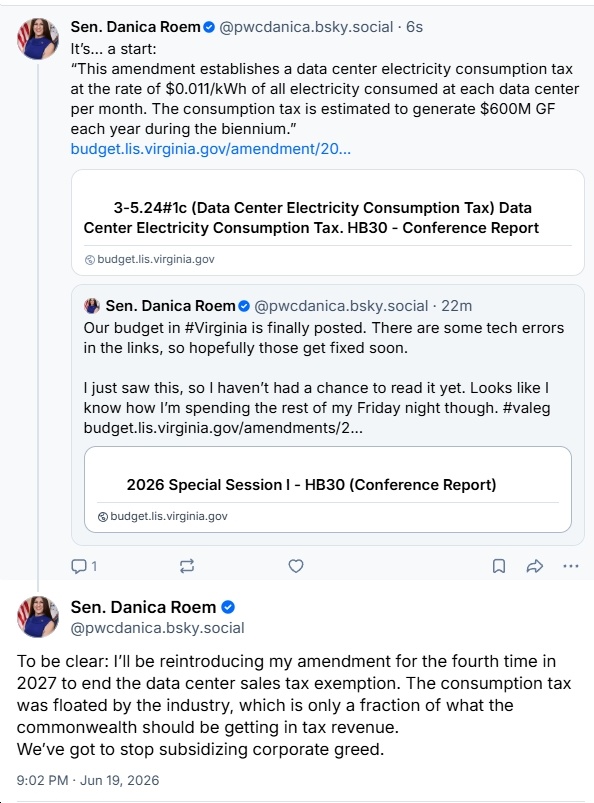
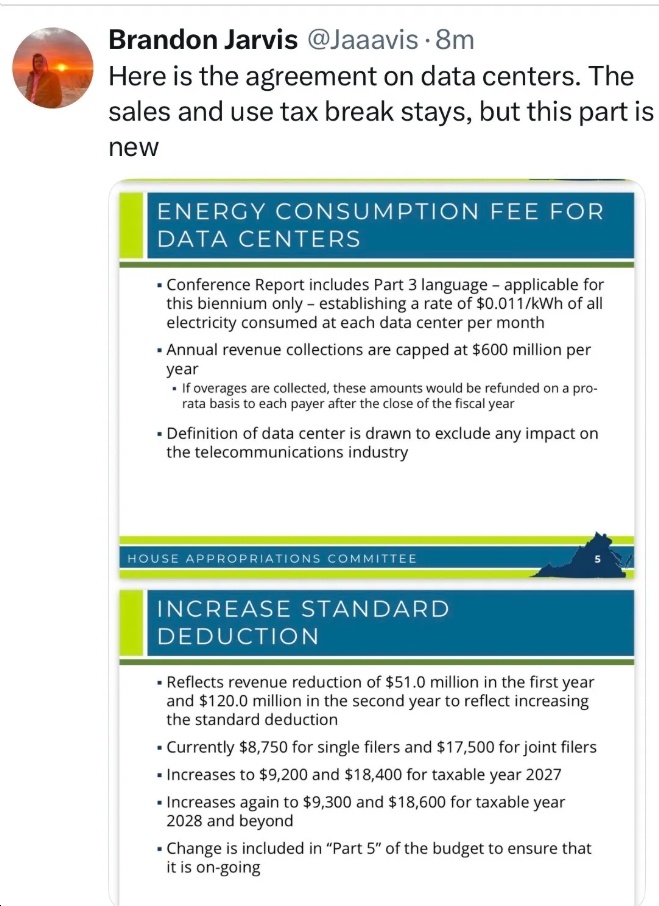
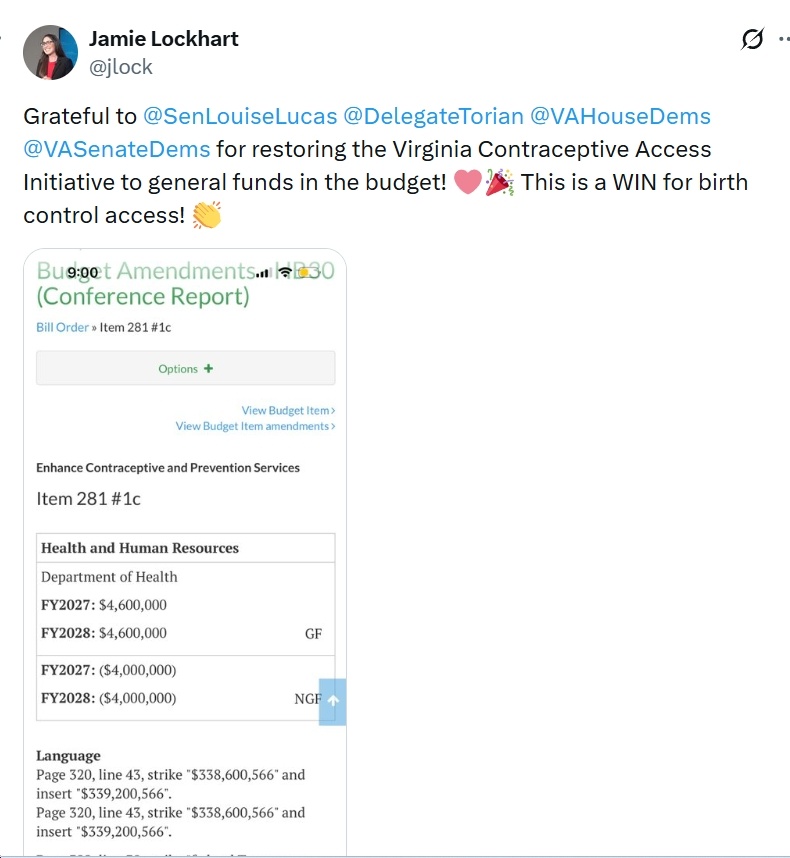
Excellent summary, by Kate for the People, of the Virginia budget
From kate_forthepeople:
“VIRGINIA BUDGET POST-MORTEM:
– 3.5%/4% pay increases for state employees/teachers
– Cannabis Market is a thing now
– Not as much capital projects because…
– The data center tax exemption lives – instead they will pay about $600M/year for the next 2 years based on electricity consumption. Net loss to the Commonwealth of about $1.3B/year.Delegates and Senators can still introduce amendments next week and some are still planning to push to sunset the tax exemption. Keep calling with your demands but know we’re in a *much* better than the nonsense we were looking at last weekend. Oh, and tell the Governor to just sign the damn thing when it gets to her desk.”
**********************************************
From the Commonwealth Institute for Fiscal Analysis:
Budget Compromise Takes Initial Action on Data Centers Paying Their Fair Share, Supporting Stronger Investments in Key Areas
Today, Ashley Kenneth, President and CEO of The Commonwealth Institute for Fiscal Analysis (TCI), released the following statement on the budget compromise that was announced yesterday:
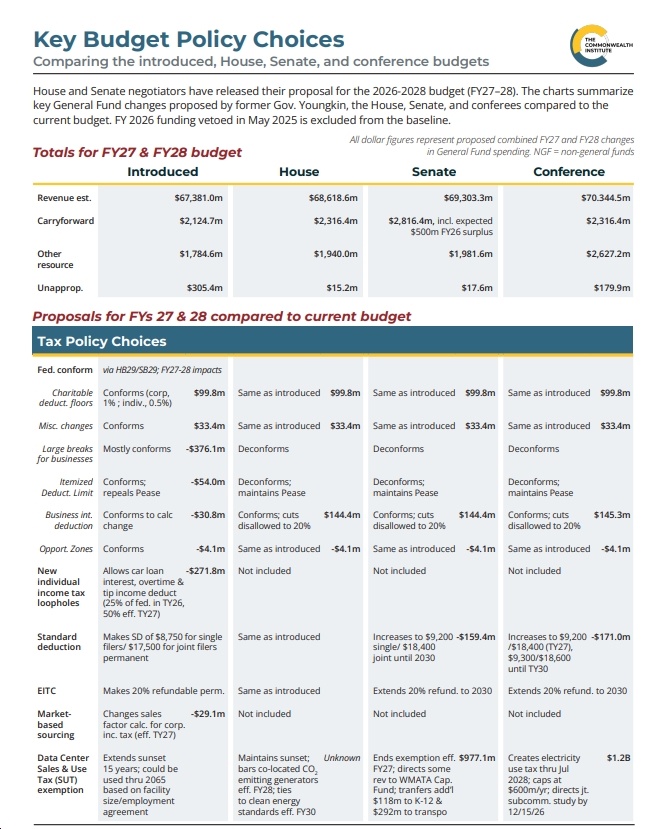
“TCI is thankful that budget conferees in the House of Delegates and Senate reached an agreement that asks some of the world’s most profitable corporations to pay more of their fair share. By asking the data center industry to contribute more fairly, conferees generated an estimated $1.2 billion through a temporary electricity consumption tax, enabling stronger investments in communities across Virginia. It is critical that the legislature still pass a permanent solution to hold the data center industry accountable. Virginia families deserve lasting investments, which require ongoing revenue.
“Virginia is the data center capital of the United States, and the commonwealth gave this rapidly growing industry nearly $2 billion in tax breaks last fiscal year through a sales and use tax exemption. That means families and most Virginia businesses are paying taxes that aren’t being applied to data centers. The budget agreement takes an important first step toward ensuring data centers pay more of their fair share, even as the current sales and use tax exemption remains untouched. TCI remains committed to ending this costly tax incentive, which began as a narrow incentive but has grown to more than 800 times the original cost estimate since it was first created.
“Through the budget agreement, lawmakers:
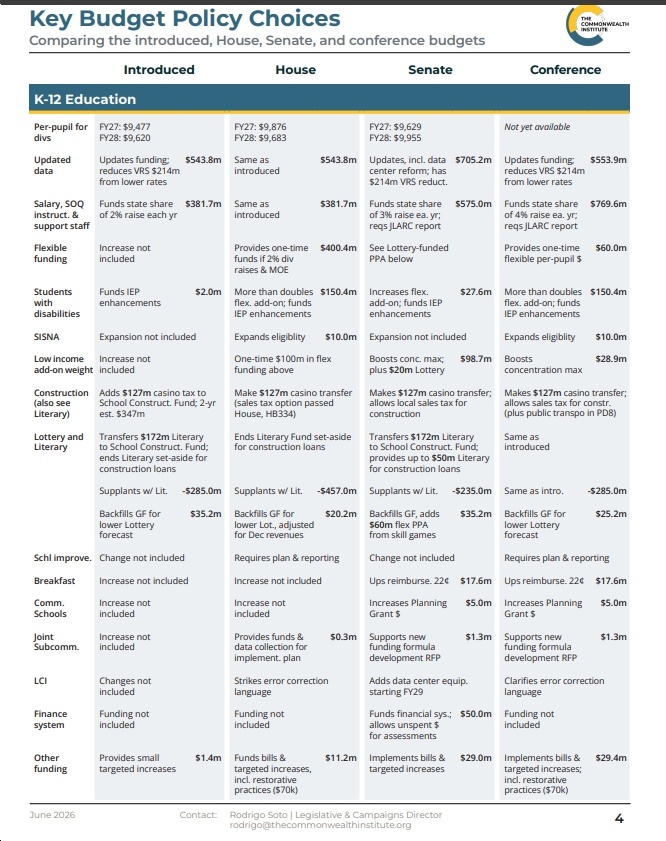
- Help schools better meet the needs of students by investing $148 million to more than double the flexible add-on for students with disabilities and $29 million for K-12 students from low-income families.
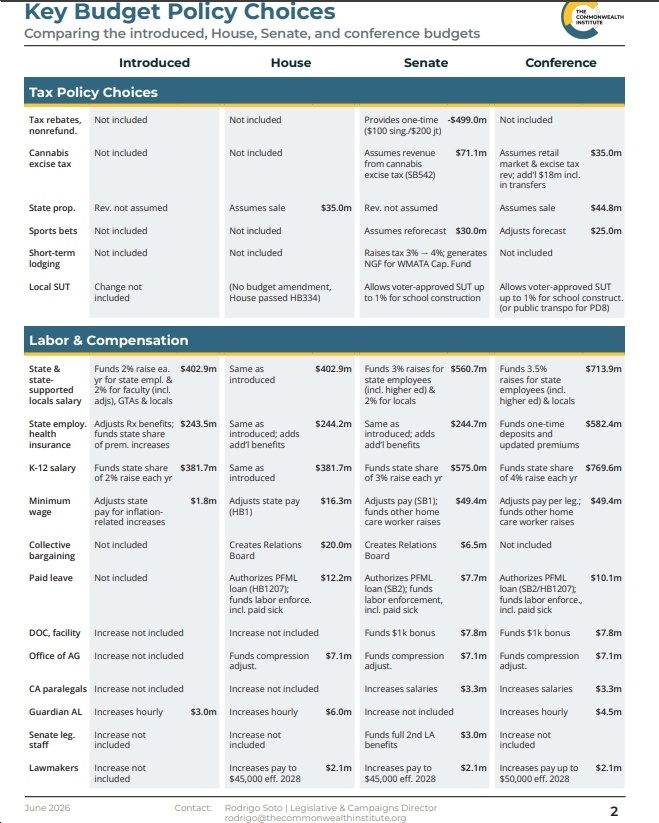
- Provide 3.5% raises each year for state employees and state-supported local employees ($311 million above Governor Youngkin’s introduced budget proposal) and the state share of 4% raises each year for teachers and school staff ($388 million above Governor Youngkin).
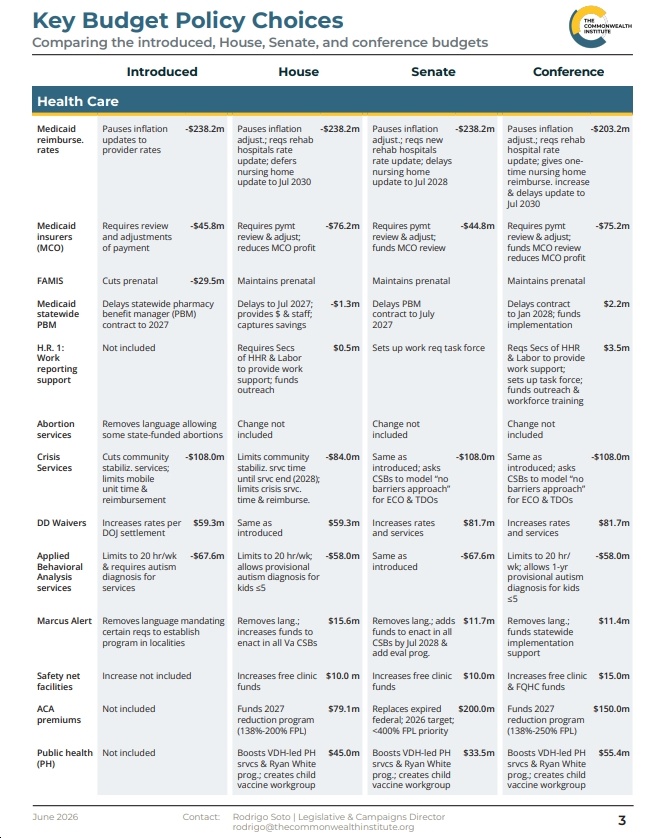
- Help lower ACA health insurance premiums in 2027 for people with low and moderate incomes (138% to 250% of the poverty line) by investing $150 million.
- Support access to care by investing $15 million in free clinics and Federally Qualified Health Centers to address increased demand.
- Preserve access to care during pregnancy by restoring FAMIS prenatal funding, which former Governor Youngkin proposed to eliminate.
- Protect access to food assistance by providing $135 million to account for new benefit cost shifts from the federal government to the state, which former Governor Youngkin did not include in his outgoing budget, and $3 million for work supports for people subject to new SNAP and Medicaid work reporting requirements.
- Help Virginia respond to federal funding uncertainty and changing Medicaid estimates, reduce future state health care costs, and monitor environmental conditions through $969 million in one-time spending, while investing an additional $577 million in general fund money for capital projects.
“This budget shows Virginia what is possible when lawmakers pair investments with new revenue sources. It will be crucial to continue holding the data center industry accountable when this temporary tax expires, rather than maintaining the status quo. As families continue to face rising costs, lawmakers should build on this progress by making additional changes to Virginia’s tax code to ensure that billionaires and profitable corporations pay their fair share of taxes. Doing so would allow lawmakers to make even stronger investments in housing, public education, health care, and other priorities in future budgets.
“Over the coming days, TCI will prepare side-by-side analysis of key areas in the budgets introduced by former Governor Youngkin, the House and Senate proposals released in February, and the final budget agreement.”
**********************
SUPER helpful, as always, by The Commonwealth Institute for Fiscal Analysis