| Getting your Trinity Audio player ready... |
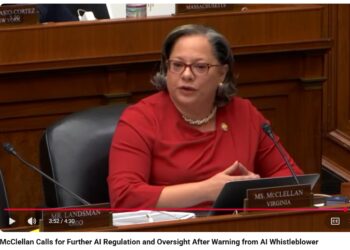
Great job by Rep. Jennifer McClellan (D-VA04), speaking out against Republicans’ attacks on the Voting Rights Act.
“Mr. Speaker, it is with great honor that I rise today to anchor this Congressional Black Caucus special order commemorating Juneteenth. Next week, the nation will pause to celebrate Juneteenth. And Juneteenth commemorates June 19th, 1865, when Union Major General Gordon Granger arrived in Galveston, Texas, and issued General Order number three, which finally freed more than 250,000 enslaved people in that state. For while the Emancipation Proclamation officially went into effect on July 1st, 1863, emancipating those enslaved in the rebelling states of the Confederacy, it took over two and a half years for the news to reach the westernmost Confederate state of Texas.
Broadly, Juneteenth marks Freedom Day, Jubilee Day, or Black Independence Day. Juneteenth is considered the longest-running African-American holiday. And while communities have celebrated the date since 1866, it was not officially signed into United States law as a federal holiday until June of 2021. Juneteenth symbolizes that unlike what we were taught in our school books, emancipation was not a moment, it was a movement. It was a movement that included active acts of resistance, rebellion, and self-liberation since Africans first, arrived on American soil in bondage.
As the first Black woman serving in this body from the Commonwealth of Virginia, I am all too familiar with this story. For the Commonwealth is both the birthplace of American democracy and the birthplace of the American slave trail. In July 1619, the House of Burgess met at Jamestown, bringing the concept of a representative democracy modeled, after the English Parliament that evolved into the modern-day bicameral legislator legislature. The House of Burgess continues to operate today as the Virginia House of Delegates. But a month later in August of 1619, a Dutch privateeer arrived at Point Comfort, Virginia, containing quote, “20 and odd Africans,” that John Ruff recorded were traded for provisions. They were originally captured by Portuguese slavers in West Central Africa, today Angola. And while slavery was not officially acknowledged in the laws of Virginia until 1661, there is no doubt that the first Africans aboard the White Lion were, treated as slaves, assigned heavy labor and treated as property by the colonial elite.
And I am quite cognizant that 250 years ago when Thomas Jefferson wrote the Declaration of Independence and said that all men are created equal and, endowed by their creator with the unalienable rights of life, liberty, and the pursuit of happiness, he did not, include the nearly half a million enslaved men, women, and children or indeed any women at all in the 13 colonies. He did not include those enslaved at his beloved Monticello, including his own children. And I’m quite clear that when James Madison wrote the Virginia plan that formed the foundation, for a government by, of we the people in order to form a more perfect union. He did not include the over 300 enslaved people who lived and labored at his Montpelier estate under three generations of his family. And the US Constitution adopted in considered enslaved individuals only three-fifths of a person for the purpose of how many people would serve in this body and for taxation. And the states that came together to create that more perfect union treated those people as property.
Since 1789, the story of America has been one of each generation trying to reconcile the ideals upon which we were, founded with the reality and making the ideals true for us all. And despite what some would have you believe, slavery literally tore this country apart. For as then Abraham Lincoln predicted in 1858, “A house divided against itself, cannot stand.” He said, “This government could not endure permanently half slave and half free.” And while he did not expect the Union to be dissolved, and he did not expect the house to fall, he expected it would cease to be divided. It took a war to do that. Once Abraham Lincoln was elected president and South Carolina became the first state to secede from the Union, its 1860 declaration of the immediate causes which induce and justify the secession of South Carolina explicitly and repeatedly stated that the preservation and expansion of slavery was the primary reason for leaving the Union. Mississippi, Georgia, and Texas likewise formally published declarations of causes that explicitly cited the preservation and expansion of slavery as their primary reason for seceding. And states like Alabama and Virginia, who passed shorter ordinances of secession while directly citing hostile attitudes of the federal government towards their quote domestic institutions and the election of a sectional party based on anti-slavery platforms, it was clear they were seceding because of slavery so that they could keep it.
After the war, Reconstruction sought to bind the country’s wounds and expand the promise of its founding to the informally enslaved. And Congress expanded suffrage to Black citizens, use federal troops to vigorously defend it in response to a violent backlash across the South. Congress passed three Reconstruction amendments designed to guarantee equal civil and legal rights to formerly enslaved Americans, And all three granted Congress the power to enforce their provisions through legislation. The 13th Amendment finally abolishing slavery in the United States. The 14th Amendment guaranteeing citizenship to all persons born or naturalized in the United States and prohibiting any state from abridging the privileges or immunities of citizenship. Applied due process of laws to the states. provided equal protection under the law and provided for the reduction of representation in the House of any state that disenfranchised any male citizen – and they meant male – over 21 years of age in federal elections except for participation in a rebellion or other crime. The 15th amendment prohibited the denial or a bridge bridge or a brbridgement of the right to vote on account of race, color or previous condition of servitude.
Yet even with these amendments, southern states resisted, resorting to paramilitary organizations like the Ku Klux Klan to terrorize Black citizens for daring to seek to vote, run for office, serve on juries, own property, open businesses, live in the wrong neighborhood, go to the wrong school, eventually drink from the wrong water fountain. In 1870 and 1871, Congress passed the Enforcement Acts to allow the federal government to intervene when states or individuals infringed upon the rights provided in the 14th and 15th amendment. And as a result, Black suffrage, Black men gained political power across the South. In 1870, Senator Hiram Rhodes Revels of Mississippi and Representative Joseph H. Rainey of South Carolina became the first Black members of Congress. A total of 22 Black men served in Congress between 1870 and 1901, including my predecessor, John Mercer Langston of Virginia’s fourth district in 1890.
The political, social, and economic power gained by Blacks across the South during Reconstruction then faced a violent backlash, as the KKK and other groups began a reign of terror that relied extensively on lynchings. And to resolve the deadlocked presidential election of 1876, the compromise of 1877 brought Reconstruction to an end. The federal government removed his truth from the South, and widespread violence, propaganda, and voter suppression began. In the final year of Reconstruction, the unraveling of federal protection and voting rights began when the Supreme Court issued two opinions that gutted the Enforcement Act…And once Democrats regained control and Reconstruction ended in the South, Congress lost interest in federal intervention in state disenfranchisement efforts.
And then the long arc towards moral justice began again. And when President Harry Truman integrated the army and when the civil rights movement began to gain ground, those southern Democrats fled the Democratic Party and became Republicans. Today we see a very similar backlash to the backlash to progress that came after Reconstruction. With the first court case, gutting the Voting Rights Act, the Shelby decision and now the Callais decision, we see a rollback of the federal government protecting voting rights. We see a weaponization of the very tools used to ensure that life, liberty, and the pursuit of happiness was open to all. Roll back the progress made in civil rights and equal, protection under the law. We see an administration that wants to tell one side of the story that I just told, that doesn’t want anything uncomfortable to be taught in our schools. That doesn’t want anything about slavery mentioned in our public spaces, in our museums, in our curriculum. That doesn’t want that backlash taught.
Juneteenth gives us two opportunities. One, to celebrate the extraordinary resilience of Black Americans who came here, through the Middle Passage in bondage, and today are at historic high numbers in political leadership and representation. But it also gives us an opportunity to acknowledge how we got here – the good, the bad, and the ugly – to recognize the pattern, to recognize the backlash to progress that always includes propaganda, whether it’s the lie of white supremacy or the lie of stolen elections. Violence, whether it’s racial terror lynchings or insurrectionists showing up trying to steal for the second in American history the results of an election they didn’t like. Or voter suppression like a modern-day poll tax that we see in the SAVE Act. We see the same backlash now.
But we as the Congressional Black Caucus are here to say we’re not going back. We will fight the backlash. We will continue the progress until when we say in our Pledge of Allegiance, liberty and, justice for all, it means all. We the people in order to form a more perfect union. As I mentioned, the history of our country is how ‘we the people’ includes everyone, is how to reconcile the ideals upon which this country was founded as articulated so beautifully by Thomas Jefferson with the reality upon which this country was founded. As we grapple with the fact that Thomas Jefferson, in writing that all men were created equal and endowed by their creator with the unalienable rights of life, liberty, and the pursuit of happiness did not even include in that sentiment the human beings who labored enslaved by him, treated as property, including his own children.
I think of our country as a family, the American people as a family. And like any family, you cannot heal from family trauma if you don’t talk about it, if you don’t acknowledge it, if you don’t acknowledge the pain of it, if you don’t forgive and move forward. And unfortunately in our country, too often when we get close to that moment, when we get close to that healing moment, when we get close to that ideal becoming true from everyone, there’s a backlash. And every time in American history that we have begun to address the impact of over years of slavery and Jim Crow on African-Americans, there’s a backlash. The first one was the backlash to Reconstruction.During Reconstruction, when formerly enslaved men gained the right to vote after gaining citizenship, after being promised equal protection under the law, after electing members of their community to Congress, over 22; after electing hundreds of their communities to state legislatures across the country, gaining social, political, and economic power, working together in some cases with white communities like the Readjuster Party in Virginia that worked together to create at the time what was considered with a small p the most progressive constitution Virginia ever had, where it finally promised for the first time every child in Virginia the right to a free public education. And the old power structure said we got to break that up.
And to break up that coalition, the backlash used three things: propaganda, the lie of white supremacy, the lie of the Lost Cause narrative, that began to ignore what was actually said in articles of succession and say, ‘well, no, the war was about, something else, wasn’t about slavery.” It began to use the lie of a Lost Cause narrative and iconography, that said we need to put Black people back in their place by putting these gigantic monuments in front of the courthouse that says justice for all except for you. And then when they didn’t get the message from, the propaganda said, ‘we’re going to use violence through racial terror lynching.’ And 6,500 people, Black people were murdered by white mobs through racial terror lynchings from 1865 through 1968. If you don’t get the message of the propaganda, we’re going to use violence, we’re going to use a mob that will start a race riot when people in Louisiana are trying to register to vote. And we’re going to use voter suppression. Because in a country in a government by, of and for the people, the government will reflect the perspective and therefore meet the needs of the people who participate. And if we can keep certain people from participating, we don’t have to meet their needs. And so whether it was the literacy test that my great-grandfather had to take in Alabama in 1901, the character requirement he had to meet by finding three white men to vouch for his character to register to vote. Whether it was the poll tax that my, father, my grandfather had to pay in Tennessee, or voter intimidation and threats, the voter suppression is always part of the backlash.
And we’re in that backlash now. But the difference is the people who lived through Jim Crow are dying off. And there is a concerted effort to keep their stories out of our schools, out of our public places, out of our museums through an executive order. And yet history is a funny thing. Those stories, just like through oral traditions that were handed down generation to generation, we will continue to tell these stories no matter how many executive orders are written, no matter how many orders the National Park Service is given to erase the names of people enslaved who worked at the president’s, house in Philadelphia. We will tell their story. We will work to continue to eliminate the impact of over years of slavery and Jim Crow, even though we have an administration that wants to dismantle the progress we made in doing so. Because that impact didn’t go away with the wave of a magic wand with the Civil Rights Act or the Voting Rights Act. And now that we see efforts to unwind it, we’re going to fight back.
I’ll close with this. I can’t help but think of John Lewis. We’re also going to come up on the anniversary of his passing. In his final words to us, John Lewis said, ‘democracy is not a state, it is an act, and each generation must do its part to build what we call the beloved community, a nation and world society at peace with itself.’ My parents, my grandparents, my great-grandparents fought for that beloved community, and they used the ballot to elect people that would help build that beloved community. And now that the Supreme Court that has basically said the medicine for the cancer of racism has worked, so let’s get rid of the medicine. We don’t need it anymore. But the cancer is still there. We’re going to fight back as the Congressional Black Caucus. We will not let our voices be silenced. We will not let our history be erased. We will not let our votes be suppressed. We will continue to fight until every American has the right, unencumbered by this government, to life, liberty, and the pursuit of happiness. And when we say in the pledge, ‘liberty and justice for all’, it finally becomes true.”