With just 47 days until early voting starts on September 19, and just 93 days until the election on November 4, the public polling so far has Abigail Spanberger (D) leading Winsome Earle-Sears (R) by something like 12 points (VCU), 10 points (Wick Insights), 17 points (Roanoke College), and 3 points (co/efficient – Republican poll, one of the worst-rated pollsters in the country by FiveThirtyEight, so take with a huge grain/pillar of salt!). Average out those polls, and you’ve got Spanberger leading by something like 10 points, with Democratic LG nominee Ghazala Hashmi and Democratic AG nominee Jay Jones up by maybe 2-3 points less than Spanberger.
Plus, of course, we’ve got a Republican – and a very unpopular one to boot – in the White House, which historically speaking, should mean that Virginia goes hard the other way. And last but not least, we’ve got the Spanberger and Hashmi campaigns, plus the Virginia House of Delegates Democrats, with large fundraising leads over Republicans – counterbalanced a bit by Jason Miyares holding a large fundraising lead over Jay Jones as of the end of June.
So, overall, things are looking good for the Democratic ticket if you go by all of that. However, it’s important to point out a couple things: 1) it ain’t over ’til it’s over, you never know what might happen, don’t count your chickens until they hatch, etc; 2) Jason Miyares is the only incumbent on the Republican side, with a large fundraising advantage and possibly an edge due to the (false) image of Republicans as “tough on crime” and of the AG’s office as “Virginia top cop.” Plus, of course, pundits and the media really want this to be a horse race, because a blowout is booooring – and doesn’t bring “eyeballs,” “clicks,” etc.
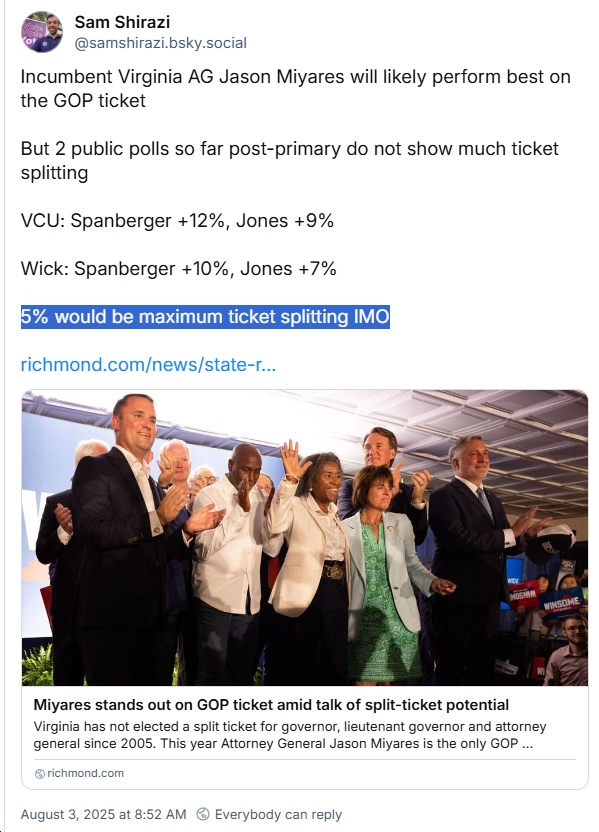
With that background, there’s an interesting RTD article this morning with the headline, “Miyares stands out on GOP ticket amid talk of split-ticket potential.” According to the article:
“Two decades have passed since Virginians last split their ticket in a statewide election for governor, lieutenant governor and attorney general, picking winners from different parties.
But with Republican Attorney General Jason Miyares showing financial strength while the Democratic nominees for governor and lieutenant governor post stronger fundraising numbers than their GOP rivals, some political observers are wondering if 2025 could break the streak.”
If you look back a ways, what you find in terms of ticket splitting in Virginia is the following (note: the differentials are between the candidate of one party’s ticket who performed BEST on that ticket compared to the candidate of that party’s ticket who performed WORST; so, for instance, in 2001 it’s between Mark Warner and Donald McEachin; in 2005, it’s between Tim Kaine and Leslie Byrne; in 2009, it’s between Bob McDonnell and Bill Bolling; in 2013, it’s between Ralph Northam and Mark Herring; in 2017, it’s between Ralph Northam and Justin Fairfax; in 2021, it’s between Glenn Youngkin and Jason Miyares).
- 2001: Mark Warner (D) won by 5.2 points for governor; Tim Kaine (D) won by 2.2 points for LG; Donald McEachin lost by 20.1 points for AG (differential of 25.3 points between Warner’s and McEachin’s margins)
- 2005: Tim Kaine (D) won by 5.7 points for governor; Bill Bolling (R) won by 1.2 points for LG; Bob McDonnell (R) won by 0.1 points for AG (differential of 6.9 points between Kaine’s and Byrne’s margins)
- 2009: Bob McDonnell (R) won by 17.3 points for governor; Bill Bolling (R) won by 13.1 points for LG; Ken Cuccinelli won by 15.1 points for AG (differential of 4.2 points between McDonnell’s and Bolling’s margins)
- 2013: Terry McAuliffe (D) won by 2.5 points for governor; Ralph Northam (D) won by 10.6 points for LG; Mark Herring (D) won by 165 votes (0 points) for AG (differential of 10.6 points between Northam’s and Herring’s margins)
- 2017: Ralph Northam (D) won by 8.9 points for governor; Justin Fairfax (D) won by 5.5 points for LG; Mark Herring (D) won by 6.7 points for AG (differential of 3.4 points between Northam’s and Fairfax’s margins)
- 2021: Glenn Youngkin (D) won by 2.0 points for governor; Winsome Sears (R) won by 1.5 points for LG; Jason Miyares (R) won by 0.9 points for AG (differential of 1.1 points between Youngkin’s and Miyares’ margins)
So as you can see, there was a massive margin (25 points!) in 2001 between the best-performing member of a ticket vs. the worst-performing, and also a pretty big one in 2013 (10 points), but in 2017 and 2021, the differentials were just 3.4 points and 1.1 points. Maybe differentials are trending smaller over time as “polarization” increases and “ticket-splitting” decreases? However, according to former Lt. Gov. Bill Bolling (R), Jason Miyares may have advantages of “incumbency, a significant fundraising advantage, a focused campaign message centered on crime, and what he described as Jones’ lack of qualifications.”
But even if those advantages are true and hold through the fall, could they result in enough ticket splitting for Miyares to overcome, let’s say, a 10-point win by Spanberger (although it’s pretty weird to think of a significant number of Spanberger/Miyares voters, given that Spanberger and Miyares are really REALLY not similar)? How about if it’s only a 5-point win by Spanberger? I could see Miyares overcoming that margin, given the 10.6-point differential as recently as 2017 (although in that election, you could argue that Ralph Northam was a very strong candidate while EW Jackson was a very weak candidate)?
But if Spanberger wins by 10, 12, 15 points or whatever, it’s really hard for me to see ticket splitting like we had in 2001 given how much more polarized the electorate is today, also changes in the media environment (e.g., expect minimal coverage of the downballot races given the steep decline in news media since 2001). As Sam Shirazi says (see below), “5% would be maximum ticket splitting IMO” – and if that’s the case, as long as Spanberger wins by more than 5 points, the rest of the Democratic ticket should be fine. Also, regarding Miyares’ fundraising lead, I’m assuming that Jay Jones will get an infusion of resources, whether from Clean Virginia or national Democrats or whoever else, and that he’ll have the money needed to communicate in the fall. And so far at least, the Democratic ticket appears to be pretty united, certainly compared to how things were in 2001, or compared to the 2025 Virginia GOP ticket…
Anyway, what do you think?
P.S. Also, just to emphasize the obvious – this election will to a large extent be about pushing back against Trump, DOGE, the “Big Ugly Bill,” etc. – both in terms of motivating Democrats to turn out and also in making it likely that anti-Trump voters will cast a straight-Democratic ballot.