
This analysis, by Appalachian School of Law graduate Kyle Ford, of yesterday’s Tazewell Circuit Court judge’s ruling on the Virginia Democrats’ redistricting amendment nails it, really nails it IMHO. I thought it was worth sharing widely. For Kyle Ford’s also-spot-on earlier analysis, on January 28, see here. Bottom line, IMHO: “The circuit court may have issued an equitable remedy it had no jurisdiction to grant. Flanary has been the law for over a century and never overruled. Never limited. If a court lacks equity jurisdiction to enter the order, the order is void. Not wrong on the merits. Void.”
That should pretty much do it right there. But see below for more reasons why yesterday’s ruling by the Tazewell judge (a former Republican candidate for House of Delegates, appointed to the court by Gov. Bob McDonnell on August 10, 2012) was badly flawed and should be overturned, hopefully in short order, by the VA Supreme Court.
1. I’ve now written two threads on the Tazewell redistricting litigation. I didn’t expect to write a third. But today, the same court entered a temporary restraining order that goes further than anything before. Here’s what happened and why it matters.
I said on Monday that this ruling would likely be reversed. I spent some time digging into a few sources. I believe what I found strengthens that view considerably. Here’s the complete picture.
2. The RNC filed a new action, Republican National Committee v. Koski, in the Tazewell Circuit Court. Today, the court entered a TRO restraining every state and local election official in Virginia from taking any action to further the referendum.
3. The exact words: officials are “temporarily restrained” from “administering, preparing for, taking any action to further the procedure of the referendum, or otherwise moving forward with causing an election” on the proposed amendment.
4. Note that this is a second lawsuit. McDougle v. Nardo is already pending before SCOVA. Rather than seeking a stay from the Supreme Court, the RNC filed a new case in the same circuit court and obtained a TRO the same day.
5. This isn’t a ruling on the merits. It’s a blanket order freezing the entire statewide election machinery before anyone has even briefed on the legal questions.
6. First problem. On February 13, SCOVA issued an order in Scott v. McDougle that said its denial of the stay motions “has no effect on the referendum scheduled for April 21, 2026.”
7. Six days later, the Tazewell Circuit Court entered an order that has exactly that effect. SCOVA said the referendum wouldn’t be disturbed. The circuit court then disturbed it. That’s a direct conflict, and it’s the kind of thing that gets a higher court’s attention fast.
8. Second problem. Virginia law says courts of equity cannot enjoin election officials from performing ministerial duties. Flanary v. Morton, 134 Va. 54 (1922). The circuit court may have issued an equitable remedy it had no jurisdiction to grant.
9. Flanary has been the law for over a century and never overruled. Never limited. If a court lacks equity jurisdiction to enter the order, the order is void. Not wrong on the merits. Void.
10. Third problem. A TRO preserves the status quo. The status quo here was a lawfully proceeding referendum. Election officials were preparing ballots. The State Board was on track to transmit the ballot question by March 2.
11. This TRO doesn’t preserve the status quo. It destroys it. The alleged harm? The RNC claims the amendment would injure their congressional districts. Districts that don’t exist. That’s speculative, future harm being used to halt a statewide election that’s already underway.
12. The State Board must transmit the ballot question to local boards by March 2. If the TRO is in effect on that date, transmission can’t happen. Once March 2 passes, the election can’t be reconstituted in time for April 21.
13. Early voting opens March 6, forty-five days before the election. The TRO bars officials from taking “any actions to implement” the referendum. If it’s not lifted by then, voters lose early voting. Every day counts.
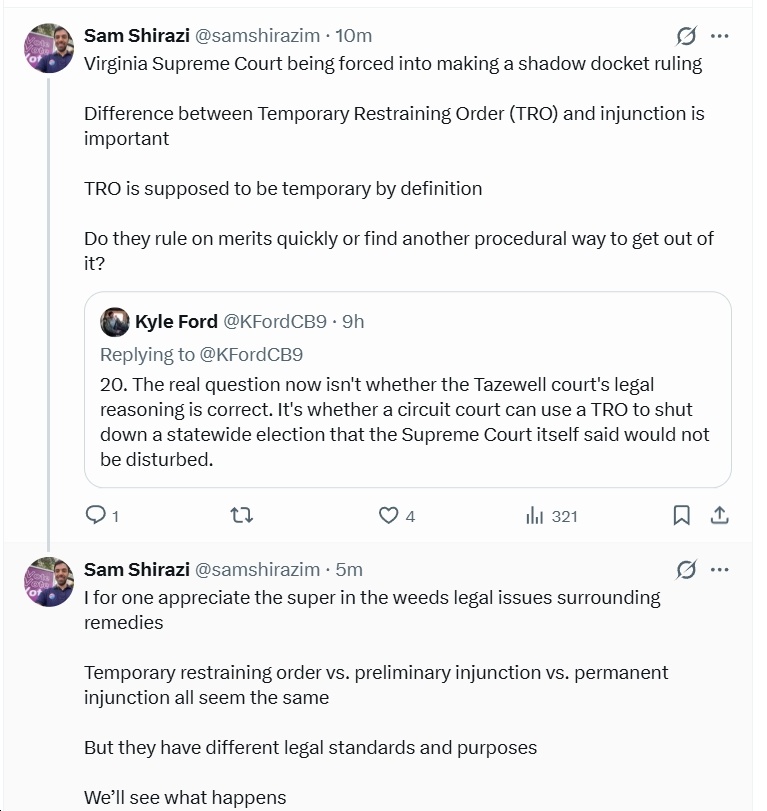
- Also, see this by Sam Shirazi, a smart attorney based in Virginia…