See below for audio and highlights of oral arguments this morning at the VA Supreme Court in the case of Don Scott/Scott Surovell/Louise Lucas et al. vs Ryan McDougle et al.
- BTW, most of the questions seemed to come from Stephen R. McCullough and Wesley G. Russell, Jr., both Republicans for sure. The other justices were largely silent. That could be telling…or not?
- Per Democracy Docket: “9:54 AM: One question in the back of our minds: Will these potential defects invalidate last week’s special election? The court could find that, while there were procedural defects in the passage of the redistricting plan, those defects don’t void last week’s election and the voters’ decision.”
- Per Democracy Docket: “9:40 AM: The special session that passed the redistricting plan was formally called to pass a budget. Republicans make the case that the legislature failed to follow its own rule requiring a two-thirds supermajority vote to address issues outside the scope of a special session set by the governor. 9:47 AM: Republicans hammer home their argument that the intended purpose of Art. XII is to make sure voters are informed about proposed changes to the state constitution. 9:51 AM: The court asks Republicans if it would be extreme for the 90-day publication notice rule to give one ‘rogue’ circuit clerk veto power over a constitutional amendment. They argue the notice, meant to ensure voters are informed, was never posted, so no attempt to follow the rule was made.”
- Per Democracy Docket: “9:36 AM: Republicans raised a lower court ruling that the legislature violated its own procedural rule requiring two-thirds majority to approve the special session. Dem reconvened the session in Oct with only a simple majority, which appellants say is outside of the court’s authority to enforce. 9:40 AM: In a bad sign for Dems, the justices haven’t asked Republicans the same tough questioning they had for Dems/VA. In fact, some of the questioning seems aimed at expanding the GOP’s arguments, such as asking whether there was precedent for calling a special session in the way Dems did.”
- Per Democracy Docket: “9:34 AM: Did the legislature follow the right procedure? A justice said that the legislature had the power to put forth the constitutional amendment on redistricting, but the key question is whether they followed the right procedures. He asks Republicans to focus on that.”
- Per Democracy Docket: “9:31 AM: Virginia’a Solicitor General, arguing for the state, said it wouldn’t make sense to override the vote of the people. ‘It would be patently unfair to override the people’s vote because of a concern that they had not gotten the opportunity to voice their opinion months earlier.’ “
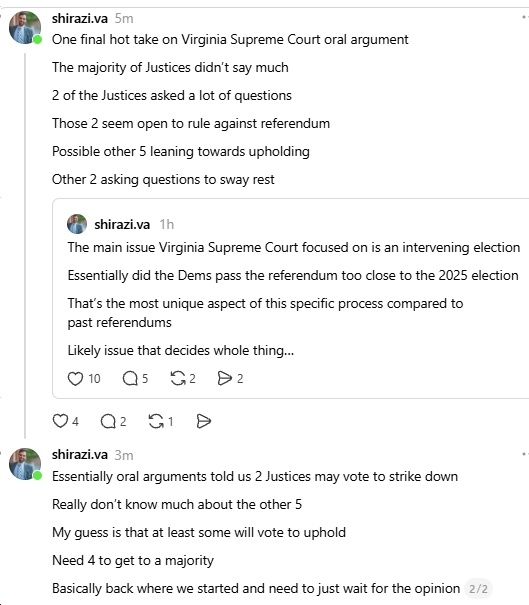
- Per Sam Shirazi: “The main issue Virginia Supreme Court focused on is an intervening election Essentially did the Dems pass the referendum too close to the 2025 election That’s the most unique aspect of this specific process compared to past referendums Likely issue that decides whole thing. Won’t be posting more about this But basically what we expected Court is grappling with the issue Some Justices are skeptical with lots of questions But other Justices not asking questions include Chief Suggests divided Court”
- Per Democracy Docket: “9:20 AM: Now, the Virginia Attorney General’s office begins their arguments on why the proposed constitutional amendment was lawfully passed by the legislature.”
- Per Democracy Docket: “9:12 AM: Democrats argue that the first passage of the proposed amendment was lawful because it occurred before the ‘next general election.’ The GOP argued it began when early voting opened, an ironic departure from their SCOTUS arguments when they suggested Election Day refers to just one day.”
- Per Democracy Docket: “9:10 AM: At the outset, several justices sound skeptical of two Democratic arguments: 1. The special session was valid despite the procedural arguments Republicans have raised against it 2. It’s a problem for the courts to overrule the will of voters This could suggest challenges ahead for Dems…Justices are asking whether the special session ends with the convening of the general legislative session. For this redistricting plan to pass, the amendment must be passed by two consecutive sessions. The question now is whether the first passage during the special session counts.”
- Per Sam Shirazi: “My initial take on Virginia Supreme Court oral arguments Some Justices don’t view Yes vote as determinative and have technical questions about process. This was expected and what their previous order said. Still need 4 out of 7 Justices to get a majority either way. A couple Justices testing lawyer for Yes side. Other Justices are not asking many questions. Perhaps trying to sway their colleagues Suggest Court is divided on the issue and wouldn’t be surprised by split opinion”
- Now Seligman is being questoned about special sessions vs. regular sessions; “next” general election; etc.
- Democrats’ counsel Matthew Seligman kicks it off by arguing that last week, Virginians approved an amendment to the constitution, and that was the final step in a process that was complied with every step of the way. So now, Seligman argues, the amendment has been ratified and is now part of the Virginia constitution. He argues that the challengers are trying to overturn the results of a democratic process.
- Per Democracy Docket, “9:03 AM: Attorney Matthew Seligman, representing Democratic lawmakers, kicked off saying that VA voters approved the final step in passing the new map. He argued the court doesn’t have the authority to enforce alleged violations of the legislature’s own rules.”
************
UPDATE 11:07 am: From VA Senate Majority Leader Scott Surovell
Got to listen to most of today’s oral argument – a few quick thoughts:
– Questions came from only 2 justices and mostly Russell, 5 justices were silent
– Russell has always been conservative so his questions were not surprising
– 30-13 clearly argument doesn’t hold water
– Gen Assembly defines the limits of special sessions by majority vote – Justice McCullough wrote that in his own treatise
– Decision will come down to whether Election = the Election Day
– Election Day is how election provision/statutes have been interpreted for a century
Our actions in the special session were vetted by dozens of attorneys including the nonpartisan attorneys who advised the General Assembly at the Division of Legislative Services
Voters had 2 weeks to consider our special last Oct, 75% voted after special session was announced, turnout was 400,000 votes higher than 2021 & voters delivered an overwhelming mandate for a Democratic HoD – if voters didn’t want it, they didn’t say it then or last Tuesday
Also, a few more thoughts from Sam Shirazi
P.S. This needs to be cleaned up, but for what it’s worth, here’s the YouTube-generated transcript of the oral arguments this morning.
“You may be seated. Good morning and welcome to this special session of the Virginia Supreme Court. I am Chief Justice Cleo Powell. All of the justices of the Court are sitting. Please call the case.
Don Scott in his official capacity is speaker of the Virginia House of Delegates et al against Ryan T. McDougall, Virginia State Senator and Legislative Commissioner for the Virginia Redistricting Commission et al. Richard F. Hopkins III, Matthew A. Seligman, John E. Likenstein, Tilman J. Breenidge, Appellance Council, Michael A. Thomas, Thomas R. McCarthy, Connor D. Woodfin, Apple Council.
Madame Chief Justice, members of the panel, may it please the court. I am Richard Hawkins of the Hawkins Law Firm. It is my privilege this morning to be here on behalf of the appellants, Speaker Scott, Leader Surovell, and President Lucas. And it is also my privilege this morning to introduce my co-consel Matthew Seligman, a member at good standing of the California bar and who one who has been admitted prohiche before this court. Mr. Seligman will be handling the oral argument and I turn it over to him now…
…Madame Chief Justice and may it please the court? I’d like to reserve 3 minutes of rebuttal time. Also, I’ve been informed by council for the legislative clerks that he will be yielding his 5 minutes of time to me. Okay. So, that gives you how much time? 20 minutes total. Your honor. Thank you, Madam Chief Justice. And may I please the court? Last week, the people of the Commonwealth the people of the Commonwealth approved an amendment to the Virginia Constitution. That approval was the final step in a clear and comprehensive process laid out in article 12 of the constitution. The General Assembly and the people complied with every step of that process. First, the General Assembly approved the proposed amendment for a first time in October of last year while sitting in special session. Second, the general assembly referred the proposed amendment to its session after the next general election. That next general election took place on November 4th, 2025. The general assembly then passed the proposed constitutional amendment the time in January 2026 of on January 14th. Finally, the people approved the proposed constitutional amendment last week on Tuesday, April 21st. The General Assembly and the people thus complied strictly with every step that the constitution requires. That is all that article requires. As a result, the proposed constitutional amendment has been ratified and is now part of the Virginia Constitution. The circuit court attempted to interfere with that democratic process by halting it. This court properly put a stop to that. The challengers here now tried to overturn the results of that democratic process. This court should not countenance that either.
I don’t understand that as a legal argument given that you asked us to invoke our ironically enough named Scott decision from over a hundred years ago that specifically says you don’t deal with any potential procedural irregularities before the people have voted. So saying that the people have voted yes after having said you don’t even look as to whether there’s a procedural irregularity and after voted doesn’t add anything to the equation, does it?
No. And to be perfectly clear, we’re not arguing that this court lacks jurisdiction to review whether the constitutional requirements of article have been complied with. It does. instead, I’m saying that on the merits, this court should not accept the challengers arguments.
But the fact that there’s a yes vote doesn’t tell us anything about those merits?
No, it does not.
Okay. so now on to the merits of those arguments, those those arguments lack merit. So the first argument the challengers offer is that the General Assembly didn’t properly pass the proposed amendment at its special session in October of 2025 that is error. Now the challengers here have abandoned the principal basis that the circuit court relied on. That principal basis was whether the general assembly complied with its own rules of procedure and the challengers are right to abandon that argument.
You don’t disagree that the General Assembly didn’t follow the terms of the resolution for expanding the argument is as a legal matter under article section it’s irrelevant that they didn’t follow that?
And that principle is firmly rooted in law in American law and in this court’s cases…
And that’s a yes?
That is a yes but to be precise so first of all there are two points here one about judicial power and the about compliance with legislative rules first It’s about judicial power. This court does not have the power to enforce alleged violations of legislative rules. That principle has been established by the United States Supreme Court. It’s been established by this court and state courts around the country. That’s the point about judicial power.
I think that’s a compelling argument on how the legislature by majority vote sets up its own rules. The more tricky and in my mind unprecedented , aspect of that question is the idea of a sort of perpetual special session when the constitution envisions a citizen legislature that’s part-time that meets at prescribed time periods. And we’re writing on a blank canvas on that question. And so to me that was the argument that had more layers to it than than the one you were just immediately addressing.
Well, I think the text ultimately answers this question. It’s true that this court has never addressed it, but I think the text of the constitution answers that question. So section six itself says exactly what the challengers wish that it said about special sessions. It does say it about reconvene sessions. It specifically limits the business to be conducted at special sessions to…
But other than constit following up on Justice McCulla’s question, other than constitutional silence, what is your authority that a special session survives the convening of the next general session? Because from the 1971 debates, it was do we let them meet once every two years for 90 days to annual sessions of 60 and 45 days with potentials to be expanded by twothirds vote. Clear implication, we don’t want a legislature that sits year round. Your interpretation of the special session would allow them to sit in continuous session for the better part of two years.
I don’t think that’s quite right and I think the distinction is important. So what the constitution permits well so what it requires is a general session sitting for a limited period of time then it authorizes the General Assembly by applying to the governor with a two-thirds vote or the governor on his own motion to convene a special session. Now that political process that leads to the convening of a special session is different than a general session and that’s what makes it special. So what the 1971 constitution did is it created a process for political accountability. and that process for political accountability means that the members of the General Assembly and the government will have to answer for the fact that they convened a a special session which they will in the general election.
But my question is is a little more specific than that. Special session definitionally is something that happens outside of a general session. If you’ve been in special session and we get around to another general session, why doesn’t that by its very nature, the term special and general, why doesn’t the general end the special? What authority do you have for that proposition, other than constitutional silence?
Well, I think the constitutional silence is telling and that constitutional silence exists not only in contrast to other sentences in the very same section of the constitution, but also in contrast to every single and I repeat every single other states constitution that the challengers rely on here. So beyond that, I think the purposes of the power to convene a special session illuminate that silence. The purpose is to be able to deal with exigencies that arrive arise that are unexpected and outside of the regular.
Would a special session convened in 1929 if they forgot to adjourn snee die still be in session?
No, your honor and I think there’s an important distinction here and this is reflected both in the Virginia legislature and also in Congress and other states legislatores. So any open sessions at the end of the term of office of the members of the General Assembly here or congress it automatically terminates. Now the practice has been mixed here about whether the General Assembly adjourns and die expressly or just lets the sessions expire with the expiration of term of office and that reflects the practice both in Congress and in other states as well.
Turning to article 12 section one specifically. Yes. Do you agree that that the word next and modifying next general election for the House of Delegates means that if the election has started that’s not the one you have to go to the next one. Your disagreement with the other side is when the election starts.
My disagreement with the other side is the definition of the word election in five separate provisions of the consecution.
If a constitutional amendment is passed by the general assembly at 5 pm on a on this the first Tuesday after the first Monday in November, that can’t be the election to which it refers.
So I think that’s a much harder case that’s not presented here. I think it’s probably that wouldn’t be valid. But again, that’s a very different case here.
You you would say doing it on election day itself anytime before the polls closed might be valid.
I think probably not. The point I’m just trying to make here is that that’s not the case that we have here. The case that we have here is the General Assembly passed the proposed amendment before the election where the term election is defined in the constitution by five separate provisions as a single day that takes place in November. So article 2 section 6 defines the election as the November general election. That is an election that takes place in November, not over a three-month period that begins in September.
It does because the phrase in article 12 section one is next general election and article 2 section six it’s that’s when the members of the house shall be elected. It’s not the same phrase. It’s not the same word. It’s not even the same type of speech. One is a noun, one is a verb. What well what is inconsistent with interpreting election as describing the process and saying shall be elected is by definition the termination of that process by which the members are elected and in fact the verb is passive. Somebody else has to do something for them to be elected that is the voters have to vote.
So two answers to that your honor the first textual and the structural. The textual answer is that we have other provisions of the constitution that answer directly this point. So article 7 section 4 says regular elections for such officers this is local and county officers regular elections for such officers shall be held on Tuesday after the first Monday in November. And so that answers exactly the grammatical point that you’re making here and that speaks to the broader structural point that I’ll make which is that we have a coherent structure across multiple provisions of the constitution that the election takes place on a single day that takes place in November assuming it’s a general election and there can be early voting that participates early in that election that takes place in a on a single day.
So your position requires us to interpret election in such a manner that literally every single vote that is cast for whatever the office is is cast before the election even begins.
Yes, your honor. And that’s consistent both with the way the federal government has consistently interpreted this, the federal courts and sister states. A contrary interpretation would make Virginia a sole outlier.
We have consistently held that constitutional provision should be interpreted unless there is a specific legal definition provided in the provision as the way the people who would have ratified it would. Do you think it is at all anomalous to tell somebody that when they went and voted for a member of the House of Delegates up or down irrevocably cast their vote that they were not actively participating in the election when they cast their ballot?
Well two responses your honor. Again going back to the text as you referenced there is a specific explicit definition.
Not in article 12 section one there isn’t.
But as this court has repeatedly held it interprets the constitution as a whole. And so the words that appear in one provision should be interpreted in a in a manner that is consistent or harmonious with the…
If they’re the same words but they’re not.
Well so the it’s the word elected. and then again in article section section it is the word election. But moving on to your other concern, I understand I understand the concern that someone who cast their ballot before something happened might be upset or regret that and that is a problem that is endemic to early voting. That is a problem that someone accepts by taking advantage of the option of voting early. It’s worth pointing out that every single voter in the Commonwealth has the option to cast their ballot on election day. The statutes which exist all over the country as well and are interpreted in exactly the same manner provide for the opportunity to participate in the election early. That’s why it’s called early voting. and indeed Black’s law dictionary defines early voting as early participation prior to the election. And so there’s a consistent understanding across law that early voting is participation in the election before the election. And so but again to your policy point I understand but that’s…
It’s not a policy point. It’s what does the word mean? That’s a legal question.
I agree your honor. And so that’s why the text is the most important source that we have here. And again there’s five separate provisions of the constitution that define election or a word that’s closely related to the word election.
Recognizing the text is most important. If you look at the General Assembly debates over the 1971 constitution, didn’t at least a few of the members say that the reason we have the intervening election requirement is so people will know when they vote how people how incumbent members voted and allow their opponents to say they would have voted differently. I mean, that’s what they said on the floor. Correct.
I am aware of one statement to that effect and it was during a debate about a separate a separate provision about article section about conventions. so first of all I don’t think that statements by individual legislators can overcome the clear text of the constitution.
I agree with you on that.
So I’m glad we’re in agreement. so given that I don’t think that I don’t think that those spare statements can overturn the text. And second, we have again the absence of a waiting requirement for the intervening election. So the 1971 constitution intentionally removed a publication requirement that had previously existed for days. And not only that the 1971 constitution includes exactly the waiting requirement that the challengers here wish there was before the intervening election. It includes that prior to the submission to the people. There has to be 90 days. And so ra the drafters of the 1971 constitution knew exactly how to put in the waiting period. The challengers tried to impute into the text. They knew how to do it expressly and they declined to do so with respect to the intervening general election.
Do you agree that by statute the general assembly may prescribe the manner in which the amendments are submitted to the people?
Yes, your honor. And that refers specifically to the manner in which the proposed amendment after it has been passed a second time, how it’s submitted to the people.
Recognizing that there retroactivity repealed issues and all kinds of other things as a factual matter, did the trial court correctly find that the things specified in 30-13 as it was in effect in October and November 2025 of were not done?
So it was not published 90 days before the intervening general election
And wasn’t posted by the circuit court clerks. Your position is that that is of no legal significance either because of the repeal or because it doesn’t provide the remedy. We tend not to treat shall as mandatory in such a circumstance.
I think there’s a deeper structural constitutional reason that I think is more important. The deeper structural constitutional reason is that section 30-13 which you know requires publication or did require publication 90 days prior to the intervening general election. The constitutional basis for that was a publication requirement in the 1902 constitution that was repealed. Now the fact that the 1971 constitution eliminated that constitutional provision did not by itself repeal section 30-13. However, what it did do is it meant that section 30-13 can no longer be a legal precondition for the validity of a the constitutional amendment’s ratification. To interpret section 30-13 to condition the ratification of a constitutional amendment would be akin to the General Assembly passing a statute that says that in addition to the requirements of article twel;ve section one the people have to vote in favor of the vote in favor of the proposed amendment twice. That simply cannot be constitutionally added to the clear and comprehensive framework that’s laid out in article twelve section one.
And who goes to the courthouse to get their news anymore anyway?
I think that’s right. So the status of section -at this point is well it’s now repealed as your honor referenced. In addition to that, it may have served a purpose before. I think part of the reason why the general assembly has now repealed section 30-13 is precisely because everyone in the Commonwealth knew about this without going to look at the door of the local courthouse.
I mean, in colonial times have market days and people would go to the courthouse and there was a big, you know, to-do and people would learn about different things at the courthouse. Well, that’s not just not.
Yeah, that’s exactly right. I see that I’m running into my reply time. And if there are any other questions. Thank you.
Thank you. Good morning and may please the courtman records for the Commonwealth. I’d like to begin in the intervening election issue and then happy to answer any questions on any of the three issues. The reason for starting with the introvening election issue is that I’d like to break down the arguments on how each judicial philosophy applies given the fact that there’s been some discussion in the briefing about purposes ofism versus textualism and things like that. I’ll start though with textualism and then work my way to purposivism. As a textual matter, the constitution is pretty clear as Mr. Seligman broke down. It’s it states that the next intervening general election will be and of the House of Delegates and the House of Delegates is elected on the first Monday, first Tuesday after the Monday in November. Always hard to get that one straight. But given that you also have other provisions in in the constitution that establish that by general election it means the the first Tuesday after the Monday in November. So for instance the one-year residency requirement establishes the nature of the election and the fact that one is elected on that day election day. And so now under the new regime that the respondents suggest, I wonder if we would then be stuck with a year and day residency requirement. I I’ll ask you I’ll ask you the same question. Why isn’t it a natural reading to read the phrase election, the noun, as the process and the verb phrase shall be elected as indicating the end of that process or at least the voters’s participation, the p the group that is the passive verb is referring to to do something shall be elected is the end of that process because even on election day, you’re not elected and because you’re not elected until you’re certain. Right. That is correct, your honor. And that’s why I want to use the Constitution’s text primarily because the Constitution treats both the word elected and election as that that first Tuesday after the Monday in November. But to the extent that we’re talking about natural reading or dictionary definitions, if you go to the Oxford dictionary, it defines an election as the formal choosing of a person for office, dignity, or position of any kind, usually by the voices of a constituent body. Now, I realize that that could have gotten a little bit confused because the respondents briefing appears to, as best I can tell, mush together a few definitions or maybe a couple definitions of election. I couldn’t get a hold of a Oxford dictionary. But, but just to be clear, much like the legislative leaders council, you agree that for you to be the correct, people casting votes are not actively participating in the election when they cast their votes. No, I disagree with that, your honor. Okay. How am I, if I voted on October st, actively participating in the election when I cast my vote if the election hasn’t begun yet? Because you cast your ballot early, but your vote isn’t counted until election day. Well, that’s the difference between casting and counting. My qu I understand that your position is they’re counted on election day. My question is, am I actively participating in the election when I vote? That seems to be the sin quan na of an election. I go and vote. Well, I I disagree, your honor, because you’re casting your ballot on you’re casting your ballot before election day. Your vote is a vote is is your vote actually happens on election day when your ballot is counted. That is a vote. So, so your interpretation of the provision is that we literally could have an election where every single vote is cast before the election actually even begins. I guess in the abstract perhaps if everyone voted early that seems a very extreme definition of election to me that’s the it’s the definition of the election that the constitution gives your honor and if we are going to take a sort of living constitutionalist approach to it where the where the definition of election kind of changes because we have new early voting procedures then that would be sort of a more of a fairness argument and if we go to that direction then I would say that I think it’s inherently fair for anyone who casts their vote early as I have in the past many times to say that they should have to say to themselves, I am accepting that there’s something might happen in the interim that that is significant that would might u change my vote if I had waited. And so that includes an October surprise or the death of a candidate. And so the respondents have, you know, kind of said, oh, a mere October surprise. So, they seem to be suggesting that there’s an importance difference and and a tough challenge to figure out what the standard would be for that. But I would have trouble figuring out something that’s more important than the death of the candidate you voted for. , What is your position, your client’s position regarding a constitutional amendment that is adopted at p.m. on election day with an hour left at the polls? Is that the next gen is that still the next general election? Because hey, you could have waited until to go to the polls to vote. Therefore, that’s the next general election because there’s still left. No, your honor, because the Commonwealth’s position is to base the decision in the text of the Constitution, which establishes that election day is the election. So, anything that has that gets passed must be passed before election day. We we’ve talked text. What about purpose? So one argument is we need this delay so that there’s time for voters to educate themselves for debate. Number one and then number two so there’s accountability. So if the legislature swept on a tide of passion does something that the voters decide is bad there’s the opportunity then to hold them accountable in the next election. So we have text you’ve addressed that very well. help us with the purpose aspect of it. Sure your honor. two answers to that and both are based well you know going going with the purpose reason one is based in establishing what the purpose really was and then another based on even if the purpose was as stated it would not be served by a contra by affirming the court below. So to go to page of the debates where Delegate French Slaughter expressed the purpose of that provision. There were a few words left out in respondence brief. So I want to give the whole quote. He said not only would there be an intervening House of Delegates election where you might be able to get the sentiment of the people on an amendment you had acted on previously, but upon reflection the general assembly might decide not to submit the amendment. So that might you you might get what the what the people think and upon reflection the general assembly might decide not to submit the amendment suggests that there there should be some intervening time and that’s the per that’s the issue is to provide an intervening time period for the general assembly to change over to a new general assembly maybe hear from constituents maybe not but then two pages earlier there is the discussion of the publication requirement and whether there should be a publication requirement And Mr. Slaughter states in no uncertain terms that the whole reason for the for removing the publication requirement for before the next general election election issue is that the idea is that the people get to get educated before they vote to ratify it. And so therefore that is when people need to be educated is when they actually vote. And so if we’re talking purposivism here, if we’re talking about the purpose of protecting the people’s vote and the protecting the people’s ability to weigh in, then I feel like it would be patently unfair to override the people’s vote because of a concern that they had not gotten to the opportunity to voice their opinion months earlier. Regarding the special session surviving the convening of a general session, do you have any authority other than constitutional silos? No, your honor, there’s no authority one way or the other on it. It really just comes down to the fact that, you know, and and there is one thing I do want to correct on the record about that, though. You know, there’s a lot of discussion of or days of continuous session, but to be clear, the legislature did business a grand total of days. They were not but contends they were in session the entire time. They didn’t have to they didn’t have to pass a new resolution by a supermajority or have the govern governor call them back in at their option and weren’t they actually proforma continuing the session the yeah they were they they recessed the session several times but the bottom line is your honor they were in session for they were actually in session for days. So the session lasted the entire two years whether they did business during the session is a different question. Well, perhaps your honor, but the bottom line is there’s there’s no reason to start talking about how this legislature created some non-citizen legis or professional legislature. They were in for days. They they didn’t violate any concept of a citizen legislature by remaining in recessed session for a long period of time. They only actually did business for days. And so given that and given the fact that there is there is no authority one way or the other but you know the bottom line is that they weren’t converting themselves to a citizen legis legislature. I really don’t think that there’s any a constitutional argument that they somehow violated their their powers as a legislature to continue the session. Unless there are any further questions I have one but I didn’t want to eat into your time on the three issues that are before us. My understanding is there’s additional lawsuits that are working their way through the courts. Can you give give us a just very quick update on essentially where those are if you’re a able to? Yes, I am, your honor. There’s there are two other lawsuits working their way through. Currently, one has been filed. We the Commonwealth has filed a notice of appeal in the court of appeals. This court then certified it to itself. we currently have a motion to expedite that’s pending and awaiting a r ruling on that. there is also a lit litigation on the compactness of the maps. The circuit court of Richmond ruled yesterday that the maps are both compact enough and the constitutional amendment abregated the compactness requirement for this anyway. and we have not seen any response to that just yet, but that was yesterday. Was that a final order on the merits or a final order on a request for an injunction? , That was an order on a request for an injunction, your honor. So, to the best of your knowledge, there’s no final order in that one. That is correct, your honor. A lot of balls in a lot going on. It’s helpful to to have the latest on that. So, thank you. They’ve been keeping me busy. We figured you’d be the one who would know. Fair enough. Thank you. All right. Thank you. Thank you, council. Good morning, madam madam chief justice and may it please the court. Thomas McCarthy for the apple. The Virginia Constitution and Code delineate a very specific and detailed process for amending the Constitution. A process that proceeds in two stages with an important role to be played by the voters of the Commonwealth in each. The court held nearly half a century ago that Virginia voters are entitled to strict compliance that constitutional amendment process. Yet a bare partisan majority of the general assembly rammed the proposed amendment through the legislature, departing radically from the mandated constitutional amendment process and historical practice, severely undermining the rights of Virginia voters and indeed undermining confidence in the results of the very referend itself. When you when you say a bare partisan majority ran it through, that sounds like an argument about something that they shouldn’t do. But we’re only concerned with what they couldn’t do. It doesn’t matter that it passed by one vote and if it only passed by one vote in the general assembly if they have the power to do it or if they followed the right pro they clearly have the power to do it. The question is did they follow the right procedures. So I would ask that you focus your argument on that. Certainly honor as an abstract matter certainly they have the power. The legislature has vast powers. But for that very reason, Virginiaians have long distrusted legislative power and fear the tyranny of permanent legislatores, which is why there are strict limits in the Virginia Constitution on when and how the legislature can meet. And our, as I think was noted earlier, our constitution provides for a citizen legislature, right? What it does is regular sessions are only once a year, Wednesday of every January and only for or days. So the default position is that the legislature is not sitting. There is of course also the constitution provides for special sessions. The governor may com convene a special session of the general assembly in the interest of the commonwealth when the interest of the commonwealth may require it and the govern the governor shall convene a special session upon the application of twothirds of the members elected to each house. Now the proposed amendment violates the constitution’s limitations on special sessions in two ways. First, it’s the product of an improperly expanded special session. Starting with the text, special sessions are special. That’s why a twothmajority at each house is required just to assemble the body outside of its normal course. Both blacks law and the general assembly’s own legislative information service defined special sessions as limited to specific issues. Not only that, but both the general assembly in its application and the governor in calling the special session recited the same limited purpose to consider budget bills. As noted in our briefing, both Ma Mason’s manual of legislative procedure, which by the way, the Senate uses to constru its rules and state court president construing similar provisions. They say that limiting the scope in this way as they said that the scope of special sessions is limited to the expressly identified purposes in those calls. The substantive limitation on the scope of special sessions is not just there. It inheres in the very structure of article section most particularly in the dual /requirement. That twothirds requirement is important. When an application for a special session is proposed, all members of both houses, but does that doesn’t apply if the governor calls it? Correct. I’m sorry. If the special session is called by the governor, it’s a one person call. He doesn’t need the supermajority in the house. It’s if the general assembly wants to do it, they have to do it by supermajority. If the governor calls it, he just calls it. That’s correct. And this is one that was called that was proposed by application of the general assembly. So, we’re in the twoline. But for an argument that the general necessarily ends a special session, their position is that this is the governor’s special session, so we didn’t need a supermajority to address it. So, this was certainly not the governor’s special session. This was the general assembly special session. They called for it by a joint resolution HJR I’m sorry, HJR in April of Okay. They called it they said it was for budget for budget bills. The governor then responded as he has to do in the process and and actually calls it he has to convene it. Then he doesn’t have an option. It’s not his. It’s the general assemblies. That’s why the two-third requirement applies. Now again, the twothirds requirement is very important. As I was getting to, when an application for a special session is proposed, every single member of each house has the opportunity to approve or disapprove of the issues that that are proposed to be taken up. Meaning that a minority in either house, right, one-third of the body plus one member can block that proposal. So to allow special sessions to address issues outside of the scope of its application would flout that twothirds dual house requirement in the special session clause. In other words, HR which was the first supposed passage of the proposed amendment is invalid because it’s not a budget bill. Now there’s a narrower argument on the scope of the special session and this is the one adopted by the circuit court which by the way we did not abandon. It’s on our it’s in our brief on pages and We discuss what this circuit court did and we endorse it. the argument is that the special session exceeded its substantive limits as approved by twothirds of both houses in HJR HJR expressly lumbered a special session to consider certain things, budget bills and four other items which are not relevant here, but it was memorial resolutions and judicial appointments, other appointments that required confirmation of the general assembly and internal business. But in any event, it definitely did not include a proposed amendment or anything about redistricting. So HJR again exceeds that substantive scope. What does a historical record tell us about the general assembly taking on additional legislation beyond the stated purposes originally? I mean, is there a historical track record one way or the other of this being an established pattern or is this completely unprecedented or what? Well, as far as we can tell, it’s unprecedented and petitioners do not cite a single occasion where da special session went outside of its bounds in this manner and and and not only that, they certainly don’t have any judicial precedent that endorses that. So, we think what there is is an unbroken historical practice of doing what we say is required by that can inform the reading of a text. Yes, absolutely. sort of text, structure, history, it’s all relevant when considering constitutional provisions, especially when you’re talking about a long history like this is is the is the resolution for a special session that we’re talking about, is it a purely legislative act? Why isn’t it why isn’t it fair to allow them to inter- the general assembly to interpret its own rules and procedures if it’s a purely legislative act with no other branch involved? Well, it’s not simply a purely legislative act in the sense that there is this twothirds requirement in the constitution, right? That’s a meaningful that’s that’s where the substantive limitation on special sessions inheres in that, right? For this very reason that you know, I guess maybe put it this way, neither HJR nor HJR would have yielded twothsupport if a proposed amendment for registering were on the table. I don’t think anybody would suggest they would have passed. So allowing a bipartisan majority to reconvene that special session and pass HJR by a simple majority absolutely just eviscerates that requirement. It’s acting as it’s not even there in the constitution. And I think that you know this court should not condone or countence that especially when you know the people are ultimately the ones who possess government power. The court set itself in staples. The people are the ones who hold the power to amend or modify the constitution. And that’s exactly why this court in Coleman said that strict compliance is required with all specified procedures. It didn’t say just the ones that are in the constitution, but all of them because it’s ultimately for the protection of the people because it’s in the people where the where the power where the power lies. Now I’ll move on to the intervening general election. Well, actually before I do that, there’s also even set setting aside the substantive limits on the special session, there’s a timing limit as well. And I think Just as Russell, you referred to it earlier. That is if a special session is open and it runs into the convening of a regular session collides with it, the special session is terminated. This is this is clear both in Mason’s manual which again the Senate relies on and state court president constring similar provisions. and not only that but there’s an unbroken historical practice just like this. There is none. There is no example and petitioners cannot cite a legitimate one of a special session that continued to act during a regular session or after a regular session where it had started before. The historical practice is that if a regular session adjourns then you would start a new special session but again then you either need the governor to call it out of necessity speaking once you are in general session you can take up anything you want. Exactly. So it really the floor is wide open to do whatever you think you need to do. That’s exactly right. So it doesn’t even make sense. It’s sort of a nonsensical position to say that the special session exists through a regular session. Not to mention remaining open in session, maybe not actually on the floor, but for days. Now, even aside from that, the proposed amendment is void for another reason because there was no intervening election. Under article an amendment’s passage must take place after the next general election of members in the House of Delegates. Now, to conrue the word election, we begin with ordinary meaning. Webster, Oxford, Black’s Law, they all define election to mean the entire process by which votes are cast to determine a winning candidate, right? There’s campaigning, there’s ads, there’s events, there’s ballots being cast. So then the chief argument and response is, but there’s a specific meaning to that to the Virginia Constitution. So that’s the main argument. on the other side. We have to construe it as a whole. We we certainly do conrue legal documents like constitutions as a whole, but I think that petitioners are taking out of context. for number one, as Justice Russell pointed out, it’s not even the same word in the in the House of Delegates and the Senate provisions in the Constitution, it says elected, which is something different. But not only that, but almost every provision they cite, it’s about election day or the day of the election. And that is a different term than election itself. Election itself has a meaning. It is a known is known everyday understood meaning is the combined actions of the voters and officials to produce a final selection. And speaking of the historical record, I’m not aware but I may be mistaken u of an instance where the general assembly adopted this particular process. In other words, where there’s an ongoing there’s voting. I don’t want to use the word election and but where there’s vote people are going to the polls to cast their ballot. There’s campaigning events going on pro and con. I’m just not it’s doesn’t address a constitutionality per se but I’m not aware that this process was ever used before. Is that correct? That’s correct. This is unprecedented. This in fact this amendment process is unprecedented in several respects. this is just one of them. All right. But this meaning of election is consistent. It’s consistent with the common usage of the term. It’s consistent with how courts use it. I mean, in one of the preeminent election cases from the US Supreme Court, Foster versus Love, the Supreme Court said that defined election as the combined actions of voters and officials to mean to make a final selection of an office holder. The fourth circuit recently in Pierce versus North Carolina Board of Elections said the election was happening right now because early voting in person had already started. The fulcrum on which the next general election argument turns as I take it, there’s no real disagreement between the two of you. If v if voting before election day is part and parcel of the election, if it is participating in the election at the time you win, if it is putting your ballot into cold storage and it doesn’t take any significance on till election day, they win. Is that it? I think there’s a little bit more on our side, your honor, to be fair, because it’s not just the word election. We’re fighting over that, but we also have the word next, which means something. Um also on our side I think that the whole purpose is on our side as well. Um and on that purpose there was some discussion earlier about the proceedings and the debates the house on this on this part of the constitution and and the point was that it was to get to to get the sentiment of the people and I think petitioners said something the effect of well it only says they might fit the sentiment. That’s not to mean that the voters might or might not get the information in time to be able to make a decision in an informed manner. It’s about they might or might not express their will through their vote in that election a certain way or another. Voters vote one way or another for lots of reasons. So they hourmight or might not get the sentiment based on this proposed amendment or that proposed amendment. But % the purpose of this provision is to make sure the voters are informed. One also one thought occurred to me on this point which is it’s one thing when you have a ordinary election and there’s a swirl of issues etc but a con when you’re amending the constitution that could be for generations to come hence the requirement of strict compliance because it’s hard to undo if it turns out to be ill advised and so a vote on a constit with with constitutional implications may be different than an ordinary vote on general public policy questions. Indeed. Indeed. And that’s why that’s why it needs to come before the voting begins so people have an opportunity to exercise that right meaningfully. Take Camila Simon, one of the plaintiffs in this case. She is a regular Democratic voter. U she is in support of nonpartisan gerrymandering like twothirds of the of the Commonwealth. , She voted early in the general for her delegate Rodney Willlet. After that, in the winning days of the election, it was Mr. Will to introduce this new proposed amendment, and she was very unhappy about this. She wished she could redo her vote, but she couldn’t. , She was denied the opportunity. , City council, did the trial court accept that factual finding? It did. It was uncontroverted. It was it was sworn in a verified complaint. And I should note that petitioners had the opportunity to seek , discovery or ask for a deposition. They didn’t either. So they waved their opportunity, but more to the point, I think they probably waved that opportunity because they knew there was no basis to challenge it. In any event, , she like a million or more other people voted before this proposed amendment was ever even proposed. None of these voters , had any idea this was coming. And that’s not how the process is supposed to work because as I mentioned before, it’s the people, the people of the Commonwealth, the voters who possess the power to amend or modify the constitution. And denying them the knowledge that this proposed amendment is coming through should undermines the whole process. Regarding the -requirement, it’s it’s un your opponents have conceded that the steps laid out in -weren’t complied with, but but it would strike me but no remedy is pro provided for in the statute. It would strike me as pretty extreme for us to say that one rogue circuit court clerk just refusing to post it on a courthouse wall stops the entire commonwealth from ever considering a constitutional amendment. And that would essentially give a circuit court clerk veto power over amending the constitution. Isn’t that too extreme given our cases regarding shall as directive rather than mandatory to government officials? your honor, I don’t think it is too extreme and there’s a few reasons why. For one, petitioners point out that the rule the duties that are provided in section used to be a part of the constitution. So they were a part of the constitution. Then they became part part of the code as part of the amendments. Okay. They’re still the law of the land. Well, not only that, there’s no question the clerk is supposed to do it. shall direct them to do it. They must do it. But the question is if one circuit court clerk, whether to thwart a constitutional amendment or just because they forgot forgets to post it days before there is no then the whole the whole rest of the Commonwealth can’t amend the Constitution. That seems extreme. Your honor, I I understand that your hypothetical is kind of an extreme one. Two things, but it’s your position, isn’t it? Well, two things, honor. One, the point I was getting to is that Coleman requires strict compliance the entire process. But the is this. This is not at all like that. This isn’t like one circuit clerk somewhere in the Commonwealth only put it up days ahead of time or something like that. It was never posted ever anytime. But but the but strict compliance one doing it on day everybody doing it correctly and one doing it on day is not strict compliance. So I mean so it seems to me you got to buy all of it for you to be right that that that one road clerk can stop all of it.
Your honor, I I don’t think that’s the case. Now, although strict compliance is the rule, there may be circumstances like the raglin case indicated where substantial compliance might be in order where there is like maybe one clerk who’s a couple days late because I can promise you if every other clerk in the state did it or the commonwealth I should say and somebody forgot they would know the next day and they’d put it up. And the point of this though is to provide notice to the electorate, right? That’s exactly what it’s for. So we have a lot a lot of cases dealing with statutory harmless error, right? So there’s a statute says do this government official but through neglect whatever they didn’t do it. And then we say okay well was that harmless and anyone who’s paying the slightest bit of attention to the news cycle knows about this constitutional amendment. So what about the argument that okay well sure they were supposed to do it but I mean leaving to the side the retroactive repeal but really I mean now we get our news through social media through news outlets through the internet through whatever. So would would it be harmless? Could it be harmless? Certainly not in this situation. First of all it wasn’t inadvertent here. They didn’t they just did it this way. It wasn’t because somebody forgot. And , it’s not harmless at all because of people like Canelo Simon because there was more than a million people who voted before this thing was ever even proposed. This is not like, oh, maybe they did it a couple days late. That argument goes to the timing, not the failure of the clerk of the house or the clerk of a circuit court to do the steps in That that that goes to next general election more so, doesn’t it? Because she voted. But I think it goes to both because because the -day notice is supposed to be to make sure that the voters are informed and and honestly to allow time for campaigning because that’s when a lot of this comes out. I mean there are lots of voters across the Commonwealth who are not totally educated on all the events going on in Richmond and they need time. The Commonwealth needs time for the whole thing to be aired out. That’s the whole point is to to get the sentiment of the voters. The information needs to be in the hands of the voters in time for them to make reasoned decisions and to actually vote. And that’s what’s missing here. And the point I was making to justice mcculla was really about his harmless error analysis in a way which is about okay what’s the actual effect and whether it was inadvertent or not. And I think on that it doesn’t work here. This is a case where there is it wasn’t inadvertent at all. And there’s a massive error when over a million people vote without this information. In in short, your honors, the proposed amendment is invalid for several reasons. Any one of which is sufficient to invalidate the proposed amendment and require invalidation of the vote. Before I close, I want to say something about the Commonwealth. It’s often said that ours is a governable laws, not of men. Sadly, that’s not the case. If a bare partisan majority can circumvent the constitutional amendment process and undermine the rights of the people in whom all government power ultimately rests. Also, that partisan majority can transform our system from a nonpartisan one where the voters select their representatives into a partisan one where the representatives select their voters. We ask that the court enforce the constitutional moment process by affirming the decision below, declaring the proposed amendment invalid, and enjoying certification of the election. Thank you. Thank you, council. Rebuttal to and . thank you,
Your honor. so just a few points in reply to establish that the people did in fact validly ratify the proposed amendment last Tuesday. first I want to reiterate the fact that the challenger’s sole argument with respect to the scope of business of the special session at which the general assembly passed the proposed amendment the first time is that they purportedly exercised a power not found in the text of the constitution to limit the scope of business in that special session. Now I just want to point out that house joint resolution which is when the general assembly applied to the governor for that special session says and I quote that the business shall be to consider such matters as are provided for in the procedural resolution adopted to govern the conduct of business coming before the special session. So in the document that was voted on by a two-thirds majority, it refers then to the procedural resolution which the general assembly then shaped pursuant to its its own procedural rules. So they for them to win on that point that it has to be the case that the two/majority power refers not just to the convening but also a textually to a power to limit the scope of business and they have to stack inference upon inference to say that that twothirds majority request did so. So, the general assembly is the master of its own operations and if they wanted to close the door more tightly, it could. If it wants to leave it a draw, it can. Yes, that’s correct. And they can change that by majority vote at any time. And so, I think but in other words, if they had a pretty airtight resolution saying we’re only going to look at this one thing and absolutely nothing else, then you might agree. And no, you’re wrong. No, you would not. No. So, I’m saying that their argument fails for two independent reasons. And the first is that the constitution doesn’t give the general assembly to limit business in the first place via that mechanism. then with my few remaining I’d like to just refer to federal law. So federal law defines the election as the day of the Tuesday after the first Monday in November. And this goes back when they defined the election as the day for the that day as the day for the election. the federal cases are unanimous on this. Indeed, the Supreme Court heard a case last month concerning, this is Watson, BRNC, concerning whether ballots that are mail ballots that are received after election day are consistent with the federal election day statute, which again states that the day for the election is the Tuesday in November. And it was conceded agreed by every single party that early voting is consistent with the day of the election taking place on a single day in November. And so the legal meaning of the word election is unanimous unanimously agreed upon to be a single day in November. That defeats our argument. finally I think that it’s important to recognize that…
Your time has expired.
Thank you your honor.
Thank you. Court will be adjourned. All rise.”