| Getting your Trinity Audio player ready... |
See below for an excellent article by Ivy Main, cross posted (with permission) from Power for the People VA. I’d just make a few points on this:
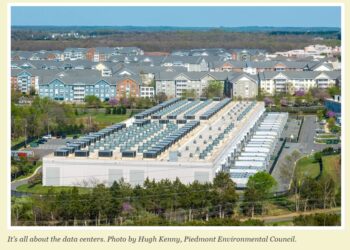
- With the climate crisis raging, we can expect more droughts and heat waves in our future, as well as more flooding – basically, more chaos in the weather, leading to more chaos for water supplies, among other things. Given that reality, we are going to have to adapt in a variety of ways, including not assuming that we’ll have the types of precipitation patterns (and consistent water availability) we’ve had in the past. That increased chaos should be taken into account in planning, whether for data centers (which use a great deal of power and also significant volumes of water) or anything else.
- I would point out that data centers, even if you haet them with a passion, are absolutely NOT the only area putting strains on water resources. To put things in perspective – which is rarely done by the media, of course, because god forbid they do some research or anything – a comparison finds that “US data centers consumed an estimated total of 228 billion gallons of water in 2023, far less than the 2.9 trillion gallons that Americans used for watering their lawns that year.” Of course, “That is not to say that data center water usage is trivial, but it makes the issue hyper-local. A data center that consumes a modest amount of water on a national scale can severely undermine local water sustainability if the facility relies on water-stressed aquifers, rivers, and watersheds.” And data centers are growing fast, while hopefully more and more people are realizing that it’s long past time to tear out their non-native, pesticide/fertilizer/water-intensive, sterile monocultures (“lawns”) and replace them with native plants, pollinator-friendly species, etc. Anyway, this bullet point isn’t intended to minimize the problem of water usage by data centers, but simply to point out that many of the same people upset about data centers’ water usage have suburban/exurban lawns which require huge amounts of water (plus fertilizers, pesticides, etc.) to keep lush, green and “weed”-free (in air quotes, because many of those plants are far better for the environment than “lawn” grass).
- As for the six-month delay in releasing the DEQ report on data centers’ water usage, and even then only after “an open records request from the Associated Press to pry the report out of Spanberger’s office,” that’s just completely unacceptable – both by Youngkin (and Youngkin’s DEQ director Mike Rollband) and Spanberger (who for whatever reasons “retained Rollband to continue serving during her administration”). Also, what’s the full story behind this delay? The public really deserves to know.
- I’d just point out that, even if there were plenty of water for use by data centers, and even if we decided that it’s wise to use large amounts of that water to cool data centers’ equipment, I don’t really see how we get past the issue of powering these things – as a JLARC study found in 2024, data centers use a HUGE amount of energy (e.g., one large data center can consume over 1,000 MW, more than Virginia’s largest nuclear reactor)! And no, we can NOT expect that the ridiculous concept of “small modular nuclear” power plants to save us; among other things, the technology isn’t really there yet, plus they’ll be *extremely* expensive, not even getting into all the other issues around siting, waste, etc. So bottom line, how the hell do we plan to power all these data centers? And how is this massive rightward shift in the “demand curve” for power not going to increase the cost of power, if the supply curve for power remains relatively inelastic? Econ 101, anybody? Sure seems like power prices are going to have to go up for all of us, if data centers’ rapid power demand growth oustrips the growth in power supply.
- Finally, on the politics of this, public opinion has turned sharply against data centers (71% opposed), which means that for anyone who hopes to have a future in politics, being seen as siding with the data center industry against public concerns doesn’t bode well for that future. Even worse is if you’re seen as somehow covering for the data center industry, such as by delaying release of a report which highlights major problems – in this case, water usage – stemming from data center development. Of course, many politicians view data centers as a cash cow which allows them to maintain lower tax rates and higher services than would be the case without those revenues, so the temptation is clear. But like everything else, a smart politician should balance those benefits with the negatives, whether environmentally or politically, of they could find their political careers shortened considerably from what they’d hoped…
With that, here’s the excellent article from Ivy Main.
Among the many environmental, energy and economic concerns about the unconstrained spread of data centers in Virginia, the impact on drinking water supplies has ranked fairly low. That changed suddenly last week, with the release of a report that the administration of Gov. Abigail Spanberger seems to have tried to suppress.
In compliance with legislation passed in March of 2024, scientists at the Department of Environmental Quality (DEQ) studied the health of the largest aquifer in eastern Virginia. Their report concludes that the Potomac Aquifer can’t support any new industrial water withdrawals. That means no water-cooled data centers.
The implications for data center developers are obviously bad. But for the governor, the consequences may be worse. The administration delayed releasing the report for six months beyond its January 1st deadline. In fact, it took an open records request from the Associated Press to pry the report out of Spanberger’s office.
Spanberger wasn’t even in office on January 1, so outgoing Gov. Glen Youngkin and his DEQ director, Mike Rollband, bear responsibility for at least the initial delay.
However, Spanberger retained Rollband to continue serving during her administration. And in the months since she took office, Spanberger, like Youngkin before her, has sided with the data center industry much more often than with its critics.
Rollband himself has not commented on the delay. The Associated Press said a Spanberger spokesman “attributed delays in the report’s release to a backlog of outstanding items from the previous governor’s administration.”
The delay matters. If the report had been released by its January deadline, it might have influenced the General Assembly’s consideration of bills this year aimed at protecting Virginia’s water resources from the unchecked growth of the data center industry, or even spurred tougher measures.
The General Assembly passed legislation to require reporting on how much water data centers are using, but the House bill originally required disclosure upfront as part of the permitting process. Those tougher measures never made it into the final bill.
If legislators had had the benefit of DEQ’s report in January, would they have settled for merely collecting data after the fact?
Sens. Russet Perry, D-Loudoun, and Richard Stuart, R-KIng George, think not. On Thursday the two legislators sent Spanberger a letter asking her to convene a special session to consider new policies to rein in water use in the aquifer system.
Yet the report’s conclusions are not actually a surprise.
It’s true that, unlike the arid West, most of Virginia has enough water most of the time to meet our needs. But this is not the case for the Virginia Coastal Plain, roughly the area east of I-95 overlying the underground Potomac Aquifer. There, heavy withdrawals of groundwater have for decades exceeded the ability of rainfall to replenish supplies.
The depletion of the Potomac Aquifer has been a recognized problem for years among scientists and area leaders. Its consequences include sinking land, saltwater seeping into water wells in coastal areas and greater relative sea level rise that contributes to coastal flooding.
Most seriously, groundwater depletion threatens the ability of the region to provide water to a growing population.
The Hampton Roads region has even implemented an effort to inject treated wastewater into the aquifer to reverse (or at least limit) land subsidence. According to the DEQ report, all it would take to undermine that effort is one significant new industrial user like a gas plant or hyperscale data center – or a combination of the two.
Underlining the seriousness of this conclusion is the fact that most of Virginia is currently in a drought, one severe enough to warrant weekly meetings at DEQ. The agency’s online map shows that as of this writing, groundwater supplies in parts of the coastal plain have fallen to emergency levels.
The depletion of the aquifer has hindered development before.
Back in 2019, concerns about groundwater depletion became an issue for two gas-fired power plants proposed for Charles City County, which would have relied on groundwater from the Potomac Aquifer to produce steam and provide cooling.
At the time, DEQ proposed to grant one of the developers a temporary permit until a pipeline could be built to deliver enough river water. Following passage of the Virginia Clean Economy Act (VCEA), however, the gas plant proposals were scrapped.
Today, however, developers are proposing a new gas plant in Charles City to provide a data center with onsite generation.
Developer Point One seems to think it has figured out a way around the VCEA’s limits on new fossil fuel generation by using 35 smaller gas turbines instead of a couple of big ones, and using the electricity to supply the data center directly instead of feeding energy into the grid. Whether it has discussed its water needs with DEQ is not clear.
Polling in Virginia shows public opinion has turned sharply against data centers. Spanberger’s own popularity has also turned negative, and that might be due in part to her support for the data center industry.
A poll released in July by the L. Douglas Wilder School of Government and Public Affairs at Virginia Commonwealth University showed 72% of residents oppose the sales tax exemption for data centers that Spanberger fought to preserve.
Although Republican legislators in Virginia have historically supported the data center industry in larger numbers than Democrats, they may be seeing a political opportunity. Republican Sen. Glen Sturtevant, R-Chesterfield, sent a letter asking Spanberger for a “pause” on new data center approvals, citing the General Assembly’s failure to pass legislation he introduced to require site assessments.
That puts Sturtevant on the same side as environmental groups like the Sierra Club that now see a temporary moratorium as the only way to slow the onslaught. Virginia Sierra Club data center chair Ann Bennett told me that while the DEQ report clearly makes the case against siting data centers east of I-95, “we need to protect all state waters.”
With pressure from both the left and the right, Spanberger has the difficult job of balancing her support for data center development with her promises to protect the environment and make data centers “pay their fair share.” Her delay in releasing the DEQ report undermines her credibility at a crucial time.