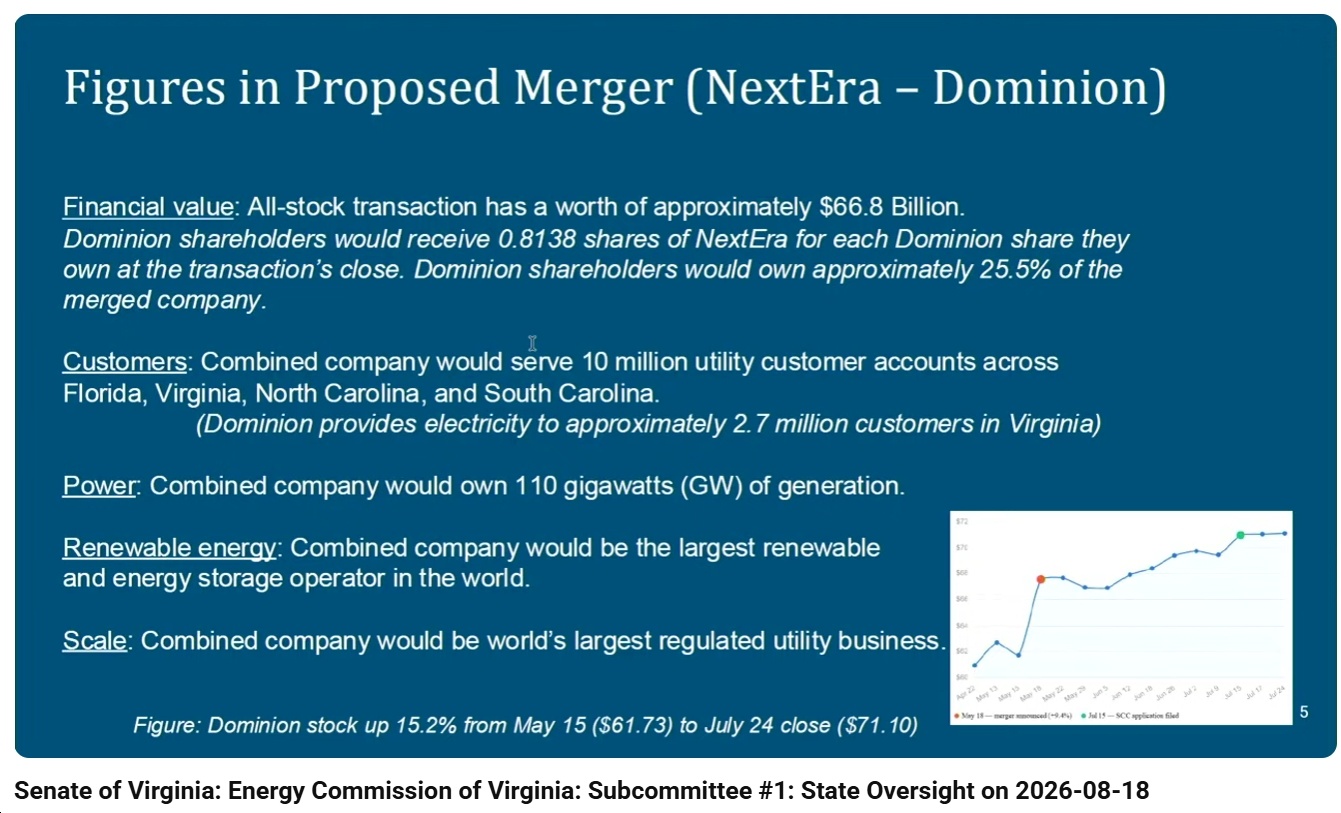
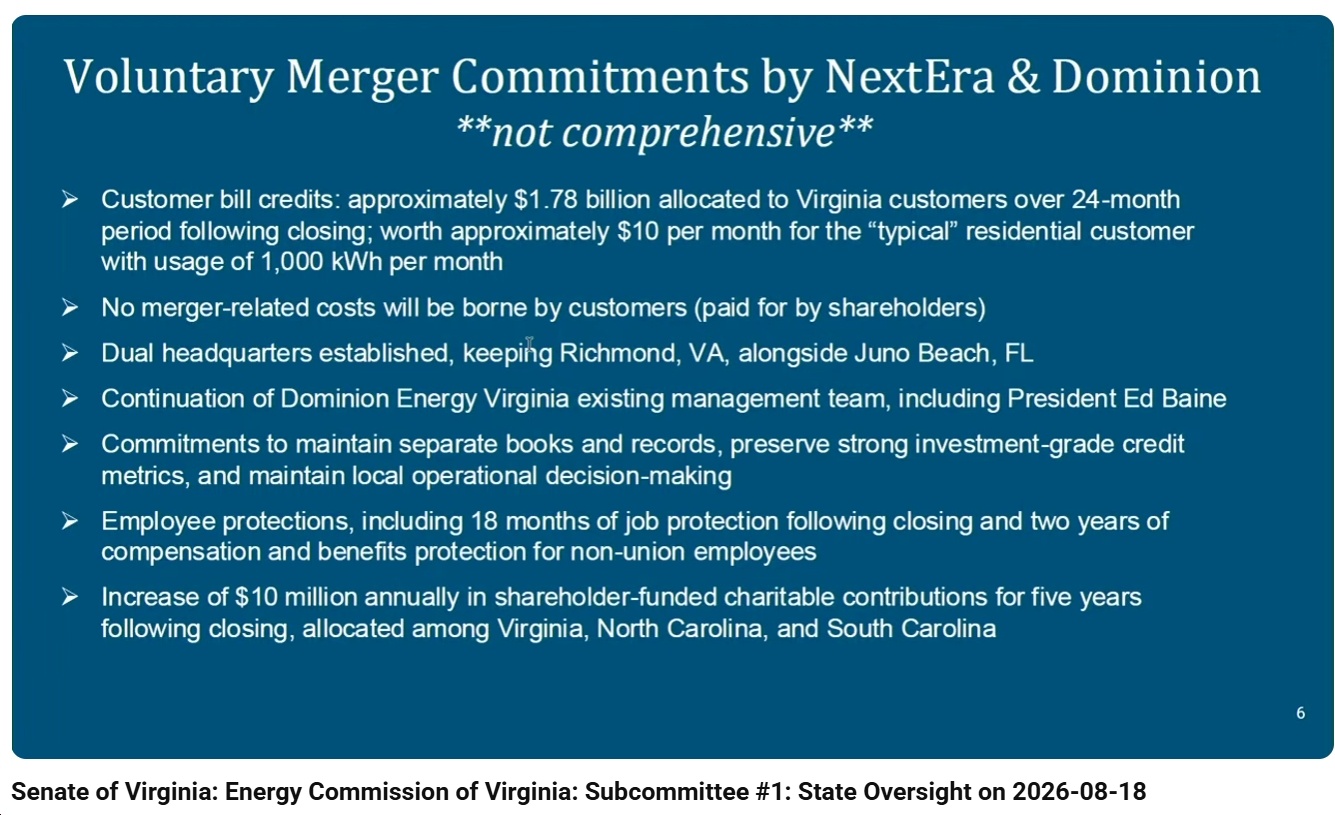
On Tuesday of this week, the Energy Commission of Virginia held a hearing on proposed acquisition by NextEra of Dominion Energy. There’s a lot of interesting stuff in here, including presentations by Energy Commission Executive Director Carrie Hearne and by Yale Law School Professor Josh Macey (whose “research focuses primarily on electricity market design and the regulation of public utilities”), plus public testimony about the proposed merger (note: the vast majority of speakers were AGAINST the merger). Overall, after watching much of the hearing, I came away more skeptical than ever about the proposed acquisition, and I definitely think the process to consider it shouldn’t be time-constrained to six months, also definitely shouldn’t have anyone on the State Corporation (e.g., Kelsey Bagot, who worked as an attorney for NextEra, and also apparently promised to recuse herself from any cases involving her former employer) with actual or perceived conflicts of interest.
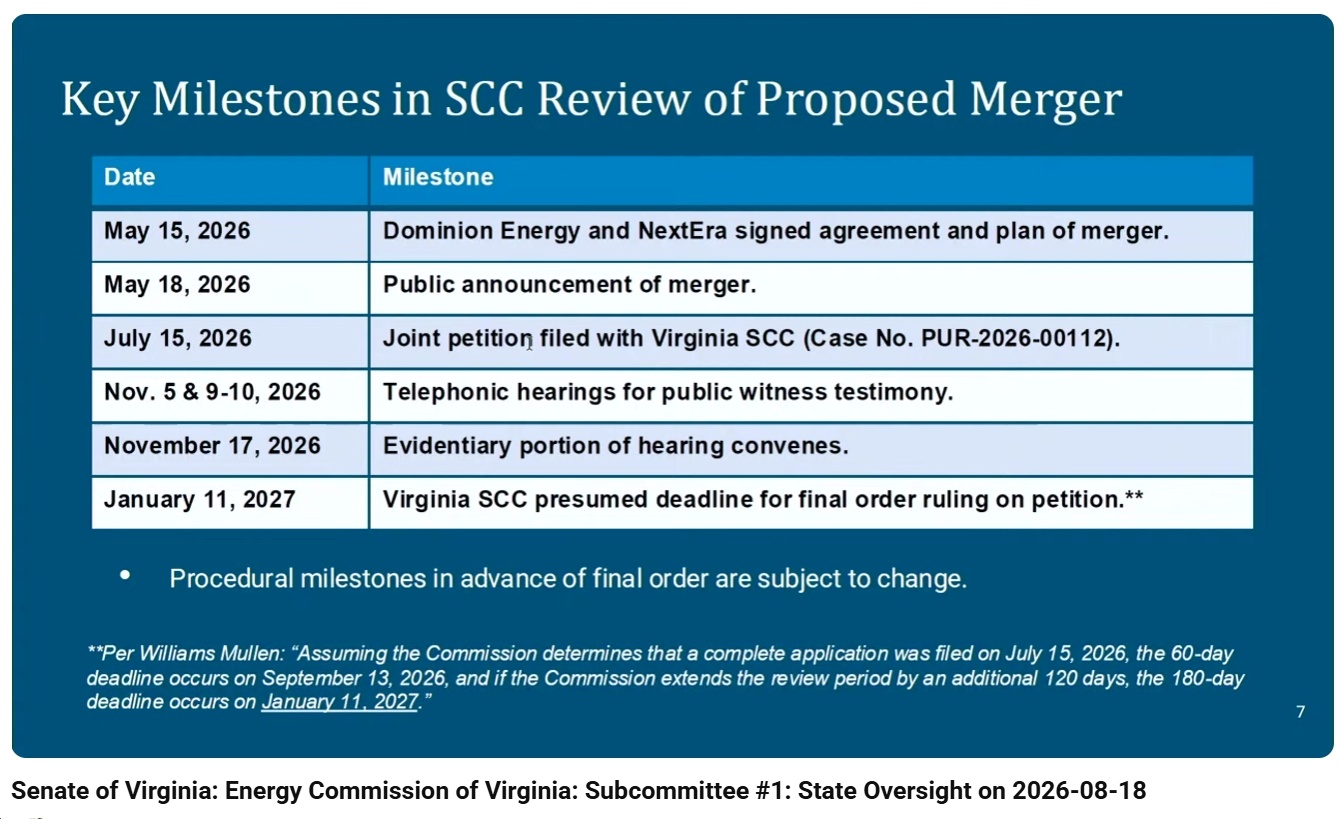
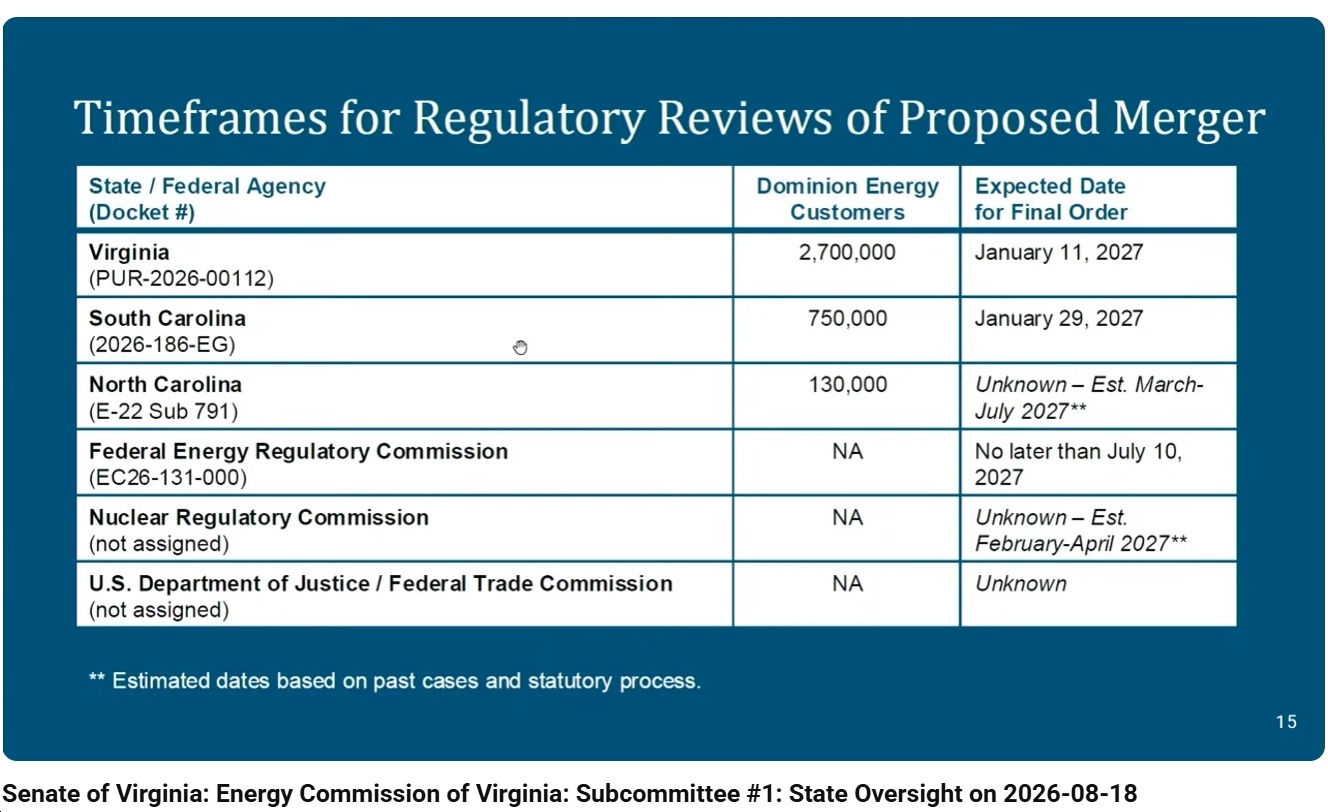
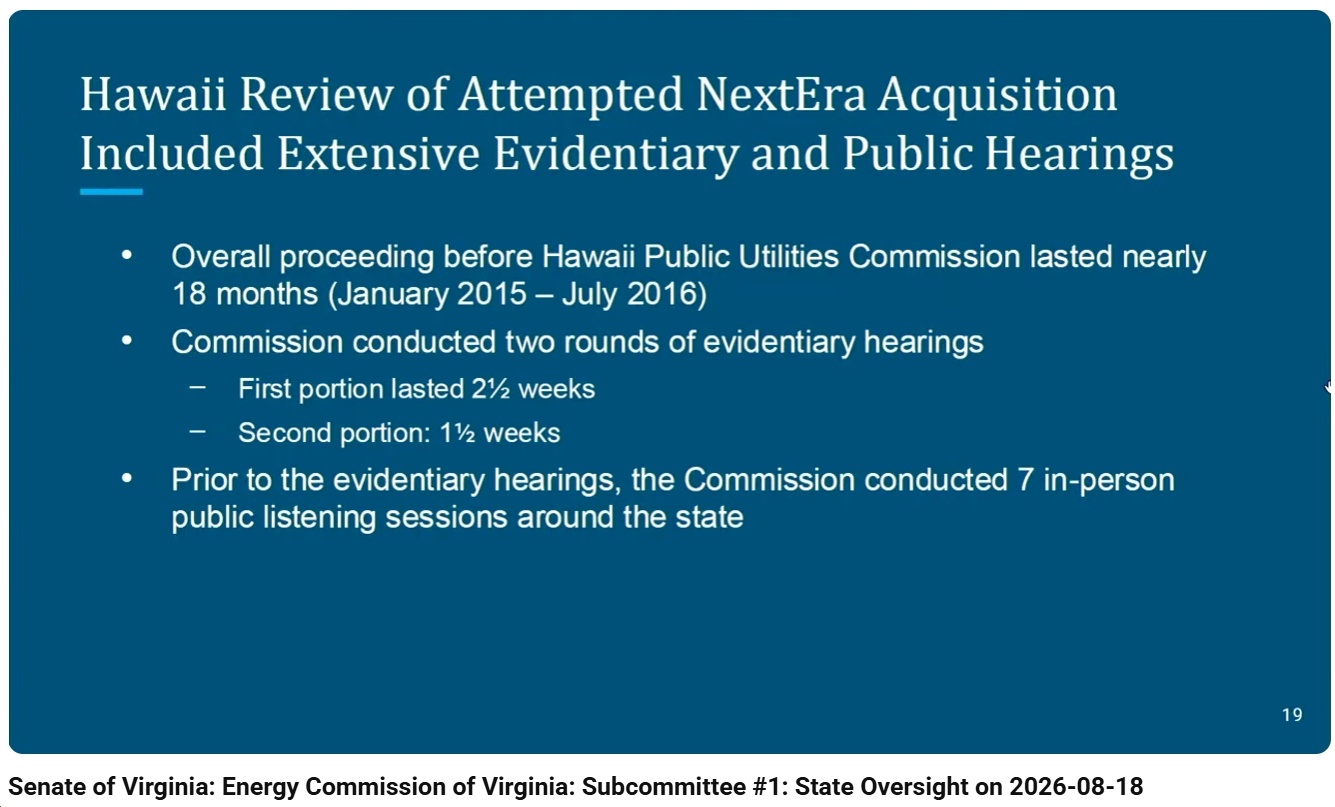
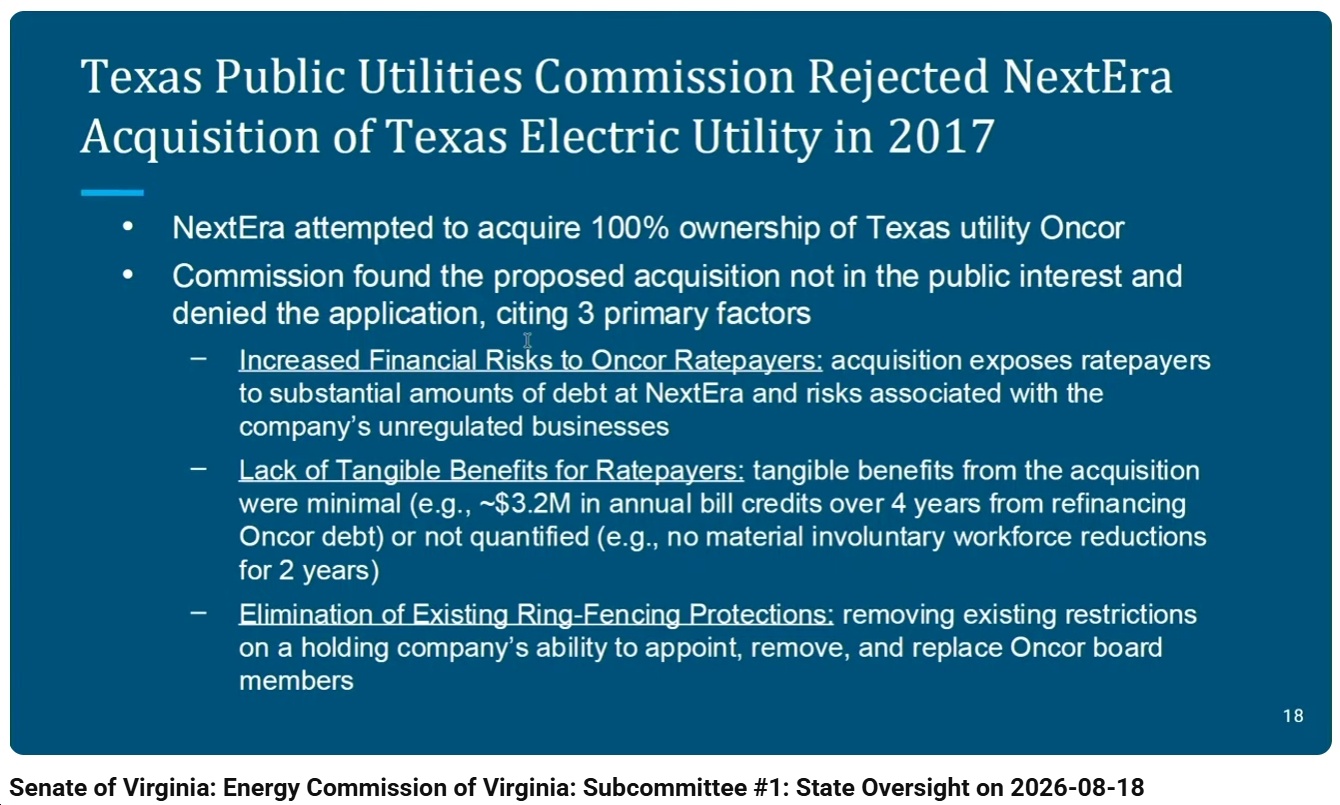
With that, here are a few highlights…first from Carrie Hearne. As you can see, the Virginia SCC “presumed deadline for final order ruling on petition” is January 11, 2027, which is just five months from now…not sufficient time, it seems to me, given the massive size and complexity of this merger. Also note that Hawaii – which ended up rejecting an attempted acquisition by NextEra there, took 18 months; and that Texas also rejected a proposed NextEra acquisition (of Oncor) there due to “Increased Financial Risk to Oncor Ratepayers,” Llack of Tangible Benefits for Ratepayers,” and “Elimination of Existing Ring-Fencing Protections.” Seems like most if not all of that should be relevant in Virginia as well…
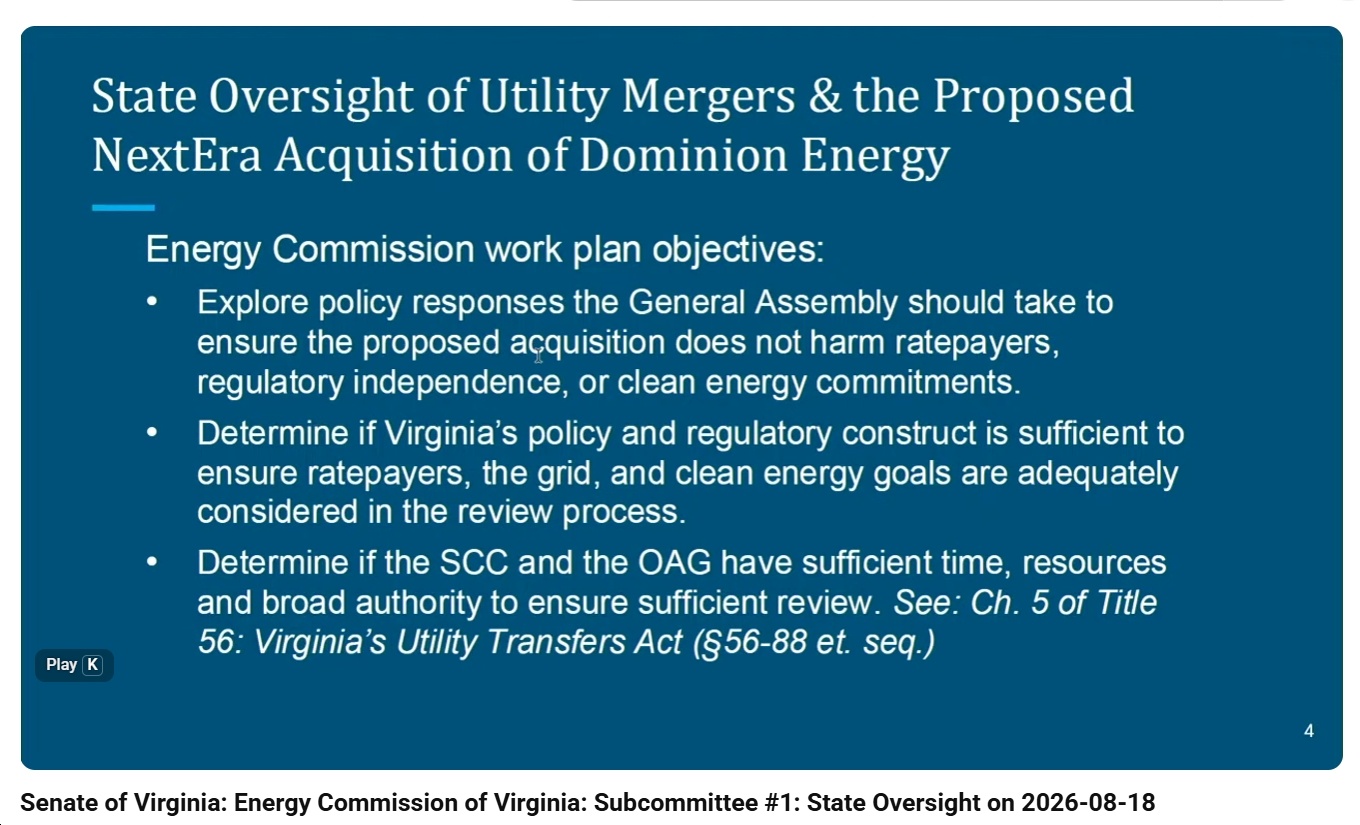
Next, see below for a transcript from the superb presentation by Joshua Macey of Yale Law School – bolding added by me for emphasis of key points:
- “The the key points I want to go over are first one that in traditional non-utility markets, we apply a certain standard of review to evaluating mergers. And that standard is typically the existence of a merger or an acquisition premium is evidence that the merger should generate efficiencies. Or at least that shareholders think that it will. And that is not evidence in a utility merger, for reasons I will get into.”
- “That said, so there are a few reasons, some of which have been flagged cross affiliate transactions, debt guarantees, financial arrangements, strategic investment decisions where it can be highly advantageous for a company to take advantage of regulated affiliates. So the retail service territory in Virginia to give unregulated rates and advantage. This is not a good reason to approve a merger. There are also efficiencies to certain mergers, and it is possible that this merger could unlock efficiencies. So I think I’m not going to say this merger is good or this merger is bad. But what I would like to urge you to think about is that there are certain processes that can ensure that the review and scrutiny applied to the merger prevents any of the bad justifications from inducing shareholders to go through with the merger and can ensure that the merger will only go through if it unlocks efficiencies.”
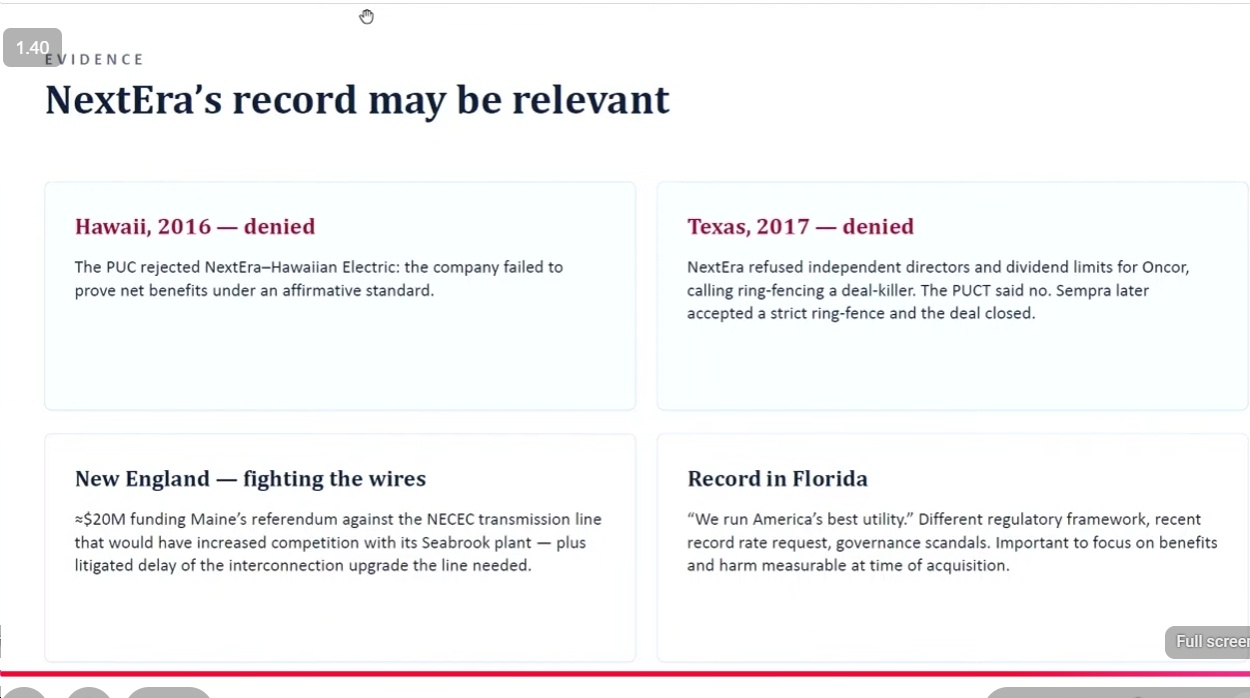
- “So you’ll note, for example, that in Texas, when NextEra tried to purchase Oncor, NextEra ultimately stopped going forward with the acquisition because Texas refused to to to lighten ring fencing requirements. And so imposing certain substantive requirements can be a way to deter mergers that are motivated by the wrong reasons.”
- “There’s a huge amount of money being thrown out. There’s the idea that we can have rate credits for Virginia customers. There are obvious concerns surrounding large load, and there’s a fairly short statutory clock to review the transaction. One thing that I think is relevant is that things like rate credits should not be a reason. There’s fairly good empirical evidence that rate credits typically have been offset through price increases. Later, the size of the company may be cause for concern. It may not. Large load is certainly cause for concern, but in terms of all of these things, the merger is also an opportunity to sort of undo by attaching conditions some of the mischief that may be going on today. And so again, the question for me is not simply do you approve the merger or not, but what are the conditions under which you might approve any future merger?”
- “So there’s a lot of discussion that I’ve seen about NextEra is a good operator in Florida, but it’s asking for a huge rate increase. There are certain scandals I at least don’t feel competent to weigh into this. I think the question is we should think about will the merger create value, and we should think about what regulatory standard will ensure that the merger creates value. So in a competitive market, if a company like NextEra is willing to pay $67 billion to buy a target, essentially what the Federal Trade Commission and the Department of Justice do is they say, is this going to create anti-competitive harms? If not, shareholder money is on the line, meaning we think that shareholders, not regulators, are best positioned to determine whether the merger will unlock efficiencies, whether there will be innovation, etc. So the existence of an acquisition premium, when people teach mergers and acquisition or antitrust, is a sign that the merger unlocks efficiencies. That is not the case in a rate-regulated environment. And this is the kind of core intellectual thing that should mean much money of the rate credits and acquisition premiums being thrown around provide virtually no evidence that this merger will be helpful to Virginia customers. And the reason for that is that if you have one company with a 10% return on equity and it buys another company with a 10% return on equity, it should not be able definitionally to provide that acquisition premium back to shareholders. We don’t want ratepayers to be overcharged. The regulator sits as an intermediary and says the merger that you get to increase rates for X reason, reduce rates for Y reason. But there is no automatic mechanism by which improvements in service cost reductions will translate into greater profits in a utility context. And the reason for that is that an administrative body determines profits. So while ordinarily an acquisition premium is something that the acquirer thinks it can use, is a vehicle for driving profits, that connection is disrupted in the context of utility mergers, because shareholders can’t automatically increase prices if they provide a better service. If they reduce their own costs, they actually don’t earn higher profits unless the regulator says that they can. So this creates the question of why do utilities want to buy other utilities?”
- “There are basically five sources of value for shareholders, only two of which are legitimate. The first is that there are real efficiencies and the acquirer thinks it will be able to privatize some of those efficiencies through the merger. Again, this involves going through the regulator. The second reason is that the acquirer thinks it will be able to earn returns above the cost of capital under typical rate making. I know you heard from Scott Hempling earlier, so you probably had this drilled into you, but the way that utility return on equity should equal the utility’s cost of capital, meaning you can only drive profits above the target amount if you overcharge ratepayers. So if the idea – and it’s important, in my opinion – that NextEra’s primary justification to its shareholders is increased capital expenses. But if the cost of equity is set exactly at the cost of capital, the utility should be indifferent between investing in additional capital expenses in Virginia or making any other investment. It is only if rates are set too high that the utility should want to buy another utility, so this is not a good reason. Driving capital, we should make. We should the utility should make capital investments needed to provide cheap and reliable service. But we do not want to create an incentive to overbuild. The third reason, and one that I think has gotten considerable scrutiny but is concerning, is affiliate transactions and financial engineering. Many utilities, especially after large mergers, have done things like cross affiliate debt guarantees, where the regulated affiliate. So the Dominion’s retail customers are guaranteeing the debt of competitive affiliates. So if NextEra participates as a supplier in PJM, it will get a competitive advantage. If it has low cost debt, which is guaranteed on the backs of Virginia ratepayers. This means that Virginia ratepayers would be subject to risks that they should not be subject to. So this is where all of the discussion surrounding ring fencing is important. The bad news is this is a real risk. The good news is that it is something that can be addressed through strong conditions if the merger is approved. Relatedly, there are concerns about the regulated utility purchasing above market supplies from its unregulated affiliates. So if NextEra is a supplier of energy in the wholesale market, we worry about procurements in which NextEra, the retail supplier, is purchasing from itself. Outside of a competitive process, this is difficult to regulate, but not impossible. “
- “The final thing that I think is extremely important and extremely concerning from my perspective, is the possibility of strategic investment decisions designed to expose captive ratepayers to excessive risk, while benefiting areas that the company has targeted for growth. So an example of this would be strategically building transmission lines so that someone things like hyperscalers that are driving growth get access to cheap energy or capacity, and ratepayers are not able to take advantage of that. So to provide one anecdote, which is not proof, but in New England, NextEra worked lobbied very, very aggressively against the New England. The New England Clean Energy Connect, a large transmission line that would have exposed some of Nextera’s independent power generation to competition from low cost suppliers. And the concern is that if NextEra owns and builds the infrastructure and it is and it builds supply, it will want to basically drive profits in its wholesale market by deliberately giving cheaper or more reliable power not to ratepayers, but to the customers driving growth. This, in my opinion, is an extremely difficult issue for a regulator to address. Much of the responsibility for these infrastructure investments is the responsibility of PJM, the grid operator, and so the best advice I can give is strong sort of auditing requirements and. But it’s quite difficult. Finally, there are arguably economies of scale.
- “So I just wanted to emphasize that NextEra itself has emphasized capital growth. This to me should not be the justification for a merger. It arguably suggests that the return on equity is already set too high in Virginia.”
- “The biggest, the first major concern is financial engineering that the regulated utility is essentially used as a piggy bank to create an unearned competitive advantage for affiliates. This is why most academics think that a regulated company should not be able to be part of the same parent company as an entity that participates in a competitive market. In some respects, that ship has sailed in Virginia. Dominion is vertically integrated, but the potential with a larger company may give rise to increased concerns.”
- “The next concern is the regulated affiliate just buys from itself at above market contracts. If NextEra has a generator it wants to build, it can be very difficult to ensure when Dominion is automatically recovering the costs of its suppliers through rates, whether it’s overpaying itself.”
- “It is worth going over some bits of the record here. NextEra’s attempt to acquire Oncor in Texas was ultimately died because NextEra did not want to agree to certain ring fencing provisions. The Hawaii merger is instructive in Hawaii, unlike in Virginia, a merger or acquisition has to show an affirmative benefit in. My understanding is that in Virginia it is simply a no harm standard, and the Hawaii Commission rejected the acquisition on the ground that no affirmative benefit was showed. So that is an area where I do think a legislative reform would be useful.”
- “So my view is that if the right way to treat this merger is rather than say, we want to kill the merger or approve it is to impose conditions that ensure that most, if not all of these risks are mitigated in the event that NextEra chooses to go through with the merger.”
- “That would involved a bunch of things, but there should be no cross affiliate transactions, no entanglements of rates, real genuine corporate separateness, very, very careful scrutiny about dividend payments so that the retail utility can’t be used to pay high dividends, leaving the company financially distressed in the event that things go wrong. Genuine corporate separateness, including independent directors…very careful review of affiliate transactions. Much, much greater transparency than currently exists. Again, very strict capital requirements to assure that the retail utility is financially capable of meeting its obligations and doesn’t get financially entangled with the parent. And then very, very clear. And I want to give the Virginia Commission a lot of credit here for already taking the lead on this, but being very, very careful to having separate rate classes for large load customers such that existing ratepayers are not subsidizing large load.”
- “To the extent that I would advise you all to change Virginia law, the first is that I would replace the do-no-harm standard with a some sort of showing that service be improved and that there be demonstrable benefits to Virginia customers that that protects them from these harms…I would extend the timeline. I think that for large multi-state transactions such as this, 180 days may be too little. I would authorize continuing oversight after the merger, include performance measures such that the combined companies compensation over a decade or two is based on very, very clear commitments to meeting performance targets and very, very, very strong requirements about transparent competitive procurements on the supply side.”
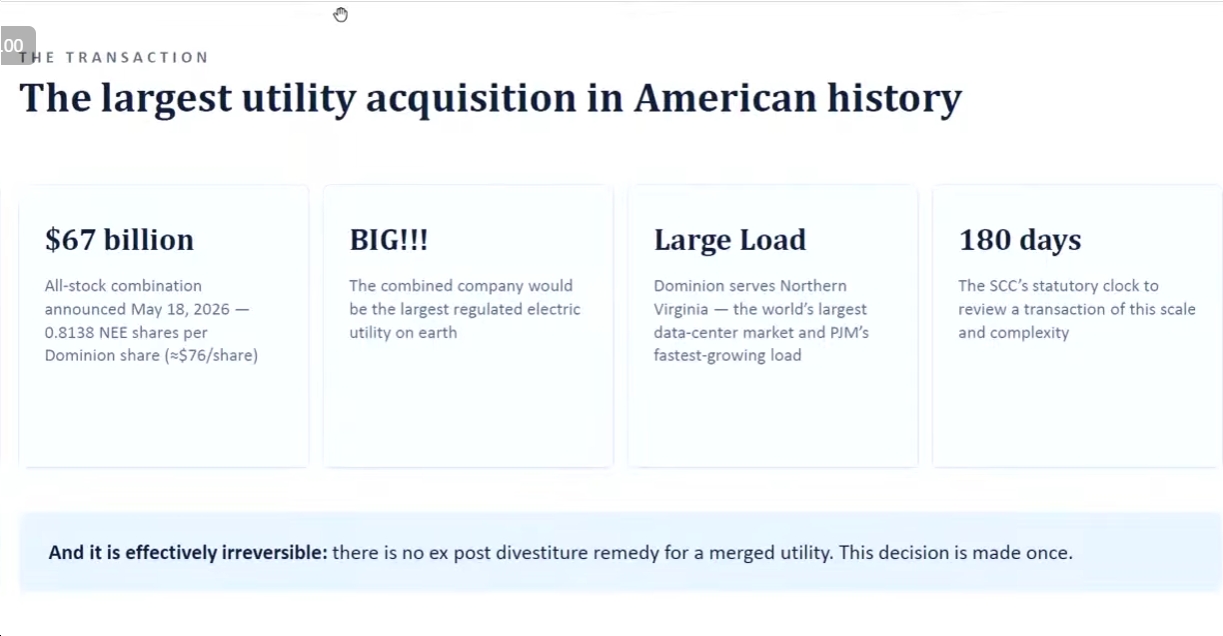
Finally, great points by Virginia activist Kate Powell: “But how can we have confidence in a process at such such terms under the current Virginia State Corporation Commission leadership? Judge Kelsey Bagot is absolutely qualified from an experiential standpoint to oversee this merger. What she lacks is the appearance of, if not in fact the actual lack of impartiality in this matter, including her previous work experience with next era energy. This work history did not escape the notice of Virginia lawmakers during her election process to the Virginia SEC. And she repeatedly assured both Senator Russet Perry and then state senator Suhas Subramanyam that she would recuse herself from next era matters. However, um she and she also stated that she would abide by the Virginia judicial code of ethics. Canon two of that code states that a judge shall avoid impropriety and the appearance of impropriety. Yet now, Judge Bagot hides behind what is admittedly a gap in the prohibited conflicts of interest as outlined in the code, stating in a letter to Senator Serval this week that long-standing historical commissioner practice. By that practice, mere work history with a regulated entity has not served as a categorical basis for requiring recusal. The judicial code includes the appearance of impropriety for a reason. The standard of ethical behavior is not merely what is tradition but also what gives that appearance. If she refuses to recuse herself, you all have legislative matters in which you can respond.”