Last year around this time, I posted my “25 Things to Keep an Eye On as Virginia Heads Into 2025.” Among the top items for 2025, I included: How will Glenn Youngkin govern – MAGA all the way? relatively sane/reasonable? – in his final year (thank god!) in office?; What will Donald Trump’s approval rating be in the fall of 2025?; Will Donald Trump campaign actively in Virginia for the Republican ticket in 2025? How about JD Vance?; Will Trump actually end up firing/moving a bunch of federal employees who live in Virginia? What if anything will Youngkin say/do about this? If this happens, how badly will it harm Virginia’s economy (particularly if deportations and tariffs also happen on a large scale)?; Will Virginia Democratic voters be fired up, demoralized/depressed, or what?Will Virginia Republican voters be fired up, checked out/asleep, or what?; Will the usual pattern of Virginia flipping hard against the party that just won the White House continue in 2025?; and Who will win the Virginia governor’s race next November – and by how much?
On most of these, I feel pretty good about what I was thinking at the time, in terms of predictive accuracy. So…as we approach the start of 2026, let’s try this again: what should we be keeping an eye on here in Virginia? Here are 26 items (definitely not exhaustive, and in no specific order, although the ones higher on the list probably popped into my head sooner, so…whatever that means, exactly) – enjoy? 😉
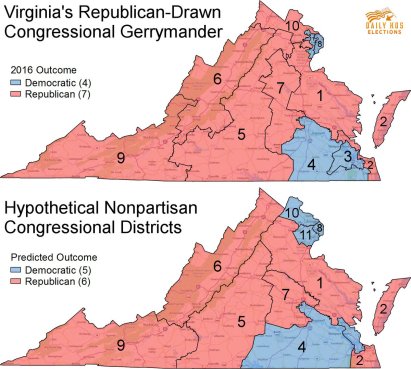
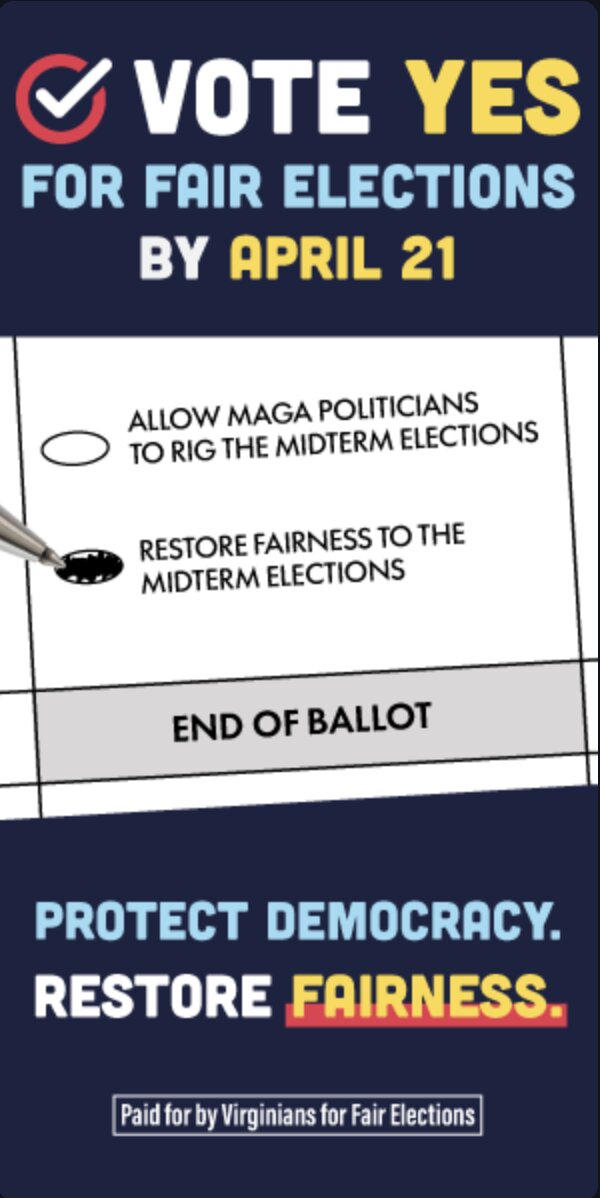
- Will a new U.S. House map in Virginia go into effect for the November 2026 elections? If so, what will that map look like? The chances of this actually happening went from essentially zero to pretty high by October 23 to even higher on October 31 (when the VA State Senate voted to approve a new redistricting amendment, after the House of Delegates already did so) to…even higher now that the U.S. Supreme Court has allowed Texas to proceed with its mid-decade gerrymandering and Virginia Democrats have declared “full steam ahead.” So now, it looks like this will be taken up immediately when the 2026 Virginia General Assembly session convenes on January 14, at which point it’s basically a lock that the House of Delegates and State Senate will pass the amendment for the second time (with an intervening election for House of Delegates, as took place on 11/4), which is required under the Virginia constitution. Then, two more hurdles await: a) the courts (Virginia Supreme Court, possibly the US Supreme Court); b) the voters, who will decide – probably in April (90 days after the General Assembly passes the amendment for the second time) – whether to approve it or not. We’ll also see, quite possibly in early or mid-January, what the new map will look like. The big question, really, is whether Democrats do what VA Senate President Pro Tem Louise Lucas has been saying she wants to do, which is draw a 10D-1R map (up from 6D-5R now), and which Speaker Don Scott has made clear he’d like to do if he can. If not, presumably Democrats will go for a 9D-2R map, leaving Rep. Morgan Griffith (R-VA09) and Rep. Ben Cline (R-VA06) in safe-“red” seats, while basically drawing Rep. Rob Wittman (R-VA01), Rep. Jen Kiggans (R-VA02) and Rep. John McGuire (R-VA05) out of theirs. Anyway, this is a huge story to follow closely next year, as it will have massive implications both here in Virginia, and also potentially for the country as a whole.
- Will Virginia’s economy head into recession? Today’s jobs report was not a pretty picture, and it certainly didn’t back up Youngkin’s moronic claim at Trump’s inauguration that we were headed into a new “Golden Age.” Seriously, wtf??? Anyway, so the question is whether Virginia’s economy will head into a recession in 2026, and if so, how bad a recession? Oh, and on a related note, I can’t wait to hear Republicans twist themselves into pretzels trying to blame *Democrats* – Abigail Spanberger, for instance – for what’s clearly coming from Trump’s disastrous policies (tariffs, federal cuts, etc.). [UPDATE: According to the Washington Economy Watch for November 2025, “Even using an optimistic estimate for the Washington Region, the area likely lost 41,500 direct federal jobs between December 2024 and November 2025.” So apparently it’s not IF Virginia is in a recession in 2026, but how bad a recession?]
- What will the impacts of federal cutbacks be on Virginia’s budgetary situation, and how will lawmakers respond? Even if we avoid a recession, the impacts of cutbacks in federal programs – SNAP, Medicaid, you name it – plus layoffs of federal workers, could REALLY hit Virginia hard in 2026. If so, this will likely have major impacts on the Virginia budget. Which is why it’s so delusional and dishonest to claim that Virginia has “plenty of resources” and even “can offer additional tax relief.” Now, of course, Youngkin has never really cared about understanding state government or the job of being governor, but still…does he not comprehend that we MUST balance our budget, and that we’re about to get hit with an avalanche of needs, thanks to the aforementioned federal cutbacks? Or is he just doing what he always does, which is lie through his teeth? Anyway, regardless, Virginia lawmakers are going to have to deal with this situation next year; the question is, how will they do so? By cutting spending? raising taxes? other options? It’s going to be a challenge, for sure, but that’s why they get paid the big bucks, right? (that’s a joke, obvously; our legislators make like $18,000 per year for what’s supposedly a “part-time” job, even though they’re busy pretty much year-round)
- What will the General Assembly do exactly to fulfill Abigail Spanberger’s main campaign promise of addressing affordability in Virginia? Yet again quoting Ivy Main: “If Virginia’s election last month was more than an unleashing of anti-Trump sentiment (and it definitely was that), it was about affordability. Governor-elect Abigail Spanberger made the cost of living the focus of her campaign, frequently mentioning high energy bills. House Democrats, whose majority has been boosted by the addition of 13 new members of their party, are also expected to focus on these bread-and-butter issues.” The question is, what specifically can (and will) the new Democratic “trifecta” do about this challenging issue? On energy costs, Governor-elect Spanberger has specifically mentioned “maximizing the use of energy efficiency measures,” which is VERY smart, as energy efficiency provides by far the biggest “bang for the buck” when it comes to energy, as it’s energy you never have to produce in the first place. Also, could we see bills passed to address housing affordability in Virginia, mostly – in Spanberger’s opinion – by promoting policies that encourage increased housing supply overall, and affordable housing more specifically? How about on health care costs? In Abigail Spanberger’s “Affordable Virginia Plan,” she talks about measures like “cracking down on the middlemen – pharmacy benefit managers (PBMs) – responsible for inflating the cost of prescription drugs”; “hold[ing] large pharmaceutical companies accountable through strict enforcement of price transparency laws and enforce penalties when there is evidence of price gouging”; “improv[ing] hospital price transparency”; “hold[ing] scammers accountable for ripping off Virginians”; etc. So how much of Spanberger’s “Affordable Virginia Plan” will pass the General Assembly and become law next year?
- Will Abigail Spanberger govern more as a “moderate,” “bipartisan,” “reach-across-the-aisle” etc.? Will she veto any progressive legislation sent to her, or will her administration work to keep such legislation from ever reaching her desk in the first place? Spanberger’s “brand” since 2018 has consistently been that she’s a “moderate” (whatever that means exactly), “bipartisan” (again, not sure what that even means anymore, when we’ve got one sane party and one far-right/insane/MAGA-fied party) “reach across the aisle” (ditto), “get things done,” etc. Of course, that was at the federal level, for the most part, although it continued into her gubernatorial campaign as well – so maybe this is what she really believes, and it’s not just marketing? Anyway, now that she’s been elected governor of Virginia, and also now that Democrats have a HUGE majority – including many progressive members – in the House of Delegates, it will be fascinating to see how Spanberger actually governs. Specifically, what will Gov. Spanberger do if/when progressive legislation – on “right to work,” let’s say, or criminal justice reform, or climate/energy, etc. – hits her desk? Or will her administration work behind the scenes to make sure that only legislation she approves of ever reaches her desk in the first place? Recall that the last time Democrats held a governing “trifecta” in Virginia, in 2020-2021, the General Assembly passed – and Gov. Ralph Northam signed into law – HUNDREDS of pieces of progressive, pro-clean-energy, etc. legislation. Will that happen again this time around? Especially given that Youngkin spent the past two years VETOING tons of excellent bills, many of which are likely to be reintroduced in 2026?
- How will Speaker Don Scott manage his massively increased Democratic caucus? On one level, having a massive majority falls into the category of “the kind of problem you WANT to have” (and also that Don Scott and his campaigns chief, Dan Helmer, deserve a great deal of credit for bringing about!). On the other hand, a bigger caucus could be more unruly, hard to manage, etc. As Speaker Don Scott said recently: ” The word of the day now is restraint. We can’t overreach. We have to be restrained. We have to be wise with the gift that the voters have given us to govern. We have to be wise in how we move forward, so it’s gonna be important for us to have a coalition that’s restrained, that’s smart, that’s disciplined and focused on what voters want us to do.” So we’ll definitely be keeping an eye on how that plays out, with lots of new (and in some cases very progressive) delegates, and what it means in practice as we head into 2026.
- Will the State Senate, where Democrats hold just a 21-19 majority, kill a lot of progressive legislation coming out of the House of Delegates? In the 2026 Virginia House of Delegates, Democrats will hold a massive, 64-36 majority, which means we could very well see a lot of progressive legislation introduced. The question is, will that legislation – assuming it passes the House of Delegates – also pass the State Senate, where Democrats (including leaders Louise Lucas, Scott Surovell and Mamie Locke) hold only a narrow, 21-19 majority (with LG Ghazala Hashmi breaking ties)? Because it would only take a two Democratic Senators breaking ranks on any particular piece of legislation, assuming Republicans vote in lockstep, to kill the bill. So we’re going to find out whether there are 20 or 21 Democratic votes on things like banning assault weapons, getting rid of so-called “right-to-work” (anti-union) laws, serious campaign finance reform, whatever. Also, you’ve got to wonder if the Spanberger folks will be working behind the scenes more to push progressive legislation, more to moderate that legislation, or more to prevent it from ever reaching her desk (forcing her to decide whether to sign, amend or veto)…
- Who will win the Virginia Democratic primary to take on Rep. Rob Wittman (R-VA01)? Assuming a 10D-1R map, it’s highly likely that Rep. Rob Wittman (R-VA01) will be in deep, deep political trouble (and deservedly so, as he’s terrible!) next November, the main question being which Democrat will have the honor of booting his sorry as* out of office. Right now, by far the favorite (in terms of fundraising and endorsements) in this race is Henrico County Commonwealth’s Attorney Shannon Taylor, but we’ll see if she stumbles, or if any of her Democratic primary opponents – see here for the full list, which is a long one! – can beat her. By the way, note that this district as currently drawn went narrowly for Abigail Spanberger in November 2025, so even if it is NOT redrawn, Rep. Wittman isn’t safe politically speaking.
- Who will win the Virginia Democratic primary to take on Rep. Jen Kiggans (R-VA02)? This November, Abigail Spanberger carried VA02 by around six points, so Rep. Jen Kiggans (R-VA02) is already in serious jeopardy of losing her seat next November. But if Democrats draw a 9D-2R or 10D-1R new U.S. House map, Kiggans presumably will be in even worse difficulty. Which means that whoever wins the Democratic nomination to run against her is quite likely to be VA02’s next U.S. representative. And right now, by FAR the favorite for the Democratic nomination is former Rep. Elaine Luria (D-VA02), who was just endorsed by Senators Mark Warner and Tim Kaine, as well as by former VA02 Democratic candidates James Osyf and Michael Williamson.
- Who will win the Virginia Democratic primary to take on Rep. John McGuire (R-VA05)? This district is pretty solidly red now (Trump won it by 12 points in November 2024), but given a 10D-1R or 9D-2R map, it presumably will be “purple” or even “light-blue,” meaning that far-right/insurrectionist/MAGA fanatic Rep. John McGuire (R) will be in deep danger of losing his seat. The question is, who will be the Democrat to do the honors of replacing this Trump bootlicker in the U.S. House? The big news on this front recently was the announcement by former Rep. Tom Perriello (D-VA05) that he’s jumping into the race, followed by a slew of endorsements (e.g., by Senators Mark Warner and Tim Kaine, as well as by three now-former VA05 Democratic candidates – Adele Stichel, Paul Riley and Kate Zabriskie). So right now, that leaves Navy veteran and civil rights lawyer Mike Pruitt as Perriello’s main rival for the Democratic nomination, with one other possible candidate being Del. Sam Rasoul, who recently expressed interest in running for a new VA05, VA06 or VA09. Anyway, stay tuned on that front. But for now, this looks like former Rep. Tom Perriello’s nomination to lose.
- Who will win the Virginia Democratic primary to take on Rep. Ben Cline (R-VA06)? Of course, if Democrats opt for a 9D-2R map, then VA06 will remain solid-“red,” and this item will be largely moot. But if Democrats really “go for it” with a 10D-1R map, then this could get REALLY interesting, REALLY fast, as the district could be “purple” or even “light blue” post-redistricting. In which case, the choice of Democratic nominee would be crucial. So who might that person be? So far, the candidates are Pete Barlow, Ken Mitchell and Beth Macy, although as noted above, Del. Sam Rasoul is a possibility as well, plus there are strong rumors that former Del. Wendy Gooditis could get in this race. Bottom line, VA06 could be really uninteresting next year or REALLY interesting, depending on how the redistricting amendment fares, and how ambitious Democrats are in drawing new maps.
- With Glenn Youngkin no longer governor (THANK GOD!), what will this pathological liar and Trump bootlicker do next? After nearly four years of Glenn Youngkin proving he’s most definitely NOT a “moderate” (as the WaPo and others would have had you believe, falsely, back in 2021, 2022, etc.), and after 100% throwing in his lot with Donald Trump (although remember, back in 2021, Youngkin said he was *honored* to receive Trump’s endorsement, and even bizarrely claimed that “President Trump represents so much of why I’m running”), what will Youngkin look to do after he’s no longer governor (thank god!)? Join the Trump administration, possibly replacing puppy-killing psychopath Kristi Noem? Fade away into obscurity (we can only hope!)? Go somewhere to make even MORE money, even though he’s already worth hundreds of millions of dollars and certainly doesn’t need any more? Figure out some other way to keep his name alive in the right-wing echo chamber, so that MAGA voters remember him when he runs for president in 2028? Regardless, we all should just be relieved that Youngkin will no longer be governor of Virginia, because in the end, he was one of the worst governors in Virginia history, certainly in the last few decades, and – seriously – what the HELL were people who voted for this guy in November 2021 even THINKING???
- What will Donald Trump’s approval rating be in the fall of 2026? As a general rule, the midterms tend to see the party holding the White House lose about 26-28 in the U.S. House and about 4 seats in the U.S. Senate. Sometimes it’s much worse than that, though, such as in 2018 – during Trump’s first term in office – when Republicans lost a whopping 41 U.S. House seats; or during Bill Clinton’s first term, when Democrats lose 54 (!) U.S. House seats and 9 U.S. Senate seats; or during Barack Obama’s first term, when Democrats lost 63 (!!) U.S. House seats and 6 U.S. Senate seats; or during George W. Bush’s second term, when Republicans lost 32 U.S. House seats and 6 U.S. Senate seats (one of which was George Allen losing to Jim Webb). So what will things look like this November? In part, that will depend on what Trump’s approval/disapproval rating is, and as of right now, it’s at a miserable 40%-56%. So if Trump’s approval rating next fall is something around that range – which is quite possible – Republicans could very well lose a slew of U.S. House seats, and possibly several U.S. Senate seats as well. Here in Virginia, that could include (even WITHOUT taking redistricting into account) Rep. Jen Kigggans (R-VA02) and Rep. Rob Wittman (R-VA01).
- How will the three constitutional amendments NOT related to redistricting fare in 2026? Among the most important items to be voted on – and presumably, passed for the second time with an intervening election – during the 2026 Virginia General Assembly are three important constitutional amendments: on reproductive rights (HJ1 – “a constitutional amendment protecting reproductive freedom in Virginia”); HJ9 (“Constitutional amendment; marriage between two adult persons.”) and HJ2 (“Right to vote – restoration of rights for ex-felons”). Assuming these amendments pass the General Assembly in January 2026, they will then need to be approved (or rejected) by voters in November 2026. Or, it’s possible that Democratic leadership in the General Assembly could decide to put one or more of these on the ballot in the spring of 2026, at the same time as the redistricting amendment is considered by voters, possibly in an effort to boost turnout and increae the likelihood that the redistricting amendment passes. We’ll see…
- In the fall of 2026, as midterm elections take place, will Virginia Democratic voters be fired up, demoralized/depressed, or what? Will Virginia Republican voters be fired up, checked out/asleep, or what? In the end, it’s all relative – which side is more fired up, ergo turns out in larger numbers, than the other. We definitely saw that in the 2024 presidential election nationally (in that case, it benefitted Trump), and we also saw it in November 2025 (when it most definitely benefitted Democrats in Virginia, as well as in New Jersey and elsewhere across the country). The question is what will happen in 2026. If I had to guess, given the way things are going in the country right now, I’d put money on Democrats being more fired up than Republicans in the fall of 2026. Of course, a LOT could change between now and then, so who knows; but definitely something to keep an eye on.
- Will Sen. Mark Warner face a serious primary challenge in 2026? Currently, the FEC lists three Democrats (Jason Reynolds, Lorita Daniels and Gregory Eichelberger) as having filed to run against Sen. Mark Warner for the Virginia Democratic U.S. Senate nomination next year. The question is, will any of them provide a serious challenge to Sen. Warner? As of 3Q25, Sen. Warner had nearly $12 million cash on hand, while his opponents combined had zero, so there’s that fact to consider. Also, Sen. Warner appears to be popular; according to Morning Consult back in January 2025, Warner had a 53%-29% (+24 points) approval rating overall; and according to this Roanoke College poll from May 2025, Warner’s approval rating among Democrats was a whopping 84%. So it’s hard to see a Democratic primary challenger – certainly one without a TON of money and name ID – gaining much traction, but you never know?
- Who will Virginia Republicans nominate to run against (and most likely lose badly to) Sen. Mark Warner? Currently, there are three Republicans (State Senator Bryce Reeves, Kim Farington and David Williams) listed as seeking the 2026 VA GOP’s U.S. Senate nomination to take on Sen. Mark Warner. Of those, Reeves has the highest profile, but that’s not really saying much, as presumably Reeves’ name ID among Virginia voters right now is very low. Also note that, to the extent Virginia voters might have heard of Reeves, it could be that Reeves called for “Taking Dems to the Train Station,” an apparent reference to the TV show “Yellowstone,” in which that’s code for “killing [people] and discarding their body off a very high ledge.” Anyway, for a bunch of reasons, it’s hard to see Reeves posing much of an electoral threat to Warner next year. Who COULD theoretically pose a serious challenge to Warner? Maybe Glenn Youngkin, given how much money and name ID the guy has, but Youngkin’s made it clear he won’t be doing that. So will other Republicans get in this race to run against, and presumably lose (badly) to Sen. Warner next year? We’ll see.
- Will any Democratic incumbent U.S. Representatives face a serious primary challenge in 2026? So far, according to VPAP, there do not appear to be any Democratic primary challengers for incumbent members of Congress in VA03 (Rep. Bobby Scott), VA04 (Rep. Jennifer McClellan), VA10 (Rep. Suhas Subramanyam) or VA11 (Rep. James Walkinshaw). In VA07, Rep. Eugene Vindman is listed as having one Democratic challenger – Matthew Rainforth; and in VA08, Rep. Don Beyer is listed as having three Democratic challenges – Michael Duffin, Frank Fereira and Mo Seifeldein. Of course, if U.S. House maps are scrambled next spring via redistricting, who knows what the Democratic incumbents’ districts will even look like. So that’s really the first big question. Then, we’ll see if any of the incumbents draw serious challengers. Note, of course, that incumbents have HUGE advantages – money, name ID, etc. – which is why it’s not common to see incumbents lose. Also, if there are multiple challengers to an incumbent, particularly without Ranked Choice Voting, it’s even less likely that a challenger will knock the incumbent off in a primary, as the anti-incumbent vote will be splintered, thus not coalescing around a single, strong opponent for the incumbent. Still, it’s worth keeping any eye on primary challenges to incumbents, particularly ones who haven’t been there very long, or whose districts might have changed dramatically – which could be the case as of next May or June, assuming redistricting happens.
- How will Jay Jones do as Attorney General? It was a rough campaign, to put it mildly, with a huge story about offensive three-year-old text messages Jay Jones had exchanged with Republican VA Del. Carrie Coyner. But now Jay Jones is going to be Attorney General of Virginia, having won the election by nearly 7 points – despite all of that controversy. So how’s it going to go? Will Republicans just keep attacking him for four years? Will he manage to put the past behind him and move forward as an effective Attorney General? Will he focus heavily on suing the Trump administration or on other priorities? Should be interesting.
- To what extent, if at all, will Rep. Jen Kiggans in “purple”/competitive VA02 break with Trump, particularly when it comes to policies/bills that would hurt their districts and/or Virginia as a whole? In 2024, Rep. Jen Kiggans (R-VA02) won reelection, but only by a relatively narrow 3.8 points in her competitive, “purple,” swing district – with tons of U.S. military, federal contractors, etc. So it was noteworthy that in 2025, with Trump pushing policies/legislation in a wide variety of areas that are seriously harming her district, Kiggans mostly just rolled over and did whatever she was told to do by the Trump White House. In short, Kiggans has utterly failed to demonstrate, even occasionally, that she has a spine – or that she cares more about her constituents than about her standing in MAGA world. That’s even more pathetic given that Kiggans’ district was essentially a dead heat between Kamala Harris and Donald Trump, meaning that it’s a “majority-maker” district that Republicans can’t afford to lose. On the other hand, if Kiggans had seriously bucked Trump, she almost certainly would have opened herself up to a primary from her even-further right. So I get the “game theory” of her behavior, but in the end, if she’s likely to lose either way, why not actually do the right thing for a change? Apparently, though, that’s been too much to ask of her so far (other than some weak noises, but no serious action, about renewing Obamacare subsidies). We’ll see if Kiggans’ behavior changes in 2026, but at this point, definitely don’t hold your breath (plus, it’s probably too late for her politically, regardless).
- Same question as in #25 for Rep. Rob Wittman (R-VA01), and even for Rep. John McGuire (R-VA05) and Rep. Ben Cline (R-VA06). Don’t hold your breath for ANY of these Trump bootlickers to stop licking Trump’s boots in 2026. It’s just what they do, and in the end, they just can’t “quit” Trump…whether because they truly think Trump’s amazing, have made a cynical political calculation, or whatever.
- Will the “mainstream media”‘s coverage of Virginia politics, particularly the governor’s race, be as pathetically bad – “both sides,” false equivalence, “sanewashing,” stenography, “access journalism,” etc. – as they were in the 2021 Virginia governor’s race, the 2024 presidential election, the 2025 Virginia elections, etc.? Back in 2021, the political media played a large role in electing Glenn Youngkin through its relentless refusal to inform their readers/viewers/listeners of the fact that Youngkin was NOT a “moderate” or a “mystery,” but had staked out hard-right positions on the issues and proudly/happily accepted Donald Trump’s endorsement. The media in 2021 also failed, almost completely, to call out Youngkin’s torrent of flat-out lies, whether ab out “CRT” or whatever. Meanwhile, the media was busy trashing Joe Biden, driving his approval ratings down and helping elect Youngkin. Unfortunately, things haven’t gotten better over the past three years. To the contrary, as I wrote in my 2024 Political Winners and Losers list, 2025 was yet ANOTHER election cycle of weak, thin, shallow, false equivalence, “both sides-ist,” “sanewashing,” stenography, godawful “access journalism,” and/or nonexistent coverage of Virginia politics by the “mainstream media.” And when I refer to the “mainstream media,” I’m not even talking about blatantly the cesspool of social media and/or right-wing-propaganda media, like Sinclair (e.g., WJLA7 in northern Virginia), Fox “News,” far-right/MAGA talk radio, etc. – I’m talking about the WaPo (which in 2024 infamously declined to endorse Kamala Harris after its owner, Jeff Bezos, ordered the editorial board not to print an already written endorsement, and which has deteriorated significantly since then). Also, sadly, local papers continue to decline, with many Virginia news outlets mere shells of their former selves (although there’s also been a rise in online publications such as Virginia Mercury, which have mostly been a positive force, but not really a replacement for high-quality daily local papers). Also, if you looked at the coverage of the 2025 elections from the Virginian-Pilot, Roanoke Times, Richmond Times-Dispatch, etc. leading up to election day, it was just very weak (many days, the front page of the digital/online version of those papers was like 80% sports and/or local festivals, etc. – nothing really about the stakes of the elections, let alone hard-hitting analysis or digging into Winsome Earle-Sears, John Reid, Jason Miyares, etc.). Overall, pathetic job; our political media really has failed us in our moment of need. And now they’re under assault by the Trump administration, regardless. So, the question is, will things be any better in 2026? Spoiler: do NOT hold your breath, because the chances of that are minimal, sad to say, as these people are simply incorrigible and irremediable.
- Will the General Assembly take serious action on data centers in 2026? This is obviously becoming a bigger and bigger issue. As this new WaPo story says: “Supersized data centers are coming…By 2030, industry and government projections show data centers could gobble up more than 10 percent of the nation’s power usage.…Estimates vary, but all show a dizzying rise of between 60 and 150 percent in energy consumption by 2030. On average, they project U.S. data centers will use about 430 trillion watt-hours by 2030. That is enough electricity to power nearly 16 Chicagos.” And Virginia is definitely one of the “ground zero” locations for the data center boom in America. The implications, as energy expert Ivy Main explains, are significant, as “adding ever more data centers across Virginia means the upward pressure on electricity prices will continue.” So, now as Ivy Main writes, “Spanberger and the Democratic majority have an opening this year to go big on clean energy. An aggressive legislative agenda this year will demonstrate national leadership on managing the data center buildout while delivering climate, health and economic benefits to all Virginians.” The question is, will the Virginia General Assembly do so? Because if it doesn’t, one thing’s for sure; this problem isn’t just going to go away on its own.
- What will happen in 2026 with regard to gaming, the proposed Tysons casino, etc? According to this recent WUSA9 article, “Efforts are underway to establish one regulatory board to oversee gaming in the Commonwealth as conversations about a possible plan to construct a casino in Fairfax County re-enter the spotlight.” Per that same article, “Del. Paul Krizek, D-Fairfax County, emphasized the importance of establishing the commission before expanding gaming, which includes future proposals for a casino in the Tysons area.” And “WUSA9 has reached out to Gov.-elect Abigail Spanberger on where she stands, but has not received a reply yet.” So…what’s going to happen on this front in 2026? Anyone taking bets/setting odds (haha) on this? LOL
- What will happen regarding cannabis in 2026? According to this recent WTOP article: “The Joint Commission on the Future of Cannabis Sales has worked on drafting a plan ahead of the General Assembly session scheduled to start in mid-January. While the proposal could change as it advances through the legislative process, state lawmakers said it creates a path forward for cannabis to be sold in stores.” Also, “Governor-elect Abigail Spanberger has vowed to sign legislation to create the retail market if it reaches her desk.” So…will this happen in 2026? And assuming it does, what will it look like specifically (e.g., when you really get into the “weeds” on this issue – lol, bad pun I know)?
- Metro funding? As this new article at WAMU explains: “The funding needs for Metro, commuter rail, and bus systems in Northern Virginia total about $400 million annually, according to findings from a General Assembly joint subcommittee on transit funding in the region. Now the question is: will Richmond fund that ask?…Now, as the Virginia legislature prepares to return to Richmond, the ball is in lawmakers’ court to respond to what Metro and regional officials say is a crucial moment for transit in Northern Virginia and the D.C. region. They will also have to weigh Metro’s needs with a panoply of other budget pressures facing the commonwealth, including addressing social safety net gaps resulting from Trump administration cuts.” This is crucial to Northern Virginia, of course, as transit there “moves 2.1 million riders per week and generates $1.5 billion in sales and income tax revenue for the Virginia general fund, according to the Northern Virginia Transportation Commission.” So this definitely HAS to be dealt with, but Virginia will be facing innumerable budgetary challenges, as discussed above. So…to continue the bad puns, will Metro funding be a “third-rail” issue for Virginia legislators in 2026, or will it be “doors opening” for more funding for Metro? 😉
OK, that’s 26 items; what did I miss? What would you add to this list?