| Getting your Trinity Audio player ready... |
By Joanne O’Connor, Bridge2Blue
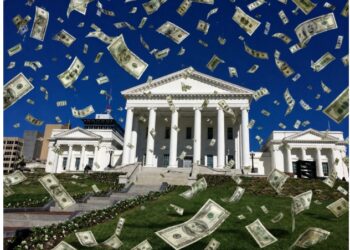
Billions of dollars will be diverted each year from federal tax revenue to private schools through the Federal Scholarship Tax Credit (FSTC), a voucher program enacted in the so-called “One Big Beautiful Bill Act” (OBBBA) – or more accurately, the “Big Ugly Bill,” as many Democrats call it – of 2025.
Modeled after state voucher programs, it is the first implemented by the federal government. The goal of school vouchers is to shift public school funding to private, mostly faith-based schools. This scheme brings the Trump administration, and the Republican Party, one step closer to fulfilling the Project 2025 proposal to abolish the Department of Education and privatize public education.
Each year, states must opt in to the FSTC and provide a list of qualified Scholarship Granting Organization (SGO)s. The SGOs collect donations and disburse funds to eligible students whose household incomes do not exceed 300% of the Area Median Gross Income. More than 90 percent of households nationwide would qualify given the generous income threshold. States that opt in will start or expand a near-universal K-12 private school voucher program.
Individual taxpayers can donate up to $1,700 and claim a 100 percent income tax credit. Over 30 states⸺ including Virginia⸺have opted in so far. The more who take advantage of the credit, the less tax revenue the federal government collects.
According to an estimate by the Institute on Taxation and Economic Policy, the cost of the program could range to as high as $51 billion annually.
Former Governor Youngkin Supported Public Funds for Private Schools
During the FY2025-2026 budget negotiations, former Governor Glenn Youngkin proposed a $50 million private school voucher program. Legislators from both chambers rejected it. A voucher program already existed called The Education Improvement Scholarships Tax Credits (EISTC) enacted in 2012 for tax years 2013 through 2027.
Just before leaving office Governor Youngkin took his opportunity to bolster school vouchers. In January 2026, he earned the distinction of being the first state to opt in to the federal voucher program before any rules or regulations were even written. The Virginia Department of Education confirmed that Virginia has officially opted in. Governor Spanberger must take the necessary steps to reverse Youngkin’s reckless decision before the program begins accepting donations January 1, 2027. Final IRS regulations are expected in late September 2026.
Public Funds for Public Schools
The Education Law Center (ELC), is working to oppose this and other voucher programs through their Public Funds Public Schools anti-voucher campaign. The ELC and the National Education Association worked closely with Congressional leaders to repeal the FSTC and prevent public funds from being diverted to private schools that can selectively choose their students.
As voucher programs grow, the number of public school students shrinks along with the public dollars invested in public school education. The national average per-pupil spending fluctuates around $15,500, though this varies heavily by location.
Democrats Aim to Repeal and Reinvest in Public Education
It is critical to advocate against this federal tax credit program and for public schools by supporting recent bills introduced by Democrats in both chambers of Congress to repeal the FSTC. The Keep Public Funds in Public Schools Act (S. 4297) was introduced in April 2026 by Senators Mark Kelly (D-AZ) and Mazie Hirono (D-HI) with 29 cosponsors. A Bill by the same name Keep Public Funds in Public Schools Act ( H.R. 9289) was introduced in June 2026 in the House of Representatives by Congresswoman Gwen Moore with a broad coalition of lawmakers.
Key details regarding the proposed repeal:
- Aims to eliminate Section 25F of the Internal Revenue Code, stopping the dollar-for-dollar federal tax credit for voucher-granting organizations.
- Argues that the voucher scheme siphons resources away from traditional public schools, blurs the line between church and state, and lacks civil rights protections required of public education.
Contact your representatives in Congress and tell them to repeal the national tax-credit voucher program here.
Governor Spanberger Can Revoke Participation in the Federal Scholarship Tax Credit
The Education Law Center ranks Virginia 31st out of 51 in funding level with $15,815 in cost-adjusted revenue per student–$2,038 below the national average of $17,853. Governor Spanberger should withdraw from the federal voucher program before it starts accepting donations on January 1, 2027.
This is the process for the governor to follow:
- Draft an Executive Decertification Letter: The new governor must issue an official notice on gubernatorial letterhead explicitly revoking the state’s election to participate for the 2027 calendar year. The letter must explicitly declare that the previously submitted list of SGOs is no longer certified by the state’s executive authority.
- Submit to the IRS and Treasury: The decertification notice must be submitted to the IRS Office of Federal, State, and Local Governments (FSLG) and the Department of the Treasury’s Office of the Associate Chief Counsel.
- Publish a Public Notice: The state tax commission or department of revenue should immediately issue an administrative bulletin warning taxpayers that contributions to those previously listed SGOs will not qualify for the $1,700 federal credit.
- Public Relations: Notify SGOs that Virginia has revoked participation for the 2027 calendar year. The Revenue Procedure 2026-6 of advance phase may have already built infrastructure or accepted pledges.
- State Legislative Mandates: Verify that the state legislature has not passed a statutory mandate requiring participation.
- Formal revocation should be finalized and acknowledged by the IRS prior to January 1, 2027.
Public schools strengthen communities by providing inclusive education to all children and serving as shared civic spaces for voting, meetings, and recreation. Their stability boosts local property values, supports employers, and reinforces the democratic infrastructure neighborhoods rely on every day. It is an institution worth protecting.