By Michelle Moore, Bridge2Blue
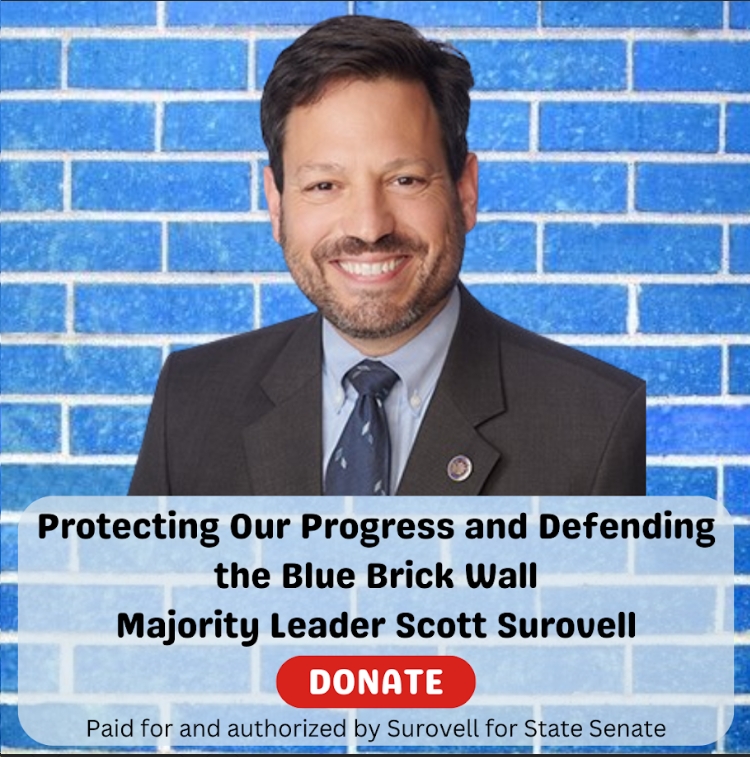
“For the first time in the 250-year history of our Commonwealth, our Supreme Court has set aside the results of a statewide election”, Senate Majority Leader Scott Surovell warned . “Over 3 million Virginians participated…Their votes have been set aside not because of fraud… but because four justices have adopted a definition of ‘election’ that conflicts with state statute [and] federal precedent.”
That is the point that should make every Virginian’s blood run cold. Because the Virginia Supreme Court, in the end, did not strike down “Democrats’ redistricting” — it negated the results of a free-and-fair election (in which 3 million Virginians cast their ballots). As if that wasn’t bad enough, this court ruling breaks the basic bargain of self-government—that the people decide and the government honors that decision – ultimately, that government derives its power from the people.
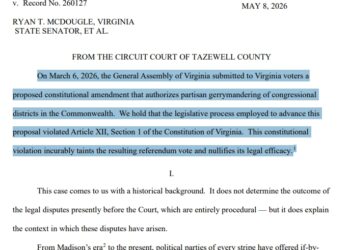
That is why the Virginia Supreme Court’s May 8 decision matters so profoundly. In a 4–3 decision, along partisan lines, the Court sidelined the results of the April 21 election. Virginians showed up, voted in good faith, and delivered a majority in support of a constitutional amendment. The merits of that strategy can be debated, sure. But the legitimacy of an election outcome should not be negotiable. We have seen the movie and know how it turns out.
As Virginia’s Attorney General Jay Jones put it: “the Supreme Court of Virginia has chosen to put politics over the rule of law by issuing a ruling that overturns the April 21st special election on redistricting…it fuels the growing fears across our nation about the state of our democracy.” He’s right.
The fact is, for most Virginians who voted, April 21 was about reclaiming agency over their futures. In a national climate of coordinated efforts by Republicans to gut voting rights and nullify the electorate’s voice, the Virginia Supreme Court’s ruling didn’t merely strike down “Democrats’ redistricting,” it overrode the will of the people and asserted the Court has the last word on the results of a free-and-fair election. As Chief Justice Cleo Powell outlined in her dissent, the majority stretched the term “election” to include early voting in conflict with how Virginia and federal law define an election: “[w]hile the courts can pass upon the constitutionality of legislative enactments, they cannot overthrow legislative determination of the existence of conditions with respect to its own procedure…” Further she argued:
“the circuit court’s ruling was based squarely on its determination that the General Assembly violated its own procedural resolutions. As compliance with internal legislative 43 procedures is a matter committed squarely to the General Assembly, it was not subject to judicial review. Thus, the circuit court clearly intruded upon the realm of legislative procedure, in direct violation of the principle of separation of powers.”
Outrage was immediate, in person and online—shared by voters who showed up in good faith, by the public employees who ran an out-of-cycle election on compressed timelines, and by volunteers and poll workers who helped people navigate disinformation and cast ballots. Lieutenant Governor Ghazala Hashmi said it plainly: “millions of Virginians… cast their ballots in good faith,” but then “the Supreme Court of Virginia has told voters… that their voices can simply be discarded.” Jamelle Bouie, a New York Times columnist and Virginia resident, went further, calling it an “absurd ruling” that presumes to invalidate not just an election, but popular sovereignty itself—resting on a strained interpretation of “election” and “election day.”
So, what now? In the face of shock, fury and the creeping disillusionment that this could happen in Virginia, Gaylene Kanoyton, Virginia Democratic Party Vice Chair and NAACP Regional Vice President, urged Virginians to “turn your anger into action.” Absolutely. But action at this moment must go beyond traditional organizing—though organizing is essential. Build alliances, reinforce strengths, identify opportunities, and shore up weaknesses. To borrow a phrase from Virginia activist Finale Norton, “we need to do the unexpected”, not one thing, many things—on multiple fronts.
We cannot delegate responsibility. We must seize it – fight back, take ground, and use every tool we have and can build. Virginia Democrats control two branches of government. That is huge. Let’s make it three.
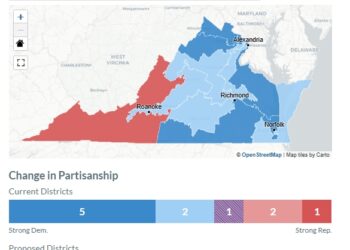
- Flip four Congressional seats: It was never a sure thing, it is possible. Let’s get to work.
- Uphold elections: Overturning a free and fair election is wrong. We all know it is; let’s fix it so it cannot be repeated
- Protect every citizen’s right to vote: Defend our democracy tooth and nail—safeguard the polls and the voters; voting rights are the foundation of accountability and legitimacy
- Demand accountability: Legislative, judicial and administrative officials who treat public sovereignty as a political instrument must be held to task. Shine a spotlight on how judges and justices are selected, reviewed, and held to standards. What they did is wrong – there must be consequences.
This is a bare-knuckles fight, and it will be decided by being proactive, nimble and unpredictable on multiple fronts. As Jamelle Bouie demanded (see below for his latest video – “An elaboration on why I think Virginia Democrats should just ignore the state supreme court’s decision on the referendum”), those “willing to walk away” should “make way for those interested in saving this democracy.” We have no time to shout “fight” from a place of security and hope someone else takes the risk. Our courage is action—unexpected, inconvenient, and consequential—taken without knowing how it is going to end. Let’s do this.