| Getting your Trinity Audio player ready... |
Well said by Prince William County Supervisor Kenny Boddye (also, see below): I agree that “Virginia is providing data centers with a major tax break that virtually no other industry enjoys,” and that what is needed is “a framework that uses the tax code to clean up existing impacts on our environment, our communities, and the electric grid; That means continued tax benefits – if they are kept at all – should be tied to clear public goals: cleaner energy, cleaner backup generation, better efficiency, stronger reporting, responsible siting, and fewer impacts on residents.”
Also, on this topic, see former VA House Democratic Leader David Toscano’s new article on this topic (“Toscano: Don’t let data centers force a government shutdown“), which argues, “The state tax exemptions for the industry means $1.9 billion less in revenue is collected by the state this year. That is a significant sum, but it represents only about 2.6 percent of the $74 billion budget proposed by the House and endorsed by Gov. Abigail Spanberger, and pales by comparison to spending on education, local government and key services. Yet, it has become the driver of the budget impasse.”
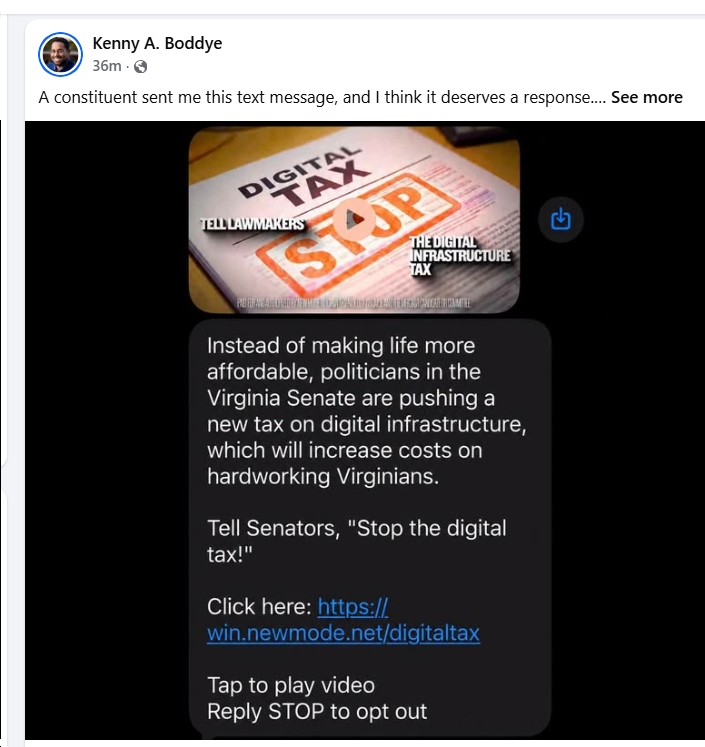
A constituent sent me this text message, and I think it deserves a response.
Calling this a “digital tax” may be effective messaging for industry lobbyists, but it skips over the real issue: Virginia is providing data centers with a major tax break that virtually no other industry enjoys. It is not a “new” tax; what is being considered is diminishing or sunsetting a tax break that currently exists.
Importantly, it was put into place when it was only foregoing around $2 Million of revenue per year for the commonwealth, not nearly $2 Billion. That matters, especially as Virginia has been forced to fill funding gaps left by federal actions.
The real question is whether that tax break expectation should continue without stronger public benefit expectations.
Based on the latest reporting, the House budget walks away from Del. Rip Sullivan’s mitigation incentive framework, which would have tied the exemption to measurable standards around cleaner energy, cleaner backup generation, energy efficiency, and environmental reporting.
The latest Senate proposal keeps the sales and use tax exemption, but adds a tiered impact tax on backup generators, including diesel generators, with the rate based on permitted generator capacity. Better than the house, but only targets one piece of data center impacts.
I understand the need for compromise, especially when the budget itself is on the line. But from a policy standpoint, this still moves in the wrong direction.
The better compromise is a framework that uses the tax code to clean up existing impacts on our environment, our communities, and the electric grid.
That means continued tax benefits – if they are kept at all – should be tied to clear public goals: cleaner energy, cleaner backup generation, better efficiency, stronger reporting, responsible siting, and fewer impacts on residents.
Data centers are viewed by some as critical infrastructure. They are also large industrial facilities that consume significant land and electricity, strain local planning, affect neighborhoods, and shape our long-term energy future.
If Virginia taxpayers are going to continue subsidizing this industry, taxpayers should receive something meaningful in return.
That is not anti-technology.
That is basic accountability.
I support economic development and the infrastructure that powers our modern economy. But continued tax break expectations should come with public benefit expectations, especially when the communities hosting these facilities are being asked to absorb the impacts.