| Getting your Trinity Audio player ready... |
Yesterday, the Energy Commission of Virginia held a meeting, in which it heard expert testimony and took public comments on several topics, including Virginia’s membership in the Regional Greenhouse Gas Initiative and the proposed acquisition of Dominion Energy by NextEra. To watch the entire Energy Commission meeting, click here. For now, though, I just want to draw attention go the presentation by Scott Hempling, who is an expert in the area of public utility law, “an adjunct professor at the Georgetown University Law Center,” and the author of a legal treatise, “Regulating Public Utility Performance: The Law of Market Structure, Pricing and Jurisdiction,” which “has been described as a ‘comprehensive regulatory treatise [that] warrants comparison with Kahn and Phillips.'” See below for video and highlights from what Hempling told the Energy Commission of Virginia; I personally found it both fascinating and troubling. See what you think…
“I want to bequite blunt with you. I have been involved in over a dozen mergers since 1985. There is no way that a full hearing of the complexity of this transaction [NextEra’s acquisition of Dominion Energy] can occur in a six-month proceeding. That’s not possible… Yes, the…SEC will complete the transactions review in the six-month period if that’s what it has to do. That’s the way commissions work. But the question is at what level of oversimplification. And this is the type of proceeding that requires a departure from oversimplification and a focus on the merits.
The second thing I’d like to say by way of introduction is I heard a comment by one of the legislators earlier that struck me as quite incisive. And it was a question that said what is it that we’ve done in Virginia that creates a context that could have been a stimulus for this transaction. And the answer is, there are many things that the Virginia legislature, the Virginia commission and in fact all other states that have presided over the hundred or so mergers that have occurred in the electric industry, many things that have occurred over these years that have created the conditions for this transaction. And so, I want to give you one opinion if I may to step aside as an educator, and say that the very statute and standard, the timeline, the standard, the criteria, the procedures, the administrative procedures that are going to determine whether this transaction occurs and, whether if it occurs is consistent with the public interest, are all a result of legislative actions. And so for the legislature to now say to itself, what is our role? I hope the answer will be to ask itself what is our policy with respect to transactions like this, what are we looking in terms of the good of the state, the good of shareholders, the good of customers, our industrial base, what is it that we want to get from a transaction like this? And will this transaction satisfy those needs?”
“I want you to understand that the roots of this transaction, as all utility acquisitions, lie in what the state has done historically. And what the state has done historically is to grant to Dominion and its predecessors a public monopoly franchise to provide an essential service that people cannot do without. And the transaction that you will always see in a merger transaction is not merely a merger. It is a sale of control. It’s a sale of control of that public monopoly franchise for private gain and it is a sale of control that is undisiplined by the competitive market. Let me explain exactly what I’m talking about, because it is the accurate way to look at the transaction in any M&A transaction. What are the transacting parties doing? They’re buying and selling a market position. Understanding this point and understanding the difference between competitive markets and monopoly markets is central to understanding these transactions. So in a market that is effectively competitive, a seller’s market position comes from what? It comes from the presence or absence of merit – competitive merit. But in a monopoly market which a utility controls, a monopoly granted by the state, it’s not a competitive market. The utility owes its market position not to its merits, it comes from state government. So unlike a state senator or a state delegate who has to compete for his or her slot every few years, a utility doesn’t regularly compete for the monopoly role. It just gets it and it has it year after year after year. And so what it is doing in this transaction is it is selling control of that monopoly role to an outsider. What it is doing is monetizing its government-protected market position.
Now a quick departure from my text. You’ve heard about the two headquarters. You’ve heard about the promises. But understand that what is being transferred is control. All decisions ultimately are controlled by the owners and the owner will be NextEra. That is the central change that’s happening here. So when somebody tells you that quote they will always be here close quote, that’s not an enforceable statement. That statement depends on decisions made from Florida. Now if you want, you can ask the SEC in a proceeding or you can legislate that the board of directors of Dominion will have certain powers that cannot be overridden by the board of directors of NextEra. But I would bet you that that term is not in the merger agreement. And unless it is, you are approving, if you approve any merger transaction, I’m not being specific about this one, you are approving a transfer of control. That’s control over budgets. That’s control over rate timing. That’s control over the hiring and firing of employees. That’s control over who the next CEO will be. That’s control over who will be the board of directors. Those are the matters that are transferring in this transaction from seller which is Dominion to buyer which is NextEra. I want to make sure that that is clear.”
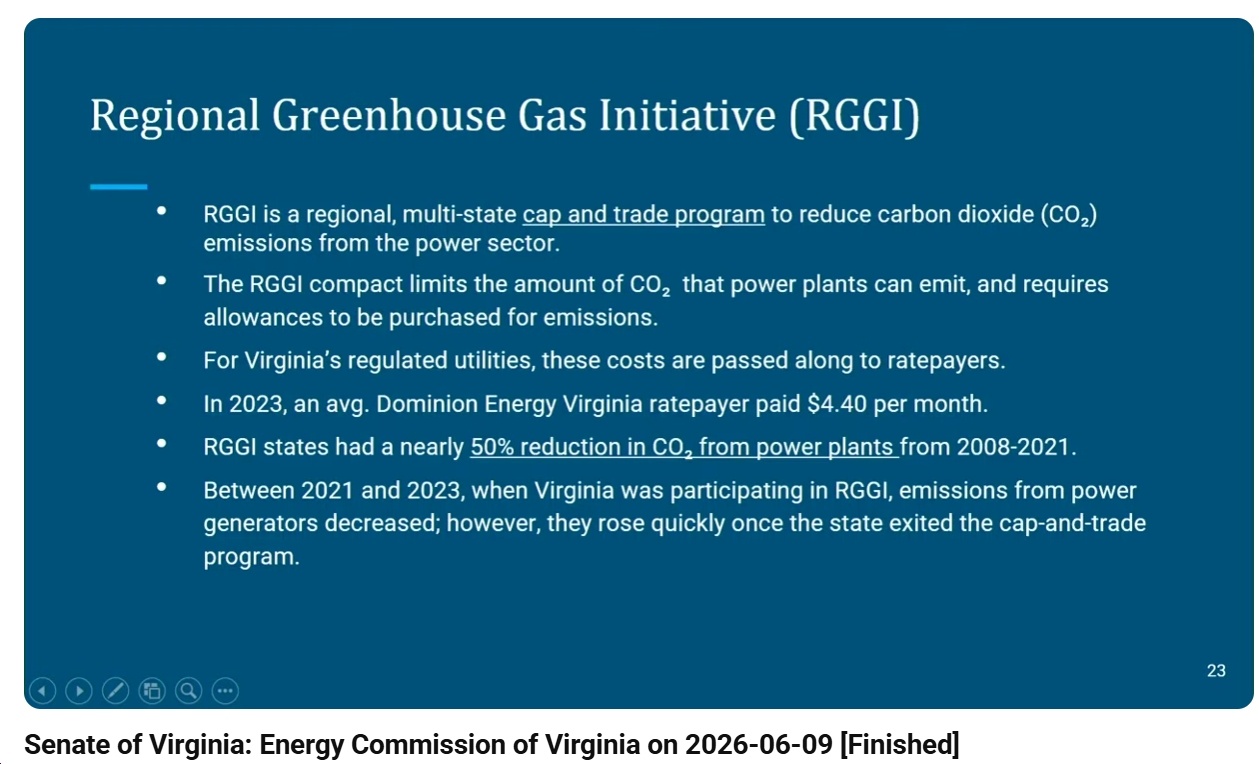
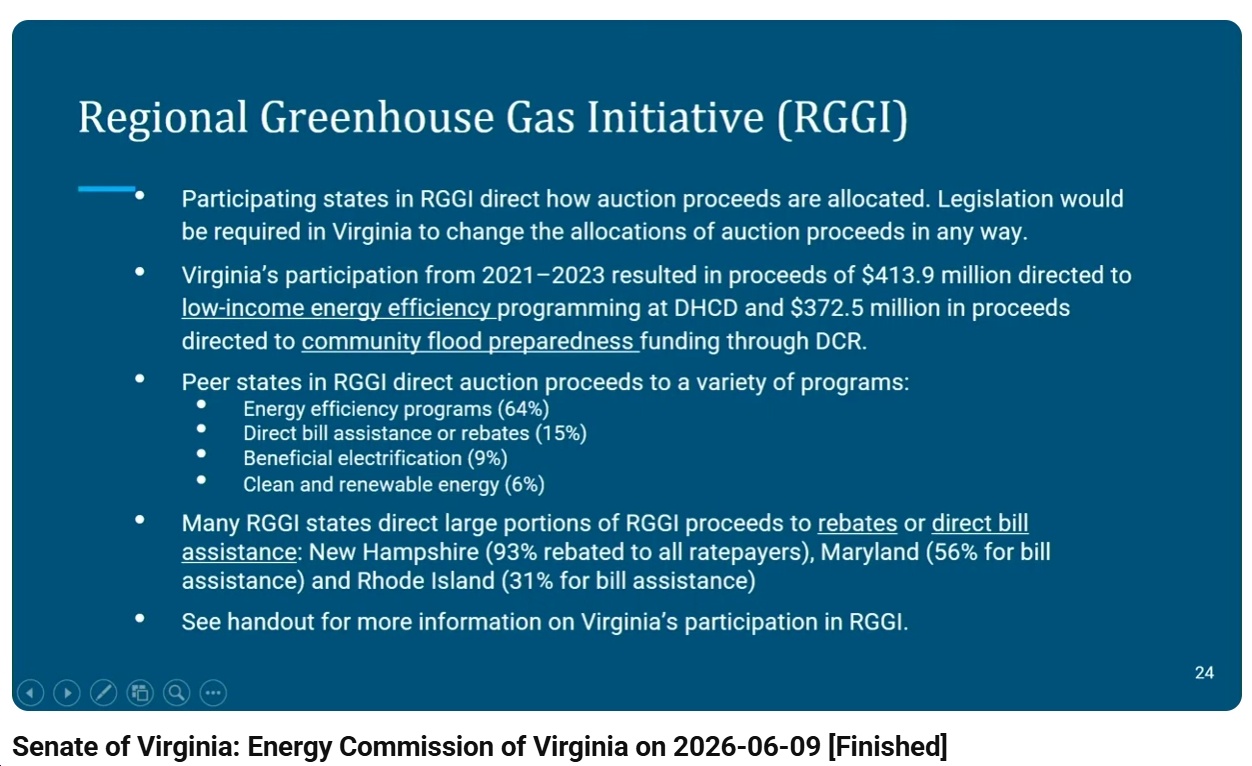
Here’s the full video of the hearing, including discussion of Virginia rejoining RGGI, which is a great thing for a bunch of reasons (seee slids, below). As for the possible Dominion-NextEra merger, my initial reaction was positive, based on cleantech guru Jigar Shah arguing that “The biggest clean energy consolidation in American history may happen on Donald Trump’s watch.” But the more I’ve learned about NextEra (for instance, “NextEra, through its principal Florida Power & Light (FPL) subsidiary, has been connected to election manipulation, surveillance of journalists, co-optation of civil rights organizations and the use of dark money networks to capture regulators and defeat energy competition. The company’s former CEO, who was in charge during many of these schemes, resigned abruptly in 2023 amid federal scrutiny. The company also recently settled a securities fraud class action lawsuit.”), the (much) less enthused I’ve gotten. And now, listening to Scott Hempling, a bunch of alarm bells are ringing, at least in my mind, and I strongly urge the Virginia General Assembly, as well as the State Corporation Commission, to take a long, hard, skeptical look at this proposed merger – and most defiitely do NOT rubber stamp it!
UPDATE 6/10: This is a fascinating exchange between Del. Rip Sullivan (D-Mclean) with the Dominion Energy executive, Ed Baine, in which Del. Sullivan – one of the main architects of the landmark Virginia Clean Economy Act (VCEA) – tries valiantly (great job, btw!) to pin the Dominion Energy executive down on whether Dominion Energy is committed to adhering to the VCEA (which is, of course, the *law*). Watch the exchange and decide for yourself if you think that Del. Sullivan received a clear, satisfactory, ironclad promise, and even if he did, whether Dominion Energy would have any real power to influence NextEra, assuming NextEra’s purchase of Dominion goes through. Because, for my part, I don’t buy it for a minute. Also, note that the Dominion executive throws in some wiggle room, with the “keep the grid reliable” line. Hmmm…

![Video: VA Gov. Abigail Spanberger Lays Out “New Nation-Leading Standards and Initiatives” on Data Centers, Also “Responding to Unprecedented Risk from [AI]”](https://bluevirginia.us/wp-content/uploads/2026/09/spandatacenters1-350x250.jpg)