| Getting your Trinity Audio player ready... |
By Michelle Moore, Bridge2Blue
It’s dangerously hot, with code-red air quality in northern Virginia. As air conditioners run non-stop, Virginians are seeing, right now, just how costly data centers are. Extreme heat worsens every one of their impacts.
Heat advisories are urging residents, businesses, and government offices to conserve energy to relieve the pressure on the electrical grid.
This intense heat showcases why wholescale construction and permissive regulations on data centers and the power companies have not just been a bad idea, they’ve been disastrous with compounding long-term consequences.
Loudoun, Fairfax, and Prince William counties, under an extreme heat warning, have nearly 300 data centers, and Reston alone has 20 with more under permitting and construction.
It’s Air, Water, Heat, and Soaring Utility Bills
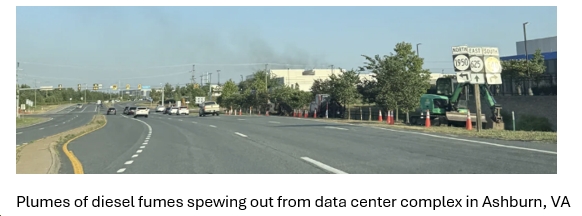
On June 30, the U.S. Department of Energy issued an emergency order warning of grid shortage, “driven primarily by data centers,” allowing thousands of data center diesel generators to run, and send out emission plumes that the EPA warned include “possible human carcinogens.” Virginia regulators have approved more than 8,000 such generators.
On June 30, the U.S. Department of Energy issued an emergency order warning of grid shortage, “driven primarily by data centers,” allowing thousands of data center diesel generators to run, and send out emission plumes that the EPA warned include “possible human carcinogens.” Virginia regulators have approved more than 8,000 such generators.
And new research indicates that data centers are creating “heat islands” around them, warming nearby land by as much as 16 degrees — making this brutal heat even hotter.
In July, during this heatwave and the worst drought in 85 years, residents in Richmond and the surrounding counties — Chesterfield, Goochland, Hanover, Henrico, and Powhatan — were urged to cut back on water use due to drops in James River Basin water flows. Meanwhile, more than 70 regional data centers, and two planned fossil-fuel power plants, consume hundreds of thousands of gallons of water per day, a figure that will reach millions once new facilities come online. Officials insist data centers follow the same imposed voluntary water-conservation measures as residents, but their massive consumption will only continue to contribute to the problem.
Energy bills are soaring. In Henrico County, utility bills have increased 25% with an additional $5 million expected next fiscal year. Officials are urging “austerity” to reduce power use, yet the county already has 37 data centers, with 17 on the way, guaranteeing these costs will continue to climb.
Business-Friendly or Harmful Favoritism
Officials told Virginians that data centers bring in local revenue and that the state must honor tax-exemption agreements to preserve our “business-friendly” reputation. But overly permissive policy and overt corporate favoritism are not fiscal responsibility or a real economic development strategy. And it is not good business to force residents, schools, and local businesses to absorb the fallout of these ill-conceived deals that overwhelmingly benefit large AI corporations and utility monopolies.
This crisis has been years in the making. Virginia’s short-sighted approach allowed massive industrial complexes to dominate local landscapes and shape economic and fiscal decision-making — dismissing public warnings and community protests. These deals prioritized speculative revenue projections, were negotiated behind closed doors, protected by non-disclosure agreements, and approved with minimal public input, no long-term comprehensive environmental or economic cost projections, and almost no critical oversight.
And yet there is little meaningful action beyond an increased data center power consumption fee and vague water conservation guidelines.
Virginians Understand the Complexities and Don’t Like the Consequences
Over 71% of Americans oppose data centers in their areas, and residents across Virginia are attending protests, council meetings, and town halls, and demanding that governments uphold their contract with the people and stop prioritizing speculative revenue projections over the actual costs to the voters and their communities.
Virginians clearly understand the consequences of living with non-existent managed growth:
- Utility bills that are soaring and expected to continue climbing
- New fossil-fuel power plants funded through rate hikes and contributing to already serious pollution and water problems
- County and local budgets strained from higher energy and water costs
- Neighboring areas subjected to continuous noise and ground vibration
- Rising temperatures in surrounding areas
- Never-ending cycle of heavy data center demand triggering more costly power generation
Public Pressure: Only Path to Stop the Expansion and Implement Reform
Virginia now has more than 600 data centers, with even larger complexes in the pipeline. Communities across Virginia are organizing and pushing back. In Hanover County, residents spent months making sure their Board of Supervisors understood the risks the Mountain Road data center posed to the county’s water supplies, electricity demand, noise levels, and the county’s rural character. In May, the board rejected the project.
Prince William County faces a similar fight. On Tuesday, July 7, the Board of Supervisors is scheduled to vote on whether to initiate a “comprehensive plan amendment” for the Dulles Innovation South project (Prince William County Board of Supervisors Agenda, July 7, item 11D) — a proposal to rezone 1,940 acres of homes and small farms into a massive data-center complex just north of the controversial Prince William Digital Gateway. Opponents, including county staff, warn the project would fundamentally alter the area’s character, erase the existing rural landscape, and significantly affect rural viewsheds and groundwater supply.
Unless we, the public, exert sustained pressure on officials to stop approving new data centers, revise the state’s overly generous tax exemptions and legislate and enforce much stricter standards on these industrial (not business) facilities already operating, this situation will get worse. Much worse.
What you can do: Attend council and county meetings and send comments to Prince William County Board of Supervisors, protest against data centers, and tell your legislators that enough is enough here.