| Getting your Trinity Audio player ready... |
Good points (see here and below) by former Virginia Democratic blogger and labor/Fairfax Democratic activist Karen Duncan, responding to this post by Del. Holly Seibold (D-Fairfax) about how, when she ran for House of Delegates in 2022, “[n]early the entire Democratic establishment endorsed my opponent [Karl Frisch],” but she won anyway (by a 51%-49% margin). Seibold continued:
“This isn’t really about any one candidate. It’s about voters who are tired of being told who they should support. They’re frustrated with politics that feels more focused on protecting incumbents, preserving the status quo, and keeping power concentrated among the same people.”
As Karen Duncan argues:
- Seibold “makes a good case that party insiders clearing a field for their preferred candidates alienates many voters. It gives credence to their feelings that all systems are rigged.”
- “Open, competitive primaries that give challengers a chance to bring forth fresh ideas excites voters, makes them feel like they have a stake in their party, , a real choice. That builds the party. That’s true, btw for both parties. Plus open competitive contests give everybody a chance to see who is the most effective campaigner, who is capable of connecting with voters, whose message resonates.”
- “Just as important, it brings out opposition research. If there’s dirty linen, it’s better to get it aired in a primary, not at the eleventh hour after a candidate is chosen. And make no mistake, sweeping soiled linen under the bed won’t keep it hidden. It just means the other party will wave it around in October when it’s much more damaging. Primaries get it out in May, June, or even July when it can be hung on the line in the sun for everybody to see. Before it’s too late. “
- “Robust, competitive primaries make stronger parties and better candidates. More important, it gives people a stake in real democracy. “
Of course, incumbents – like Rep. Don Beyer in VA08 (and de facto incumbents – like James Walkinshaw when he was running to succeed Rep. Gerry Connolly last year) have massive structural advantages, in terms of money, name ID, networks, etc. – and that’s not likely to change. But to the extent possible, particularly in blue districts, I agree that primaries should be as fair/open as possible; although I definitely think there’s a role to play for parties in “vetting” candidates for really bad stuff – like with Platner – in their backgrounds, also in intervening when the overall party, state or even country could be severely harmed if a badly flawed/damaged candidate wins the Democratic nomination.
So how have things gone in Virginia Democratic primaries the past couple years with regard to “establishment” vs. non-“establishment” candidates? Let’s take a look.
Earlier this year, there were several primaries to fill positions vacated after Gov. Abigail Spanberger named sitting elected officials to her Cabinet.
- HD5: Kirk McPike was clearly the “preferred” candidate by the “establishment” (and yes, that’s a pretty fuzzy word, which is why I put it in air quotes; what does it really mean? here, we’ll mostly take it to mean Democratic elected officials) to replace Del. Elizabeth Bennett-Parker, who was moving up to the State Senate (to replace Adam Ebbin, who went into the Spanberger administration as a senior advisor to the Virginia Cannabis Control Authority)- and McPike won the Democratic primary (and then special election) in a landslide (61%-24%-13%-3%) over three other Democrats.
- HD11: Gretchen Bulova, wife of outgoing Del. David Bulova (who went into the Spanberger administration as Secretary of Natural & Historic Resources), was clearly the “preferred” candidate of the “establishment” – and she won the Democratic primary in a landslide (48%-18%-12%-7%) over four other Democratic candidates.
- HD17: Garrett McGuire was endorsed by outgoing Del. Mark Sickles (who went into the Spanberger administration as Secretary of Finance), and he won the Democratic primary narrowly (34%-32%-23%-12%) over three other Democratic candidates.
- HD23: Margaret Angela Franklin was endorsed by outgoing Del. Candi Mundon King (who went into the Spanberger administration as Secretary of the Commonwealth), and she won the Democratic nomination by a wide margin (67%-33%) over one other Democratic candidate.
- HD77: Charlie Schmidt was definitely NOT the “establishment” pick for the seat held by outgoing Del. Mike Jones (who moved up to the State Senate to replace former State Senator Ghazala Hashmi, who was elected Lt. Governor), but he won anyway.
- SD39: Del. Elizabeth Bennett Parker was endorsed by outgoing Sen. Adam Ebbin, and won the nomination (and special election) easily.
In July 2025, Rep. Gerry Connolly (D-VA11)’s former Chief of Staff James Walkinshaw – who Connolly strongly endorsed before he died – was nominated overwhelmingly (with nearly 60% of the vote against 9 other Democratic candidates) to succeed Rep. Connolly. Now, it could be argued that even without the Connolly endorsement, Walkinshaw would still have won, but that support by Connolly and Connolly’s allies certainly gave Walkinshaw a big boost – and, fortunately, Walkinshaw’s proven so far to be a worthy successor to Connolly, doing a great job. Also note that Rachna Sizemore Heizer, who was the strong “establishment” favorite to succeed James Walkinshaw as Braddock District Supervisor, in October 2025 went on to win the Democratic nomination overwhelmingly (60%-22%) over three other Democratic candidates. Also in 2025, while the entire Virginia House of Delegates was up for election, only two incumbents (Del. Patrick Hope and Del. Delores McQuinn) faced primary challenges, and both won easily – with other Democratic primaries that year going pretty much to picks favored by the “establishment.” And finally, in 2025, we had statewide primaries for Lt. Governor (Ghazala Hashmi, Levar Stoney, Aaron Rouse, Babur Lateef, Alex Bastani, Victor Salgado) and Attorney General (Jay Jones, Shannon Tayl0r – neither of those was an “insurgent” or “anti-establishment” candidate, obviously), with no non-“establishment” or “insurgent”-style candidates winning any of them – although certainly Ghazala Hashmi and Jay Jones are progressive politicians.
In 2024, Kannan Srinivasan was the clear “establishment” favorite in the SD32 Democratic “firehouse primary” to nominate a candidate to succeed former VA State Senator Suhas Subramanyam, who was elected to the U.S. House of Representatives in VA10 – and Srinivasan won easily (by over 20 points) against five other Democratic candidates. Then, to succeed Srinivasan in the House of Delegates, JJ Singh was the clear favorite of the “establishment” (including Srinivasan, who endorsed Singh to succeed him), and Singh won the Democratic nomination fairly handily over four other candidates. Also note that in June 2024, Suhas Subramanyam – who had been endorsed by outgoing Rep. Jennifer Wexton (D-VA10) narrowly won the nomination (by a 30.4%-26.6% margin over Del. Dan Helmer) to succeed her.
So we could go on with this, looking at 2023, 2022, etc., but I think the conclusion is obvious, that in Democratic primaries here in Virginia, generally speaking we see “establishment” picks win, often (but not always) by wide margins, with an occasional/rare upsets, such as in the case of Holly Seibold over Karl Frisch (another example: in February 2026, non-“establishment” candidate Muhammed “Sef” Casim defeated Pamela Montgomery, who had been endorsed by most of the Democratic “establishment,” for Prince William Board of County Supervisors, but then Casim went on to lose the special election in the heavily “blue” district, as write-in Pam Montgomery split the Democratic vote with him, allowing the Republican to win with just 44% of the vote) .
By the way, none of this is to imply in any way that the “establishment”-backed candidates were bad, necessarily – in many or even most cases, I’d argue they’re at least solid, if not excellent (e.g., Holly Seibold’s 2022 Democratic primary opponent, Karl Frisch, is a great guy, strong progressive, and also would have made a fine delegate, IMHO – Dems really couldn’t lose in that one) – or that the non-“establishment” candidates were automatically better. But it’s certainly a clear pattern, and could lead to at least some percentage of voters feeling like the “establishment” is putting their thumbs heavily on the scale, as Holly Seibold (perhaps a case of the exception proving the rule?) argued in her Facebook post. I’d argue we definitely saw that in the case of the primary won by Gretchen Bulova, for instance; not to say she’s been a bad delegate, but I can certainly see how her primary could be viewed as feeling like a coronation, rather than a totally free-and-open process. And, of course, in the summer of 2024, after Joe Biden announced he was dropping out and endorsing VP Kamala Harris, there certainly were some Democrats who felt like there should have been an open process to select the Democrats’ 2024 presidential nominee – but obviously that didn’t happen, and we’ll never know if things would have worked out better if it had happened.
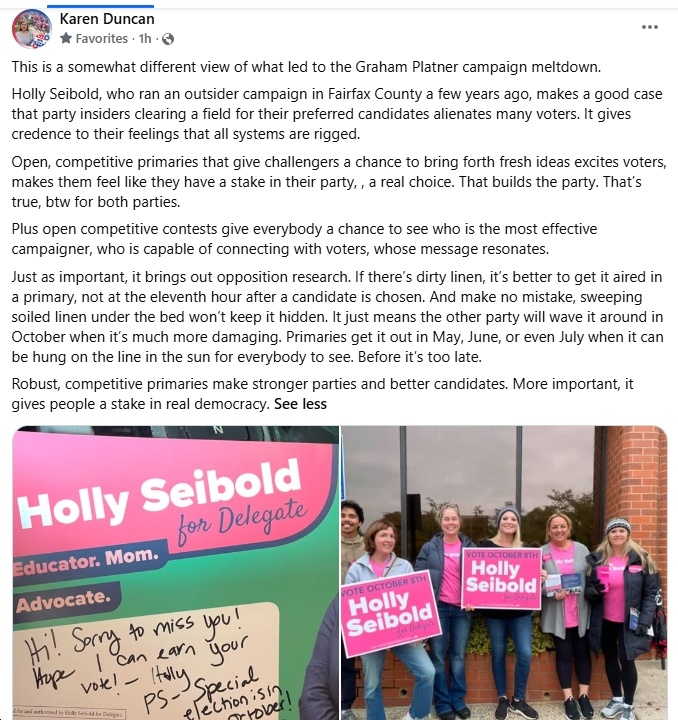
UPDATED – More thoughts from Del. Seibold, after the latest news about Graham Platner in Maine.
Can we talk about Democratic primaries again?
Earlier this week, I wrote that party leaders in Fairfax County need to stop clearing the field and let voters decide who the nominee is.
Well, here we are again, watching the drama play out in Maine. The Maine Democratic Senate primary is a perfect example of how intervention by party insiders can backfire. Before voters had a real chance to learn about other potential candidates, much of the party establishment quickly lined up behind Janet Mills. Instead of allowing a competitive primary with new voices and fresh ideas, the message many voters heard was: this is our candidate.
That kind of insider consensus can create an opening for an “outsider” to run against “the establishment” and tap into voters’ frustration with a process that feels predetermined. In this case, Graham Platner became that candidate. He was already a controversial figure and now faces serious sexual assault allegations.
Now, at the final hour, Democrats are left with a deeply problematic nominee in a race against Susan Collins, one we could very well lose after repeating the same mistakes …. yet again.
Once again, the lesson is clear: democracy works best when VOTERS, not party insiders, choose the nominee!